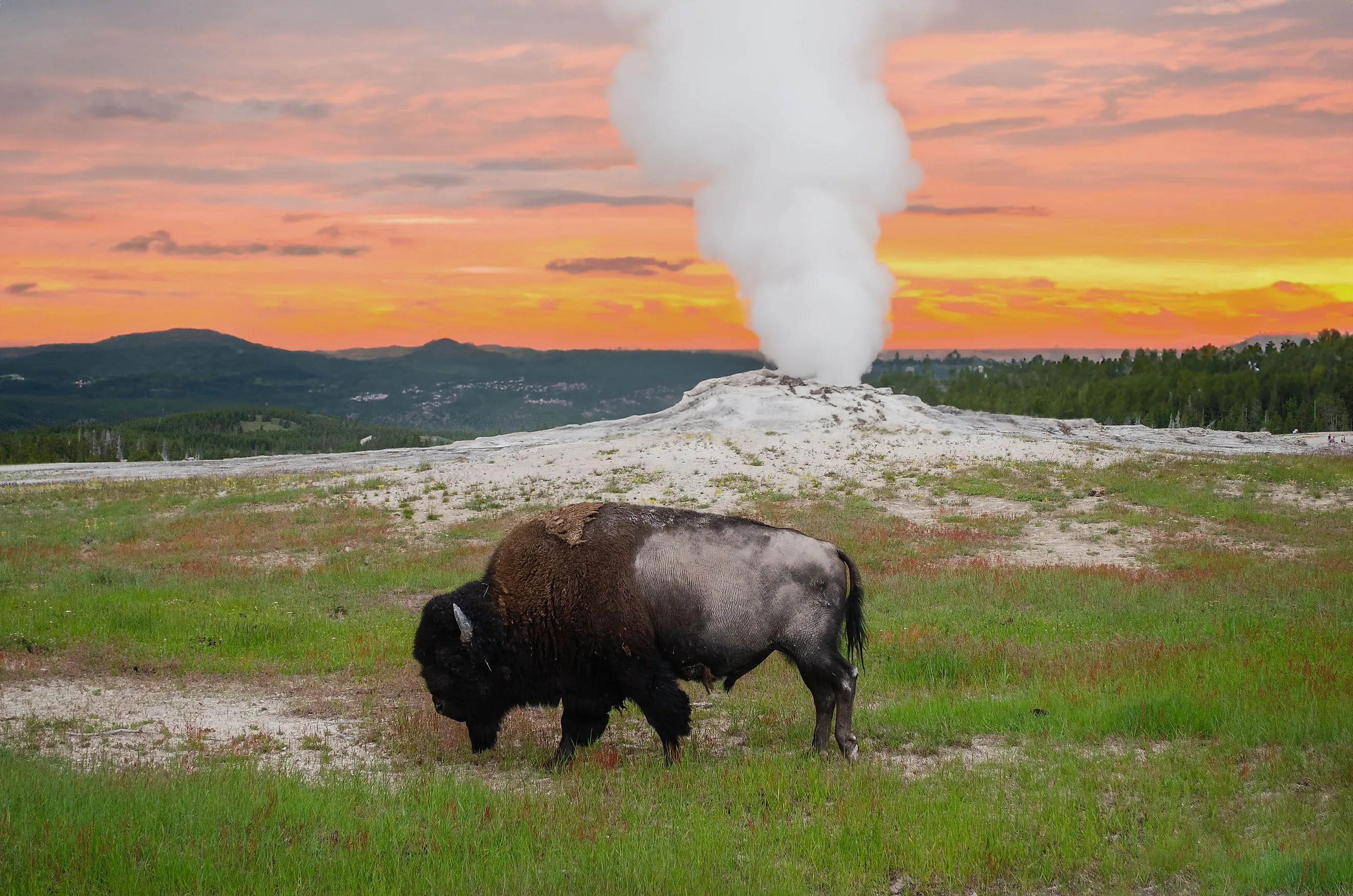
The Only National Park With Active Geysers
Geysers need an unusually precise combination of ingredients. Underground heat and water are not enough; a constricted plumbing system must trap hot water long enough for pressure to build and trigger an eruption. That geological requirement makes true geysers far rarer than hot springs, fumaroles, or bubbling mud pots. A review of North American national parks leaves one clear, scientifically documented standout. Yellowstone does not simply contain a few active examples. It holds the greatest concentration of geysers on Earth, with more than 500 documented across the park. Other volcanic parks on the continent offer vigorous hydrothermal activity, but their steaming pools and vents do not meet the same geological definition.
Yellowstone National Park, Wyoming, Montana, and Idaho

Yellowstone is the clear answer to this title. The National Park Service counts more than 10,000 hydrothermal features across the park, including more than 500 geysers, and says Yellowstone holds more than half of the world's geysers. They are spread through several basins rather than gathered around Old Faithful alone. The Upper, Lower, Midway, Norris, and West Thumb areas each hold a different piece of the park's enormous hydrothermal system, so a geyser-focused visit can fill far more than a single afternoon.
The activity is also changeable. The U.S. Geological Survey notes that eruption intervals can shift as underground plumbing changes, and some geysers alternate between active and quiet periods. From the boardwalks, visitors get close views without crossing fragile thermal ground, and eruption forecasts for several major geysers make it possible to plan around some of the biggest displays. Yellowstone is unusual not only for the number of geysers within its boundaries, but for how many different forms of geyser activity a visitor can watch within one protected landscape.
The Geology Behind So Many Geysers

The park has the unusual geology needed to keep hundreds of geysers functioning. Rain and snowmelt seep into fractured rock, descend underground, and encounter heat supplied by Yellowstone's volcanic system. At depth, pressure allows water to remain liquid even after it becomes hotter than the boiling point at the surface. In an ordinary hot spring, open plumbing lets heated water circulate upward steadily. A geyser behaves differently because a constriction blocks that easy circulation. Pressure builds below the narrow passage until some water escapes, pressure drops, and part of the deeper reservoir rapidly turns to steam. The expanding steam then drives water through the vent. NPS also notes that Yellowstone's silica-rich rhyolite matters. Hot water dissolves silica from the rock, and some of that silica is redeposited inside cracks and around vents, forming the pale sinter and geyserite visible throughout the basins.
The Upper Geyser Basin Holds 150 Geysers In One Square Mile

The Upper Geyser Basin is the easiest place to appreciate Yellowstone's remarkable concentration. The National Park Service records at least 150 geysers within one square mile, alongside hundreds of hot springs. Old Faithful naturally pulls the largest crowds, but Castle, Grand, Daisy, Riverside, and Beehive make the surrounding boardwalk network much more than a one-stop attraction. Park staff regularly forecast five major Upper Basin geysers: Old Faithful, Castle, Grand, Daisy, and Riverside.
Old Faithful's name can make its timing sound more exact than it is. NPS gives an average interval of about 90 minutes, with individual eruptions lasting roughly 1.5 to five minutes and sending water 106 to 184 feet high. Grand offers a very different show. NPS identifies it as the tallest predictable geyser in the world, with bursts sometimes reaching about 200 feet. Riverside sends its water at an angle toward the Firehole River rather than straight upward. Checking the day's predictions and walking between vents gives visitors a realistic chance of seeing several eruption styles during the same outing.
Norris Geyser Basin Has The World's Tallest Active Geyser

Norris Geyser Basin is about raw scale rather than predictability. The National Park Service describes Norris as Yellowstone's hottest, oldest, and most dynamic thermal area. A scientific drill hole there recorded 459 degrees Fahrenheit at a depth of only 1,087 feet, while geological evidence shows thermal features have existed in the basin for at least 115,000 years. The headline attraction is Steamboat Geyser, recognized as the world's tallest active geyser. Major eruptions can throw water roughly 300 to 400 feet into the air, far above a typical Old Faithful eruption, but there is no dependable timetable for catching one. Norris also contains unusually acidic thermal waters, including rare acid geysers. Even when Steamboat stays quiet, the boardwalks through Porcelain Basin and Back Basin pass active vents and shifting pools that make the intense heat below the surface easy to see.
In The Lower Geyser Basin, Plumbing Changes Fast

In the Lower Geyser Basin, thermal activity is scattered across a broader landscape. Fountain Paint Pot is especially useful because visitors can see geysers alongside hot springs, mud pots, and fumaroles on a relatively short boardwalk. Fountain Geyser erupts from a pool rather than a cone, with NPS reporting bursts about 10 to 50 feet high. Great Fountain Geyser is larger. Its eruptions average roughly 100 feet, last around 45 to 60 minutes in a series of bursts, and can occasionally produce surges of 200 feet or more. It is also the only geyser outside the Old Faithful area for which the National Park Service currently publishes eruption forecasts.
What happens below the surface can quickly alter the scene. NPS explains that the Lower Basin sits on unstable glacial gravel over solid rock. Shaking from the 1959 Hebgen Lake earthquake changed water supplies and temperatures in hydrothermal features around the Firehole River basins. Super Frying Pan Geyser formed after that earthquake and now erupts about every three to six hours. That episode is a reminder that geysers cannot be treated as permanent fountains with fixed schedules. Changes in underground fractures can redirect water, alter temperatures, or create an entirely new erupting feature.
West Thumb Sits At The Edge Of Yellowstone Lake

West Thumb Geyser Basin puts Yellowstone's underground heat beside the cold blue water of Yellowstone Lake. The basin occupies a volcanic depression formed by an eruption about 174,000 years ago, a caldera within the much larger Yellowstone Caldera. Hydrothermal features continue beneath the lake itself, and their heat can even affect ice at the surface. The short boardwalk here runs right along the lakeshore, a very different scene from the open expanses around Old Faithful or Norris.
Not every named geyser at West Thumb remains active, which offers another useful lesson about geyser behavior. Fishing Cone, for example, erupted frequently to around 40 feet in 1919 and produced smaller eruptions in 1939, according to NPS records, but it is now generally quiet. Individual vents can enter dormant phases while the wider hydrothermal system keeps working. Today's roughly 0.6-mile boardwalk is better known for colorful pools and lakeshore thermal features, yet the area's history makes clear how fluid the boundary between an active and dormant geyser can be.
Why Lassen Volcanic National Park Does Not Qualify

Lassen Volcanic National Park in California looks like the obvious second entry. Bumpass Hell, Sulphur Works, Devils Kitchen, and Boiling Springs Lake all prove that substantial heat remains below the landscape, and one feature is even named Terminal Geyser. That name does not hold up to a geological fact-check. The National Park Service explicitly identifies Terminal Geyser as a large steam vent rather than a true geyser. Cold creek water passes across the hot vent, creating spurting steam that resembles an eruption. An NPS geology publication is even clearer, stating that there are no true geysers within Lassen Volcanic National Park. Its hydrothermal areas instead contain boiling pools, mud pots, fumaroles, hot springs, and steaming ground. Lassen remains a terrific place to watch volcanic heat reach the surface, particularly around Bumpass Hell, but including it in a strict geyser article would turn a catchy feature name into a geological error.
Why Rincon de la Vieja National Park Does Not Qualify

Rincon de la Vieja in Costa Rica creates another tempting case because some visitor descriptions use the term "mini-geysers." The Las Pailas sector is unquestionably active. Costa Rica's National System of Conservation Areas identifies fumaroles, bubbling mud pots, water pools, a fumarolic lagoon, and other volcanic manifestations along its three-kilometer circular trail. SINAC reports temperatures of about 78 to 106 degrees Celsius at some of these features. Steam rising beside tropical vegetation and visibly boiling mud make this one of the continent's most accessible volcanic-hydrothermal walks.
The strict terminology matters here. Research published in the Journal of Volcanology and Geothermal Research describes Rincon de la Vieja's surface manifestations as boiling pools, mud pools, thermal springs, and associated gas discharges rather than a field of true geysers with Yellowstone-style constricted plumbing. Earlier geochemical research likewise describes fumaroles and steam-heated pools within the wider Guanacaste geothermal province. Las Pailas therefore remains an exciting place to see an active hydrothermal system, but "geyser-like" is safer than "geyser" for its spurting features. Once that distinction is applied consistently, Yellowstone stands alone among North American national parks as the clear, well-documented home of active true geysers.
Yellowstone Really Is The Exception
A strict geological definition turns what sounds like a long North American list into a Yellowstone story, and that says something remarkable about the park. Plenty of protected volcanic landscapes contain boiling water or steam vents. Yellowstone happens to combine a huge source of volcanic heat with abundant groundwater and underground passages capable of trapping pressurized water on an extraordinary scale. More than 500 geysers sit among over 10,000 hydrothermal features, ranging from tiny erupting vents to Steamboat's towering blasts. The Upper Basin alone contains more geysers in one square mile than entire geothermal regions elsewhere. For travelers specifically hoping to watch true active geysers inside a North American national park, there is no need to stretch the definition or pad the itinerary with lookalikes. Yellowstone is not simply the most famous option. Under the evidence available from NPS, USGS, Costa Rican authorities, and geothermal research, it is the one park that clearly fits.