The National Parks With Hot Springs You Can't Touch
A hot spring can look inviting and still be deadly. At Yellowstone, the ground beside a spring may be only a thin mineral crust above water hot enough to cause fatal burns. More than 20 people have died in the park’s thermal areas. At Lassen in northern California, some pools are so acidic that the water and gases can injure the skin and lungs. Parks like these ban all contact with their natural hot springs. Others like Hot Springs, Big Bend, Olympic, and Death Valley allow visitors to touch or soak in the water only at specific fountains, bathhouses, pools, or tubs. The sections below explain exactly where contact is forbidden and where visitors may legally enter the water.
Yellowstone National Park, Wyoming, Montana, and Idaho

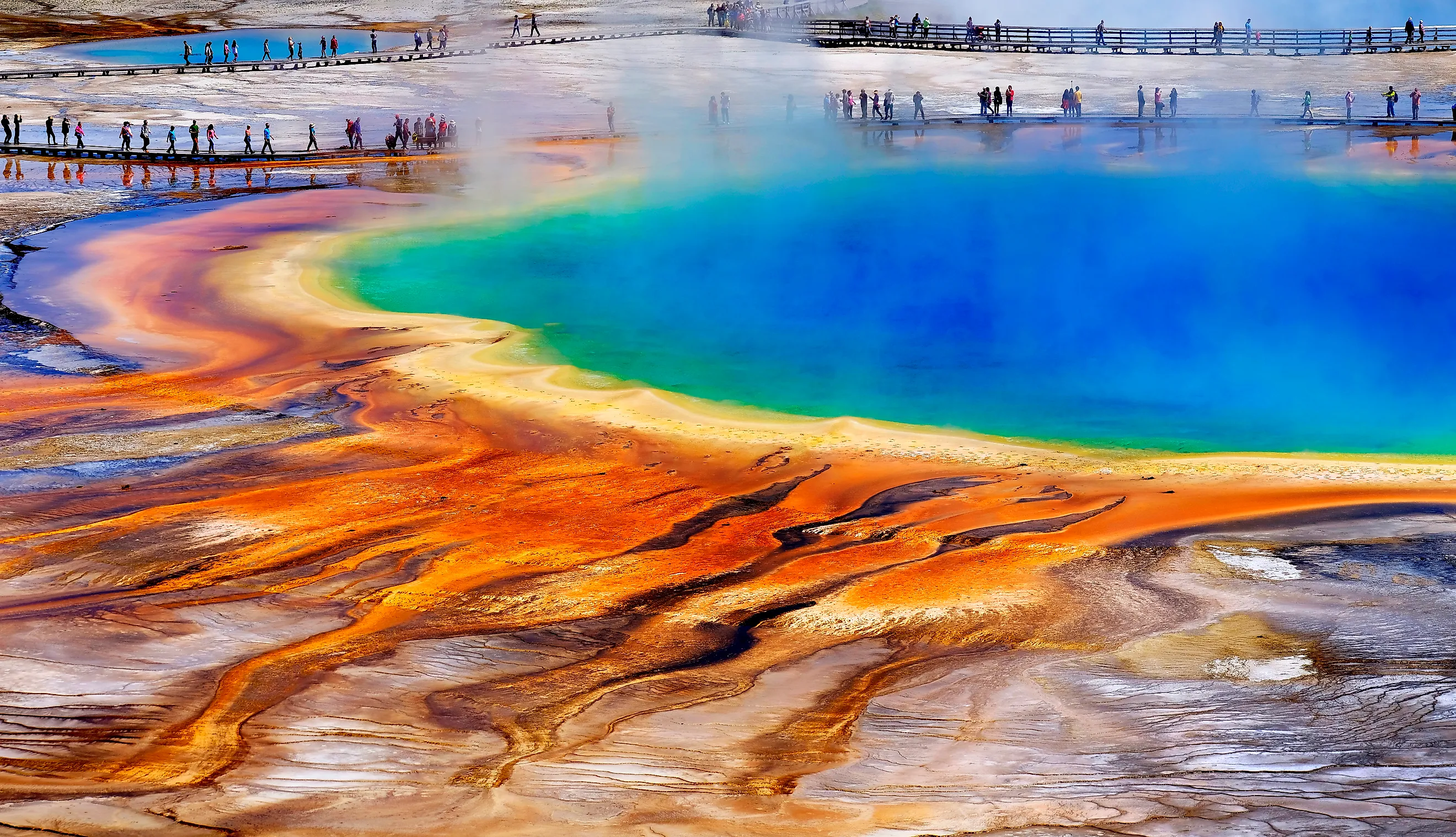
Yellowstone's no-contact rule covers the hot springs themselves, the water flowing away from them, and the colorful microbial mats surrounding their edges. At Midway Geyser Basin, visitors see Grand Prismatic Spring from a raised boardwalk or the overlook reached from the Fairy Falls Trail. Norris Geyser Basin requires even greater caution because it is Yellowstone's hottest and most changeable thermal basin. A scientific drill hole there recorded 459°F only 1,087 feet below the surface.
Mammoth Hot Springs presents a different hazard: hot water continually builds fragile travertine terraces that can be damaged by footsteps or handling. Across Yellowstone, scalding water frequently lies beneath a crust that appears firm enough to support a person. Visitors may not leave boardwalks, touch thermal water or runoff, scratch microbial mats, or soak in any hot spring. More than 20 people have died after entering or falling into the park's thermal features. The Biscuit Basin closure also remained in place in 2026 following the area's 2024 hydrothermal explosion.
Lassen Volcanic National Park, California

Lassen's prohibition applies to an extensive network of boiling springs, acidic pools, mud pots, and steam vents. Bumpass Hell contains a 16-acre hydrothermal basin reached by a three-mile round-trip trail, with a boardwalk carrying visitors above boiling pools and mineral-stained ground. Sulphur Works is easier to reach, sitting two miles north of the Southwest Entrance beside the park highway. Its mud pots and steam vents are viewed from a sidewalk, not from the surrounding crust.
Farther into Warner Valley, the 4.2-mile Devils Kitchen Trail reaches milky Hot Springs Creek and a basin filled with boiling springs. Boiling Springs Lake maintains a temperature of about 125°F, while some Lassen fumaroles have been measured above 300°F. Park rules expressly prohibit touching or entering hydrothermal water, even when a pool appears cool, because sulfuric acid and gases can injure skin and lungs. In 2012, a visitor stepped off the Sulphur Works sidewalk and broke through a crust only one inch thick, exposing her foot and ankle to boiling acidic mud and water.
Mount Rainier National Park, Washington

Mount Rainier's prohibited hot springs are small forest seeps at Ohanapecosh, not large pools developed for bathing. Rain and snowmelt descend through fractures in Mount Rainier's volcanic rock, become heated underground, and return to the surface after mixing with cooler shallow water. The Ohanapecosh seeps have recorded temperatures as high as 120°F and leave pale travertine deposits where calcium-rich water reaches the air. An early resort once operated beside the springs, but the site is now interpreted along the Hot Springs Nature Trail.
Visitors must remain on the maintained trail throughout the Ohanapecosh Hot Springs area, so stepping off the path to touch the water or mineral deposits is prohibited. Access is substantially different in 2026. The original 0.4-mile trailhead behind Ohanapecosh Visitor Center is closed during campground reconstruction. The springs can instead be reached from the Grove of the Patriarchs parking area using the Eastside and Silver Falls trails, turning the visit into an approximately 5.9-mile round-trip hike with about 600 feet of elevation change.
Parks That Permit a Soak Only at Certain Springs
Permission to touch hot-spring water does not apply across an entire park. Each of the parks below restricts contact to named springs, developed pools, bathhouses, or soaking tubs. Nearby source pools and undeveloped thermal features may remain protected because of extreme temperatures, fragile mineral formations, water quality concerns, or ecological damage.
Hot Springs National Park, Arkansas

Hot Springs National Park offers the clearest exception to the no-contact rule because the National Park Service identifies six places where visitors may physically touch the thermal water. The easiest are the Hot Water Cascade on Arlington Lawn and the Display Spring behind the Maurice Bathhouse. Smaller contact points include the Maurice Historic Spring Area, the Promenade Seep behind the Quapaw Bathhouse, the Fordyce Fountains, and the Administrative Fountain. The water rises from the ground at an average temperature of about 143°F, but it cools as it travels into the public display pools.
Touching the water does not mean visitors can climb into those outdoor features. Outdoor soaking is prohibited throughout the park. Full bathing is limited to the Buckstaff and Quapaw bathhouses on Bathhouse Row. The Buckstaff has provided traditional thermal baths since 1912, while the Quapaw uses the park's water in communal thermal pools and private bathing services.
Big Bend National Park, Texas

Big Bend allows soaking at Langford Hot Springs, where 105°F water fills the stone foundation of an early-20th-century bathhouse beside the Rio Grande. The spring is reached by a half-mile round-trip walk from the Hot Springs Historic District trailhead. Reaching that trailhead first requires driving a rough, narrow two-mile gravel road, and motor homes and oversized vehicles are prohibited on its one-way sections. The bathing area is small enough that heavy use can quickly make it crowded.
Visitors may soak but may not add soap or oil, bring alcohol or glass, camp overnight, or take pets into the day-use area. The adjacent Rio Grande is not a substitute swimming pool because its current, depth, and submerged hazards can change without warning. Flooding can cover the spring with muddy river water and leave rocks or debris inside the bathhouse foundation. Anyone planning to enter should confirm that the spring is exposed and usable after recent high water.
Olympic National Park, Washington

Olympic National Park has two very different places where visitors can enter hot-spring water. Sol Duc Hot Springs Resort operates three mineral pools and one freshwater pool beside Sol Duc Hot Springs Road. The pools are tested daily under health regulations and open only during the resort's seasonal operating period, making Sol Duc the park's controlled soaking option. Olympic Hot Springs in the Elwha River Valley are the opposite. These are natural, unmaintained seeps in designated wilderness, and the National Park Service does not test or treat the pools for bacteria.
Entering the wilderness pools is allowed at the visitor's own risk. Access is demanding because flood damage closed the road beyond Madison Falls Trailhead. Visitors must cover about nine miles along Olympic Hot Springs Road by foot or bicycle, use the washout bypass, and then hike another 1.5 miles from Boulder Creek Trailhead. Bicycles and pets cannot continue onto that final wilderness trail, and overnight users need a wilderness permit.
Death Valley National Park, California and Nevada

Death Valley's legal soaking site is Saline Valley Warm Springs, a backcountry oasis in the park's remote northwestern corner. The National Park Service management plan keeps the existing man-made tubs at Lower Spring and Palm Spring available for recreational use. That permission does not extend to every pool. Visitors must stay out of the protected source pools, and Upper Spring is being kept undeveloped. Water in the Saline Valley spring system has been recorded between roughly 61°F and 117°F, so temperatures vary among sources and tubs.
Reaching the soaking area is a major part of the trip. The springs lie about 35 miles from the nearest paved road, and the approach can involve deep washboard, rocks, sand, washouts, or winter ice. NPS guidance recommends a high-clearance vehicle with all-terrain tires, while its broader backcountry advice calls for two full-size spare tires plus extra water and food. Road conditions should be checked immediately before departure because rescue may be severely delayed.
Reading the Rules Before You Reach the Water
The line between a viewing area and a soaking pool is drawn by the ground itself. Yellowstone, Lassen, and Ohanapecosh restrict contact because their water is too hot, too acidic, or too fragile to survive a footstep, and the injuries and deaths on record show what happens when that line is crossed. Where soaking is permitted, at Hot Springs, Big Bend, Olympic, and Saline Valley, the allowance is narrow and specific: a named tub, a tempered display pool, a bathhouse fed by piped thermal water. Even those sites carry conditions, from tested resort pools to untreated wilderness seeps that visitors enter at their own risk. Checking the current rule for the exact spring, and the current access route, matters as much as knowing the water temperature, because closures and washouts at several of these parks change what is reachable from one season to the next.