The National Parks Where Sea Otters Still Live
Sea otter populations fell more than 90 percent across North America over roughly two centuries of the commercial fur trade, bottoming out at fewer than 2,000 animals worldwide. Legal protections beginning in the early 1900s, a run of reintroductions in the 1960s and 1970s, and the designation of sanctuary areas have since brought the global population back to around 100,000.
Alaska holds the large majority of them, spread across three stocks that together total an estimated 95,000 animals. Another 1,300 or so live along the Washington coast, and nearly 3,000 remain in California. Six of the country's 63 national parks have a consistent population of sea otters living in their waters: four in Alaska, one in Washington, and one in California.
Glacier Bay National Park and Preserve, Alaska
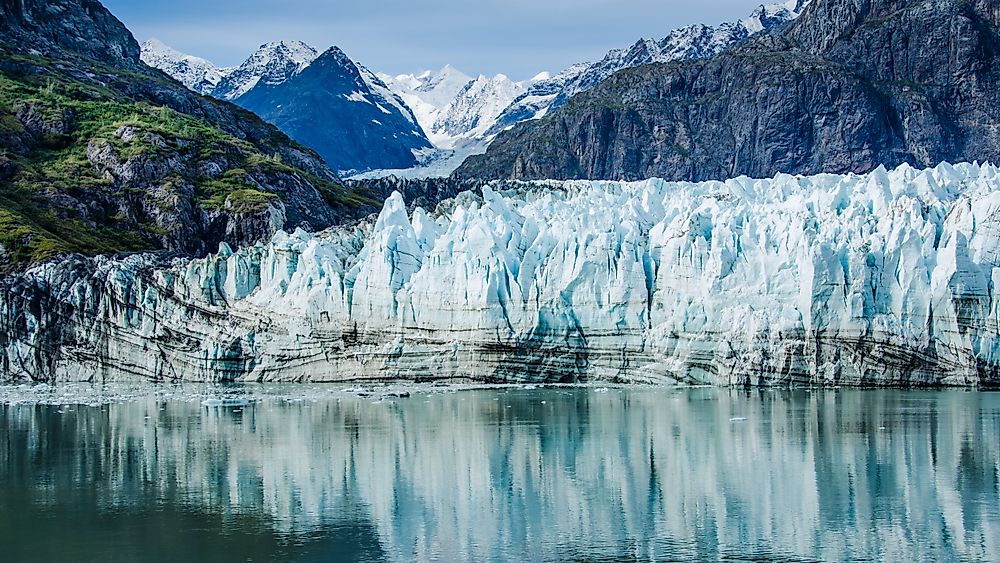
Retreating tidewater glaciers opened new nearshore habitat inside the 3.2-million-acre expanse of Glacier Bay National Park and Preserve, and sea otters wasted little time moving in.
The first animals appeared at the bay's inlet in 1988, drifting in from populations reestablished during a series of 1960s translocations that moved 413 otters into southeast Alaska. The Southeast Alaska stock the Glacier Bay otters belong to now consists of about 25,000 individuals.
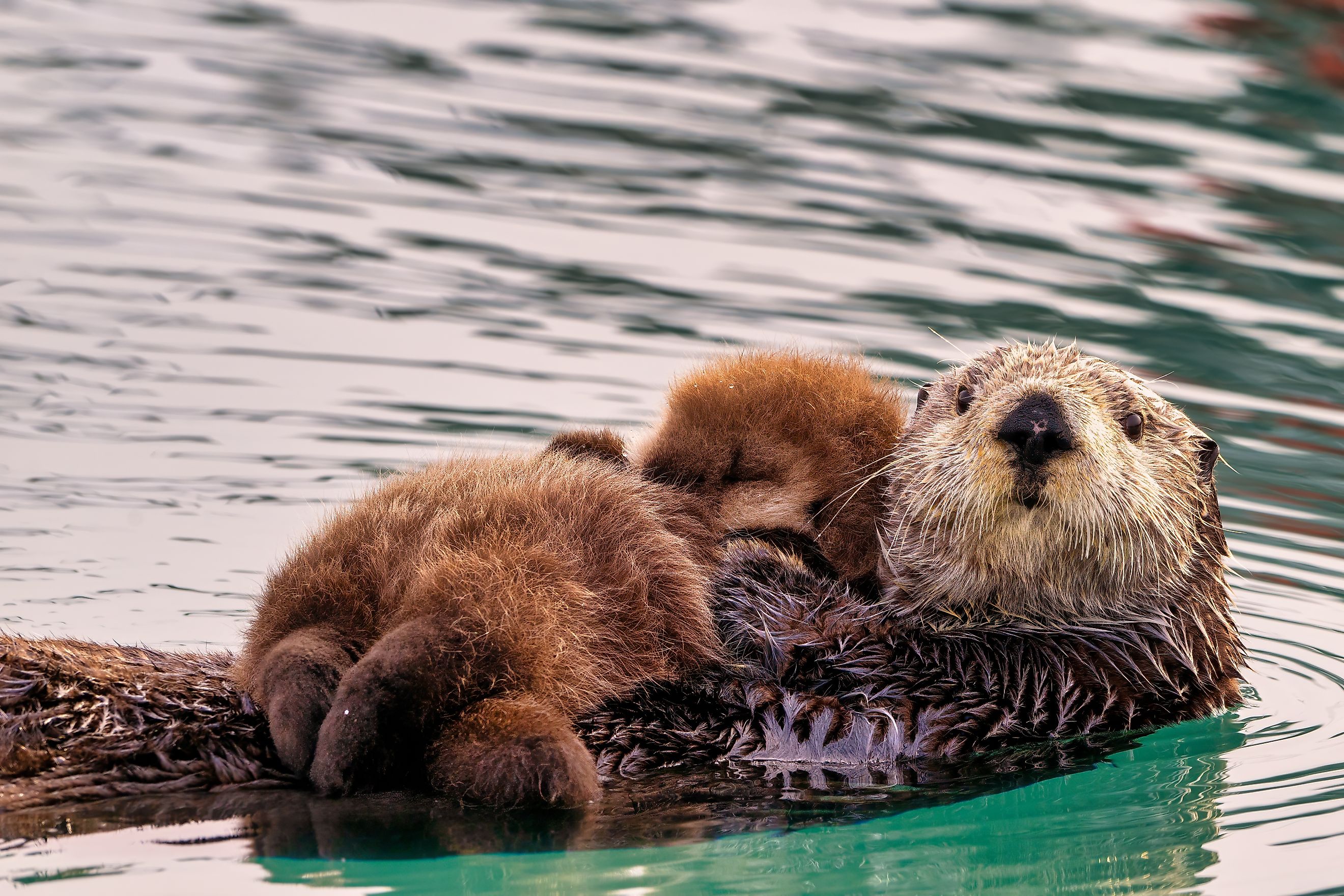
Sea otters raft together for stability while resting and grooming, holding paws or wrapping themselves in kelp fronds to keep from drifting apart.
Glacier Bay's groups can have more than 900 animals at once. Long-term diet studies by the Alaska Science Center, the U.S. Fish and Wildlife Service, and the National Park Service found that the first arrivals ate larger prey, including crabs, large urchins, and clams.
As their numbers grew, the mix shifted, and by 2019 small clams, mussels, and snails made up the majority of what they were eating.
Park concessionaire day boats running the length of the bay toward the Margerie and Grand Pacific glaciers pass regularly through Sandy Cove and Hugh Miller Inlet, two of the more reliable stretches for spotting groups along the shoreline or floating together belly-up in the channel.
Kenai Fjords National Park, Alaska

Farther south, the glacially carved coastline of Kenai Fjords National Park supports otters at a lower, steadier density than their neighbors to the north. A 2019 aerial survey estimated 3,015 individuals across the park's fjords and outer coast. These otters fall within the Southcentral Alaska stock, which numbers about 20,000.
Concentrations cluster around Sandy Bay, James Lagoon, the moraine crossing McCarty Fjord, and the waters off Nuka Island. The rest of the park's steep, deep-walled terrain offers little of the shallow, soft-bottom habitat otters need to dig for clams.
Day-tour vessels working out of Seward toward Aialik Bay and Holgate Glacier cross through some of those favored areas, giving visitors a chance of watching otters forage alongside harbor seals hauled out on floating ice near the tidewater glacier faces.
Katmai National Park and Preserve, Alaska

Shallow bays and extensive tidal flats along the Katmai coast created ideal clam habitat, and by 2008 the park's otter population had climbed to an estimated 7,000 animals, a level researchers believe is close to the carrying capacity of the local food chain.
That abundance came with pressure from an unexpected source. Camera traps set by researchers recorded brown bears attempting to prey on otters 22 times over two summers, succeeding in nine of those attempts.
Katmai's otters belong to the southwest Alaska population segment, which was listed as threatened under the Endangered Species Act in 2005 after declining more than 50 percent since the mid-1980s.
In 2009, federal wildlife officials designated nearly 6,000 square miles of marine habitat as critical habitat for the subspecies. The Southwest Alaska stock currently sits at around 51,000 animals, still the largest of the three, which is a useful reminder that a big number and a healthy trend are not the same thing.
Access to that protected coastline runs almost entirely through Katmai's bear-viewing operators, since the same tidal flats that draw brown bears to dig for clams near Hallo Bay and Swikshak Lagoon put otters and bears within sight of each other on a regular basis.
Wrangell-St. Elias National Park and Preserve, Alaska

Far to the east of Katmai along the Gulf of Alaska, Wrangell-St. Elias National Park and Preserve stretches so far toward the coast that its boundary reaches saltwater at Yakutat Bay. The adjoining Icy Bay, where four tidewater glaciers have retreated steadily since 1900, has become a fjord now used by kayakers, seals, and sea otters alike.
Mount St. Elias rises more than 18,000 feet almost directly from that shoreline, making it one of the highest coastal mountains on Earth. The otters that forage in the bay's protected, sediment-rich waters share the inlet with Steller sea lions and calving ice from glaciers still actively retreating.
Unlike Glacier Bay or Katmai, no comprehensive aerial census tracks Wrangell-St. Elias otters specifically, since the park's marine mammal monitoring largely folds into broader Gulf of Alaska survey work. Even without exact numbers, sightings along Icy Bay and the Yakutat coastline remain a routine part of any trip into the park's remote shoreline.
Visitors typically reach Icy Bay by chartering a bush plane to the raised beach strip at Kageet Point, then paddle among calving icebergs where otters share the water with resident harbor seals.
Olympic National Park, Washington

The 59 sea otters released at La Push and Point Grenville in 1969 and 1970 founded a population that now numbers well over 1,300 individuals along the Washington coast. The majority of that group lives within the waters of Olympic Coast National Marine Sanctuary rather than the boundaries of the park itself. The sanctuary runs 135 miles of shoreline, and about 65 of those miles border the Olympic National Park's wilderness coast with both the sanctuary and national park sharing stewardship.
While the bulk of the population tends to concentrate within the offshore waters of the marine sanctuary within the denser areas of the kelp beds, visitors to the beaches of Olympic National Park can still sometimes spot sea otters floating in the waves. Bringing a spotting scope to Rialto Beach or the Kalaloch bluffs can help observe otters that may be farther out within the waters of the marine sanctuary, which extends up to 50 miles off the coast.
Channel Islands National Park, California

Southern sea otters once ranged in the thousands from Punta Abreojos in Baja California north through the offshore islands that now make up Channel Islands National Park before commercial fur hunters reduced the California population to a couple dozen individuals by the 1930s.
The species has since rebuilt a foothold of an estimated 3,000 along the mainland from San Mateo County south to Santa Barbara County, but according to the National Park Service, the otters remain only an occasional visitor to the park's five islands.
The nearest breeding group in the wider Channel Islands archipelago lives at San Nicolas Island, a site 65 miles offshore that sits outside the national park's boundary. Fish and Wildlife Service biologists translocated 140 otters there between 1987 and 1990.
As of 2026, about 106 southern sea otters remain around the waters of the island. It is individuals from this group that occasionally swim the approximately 30 miles to the nearest island within the Channel Islands National Park. Visitors will have the most luck spotting a sea otter around Santa Barbara Island.
The Otter's Return
Taken together, these six parks trace nearly the full arc of the sea otter's recovery, from Glacier Bay's still-accelerating growth to Wrangell-St. Elias's quieter, less monitored presence to California's stalled southern population. Two of the six hold otters only because people carried them there in crates in the 1960s.
What began with a few hundred translocated animals has become roughly 95,000 in Alaska alone, enough that researchers can study sea otters not only as a recovering species but as a keystone predator actively shaping the kelp forests and nearshore communities of the parks that protect them.