6 Most Beautiful Public Libraries in Oregon
Libraries are an integral part of the community and welcome people from all walks of life. Despite easy access to e-books, audiobooks, and readily available information on the internet, visiting a physical library remains a distinct experience that allows visitors to step into a world of books, learning, and educational programs. In Oregon, libraries are scattered across the state, with some housed in historic buildings and others thoughtfully restored or expanded. The six libraries featured here stand out for their architecture, setting, and continued role as community spaces, making them among the most beautiful public libraries in the state.
Oregon City Carnegie Library

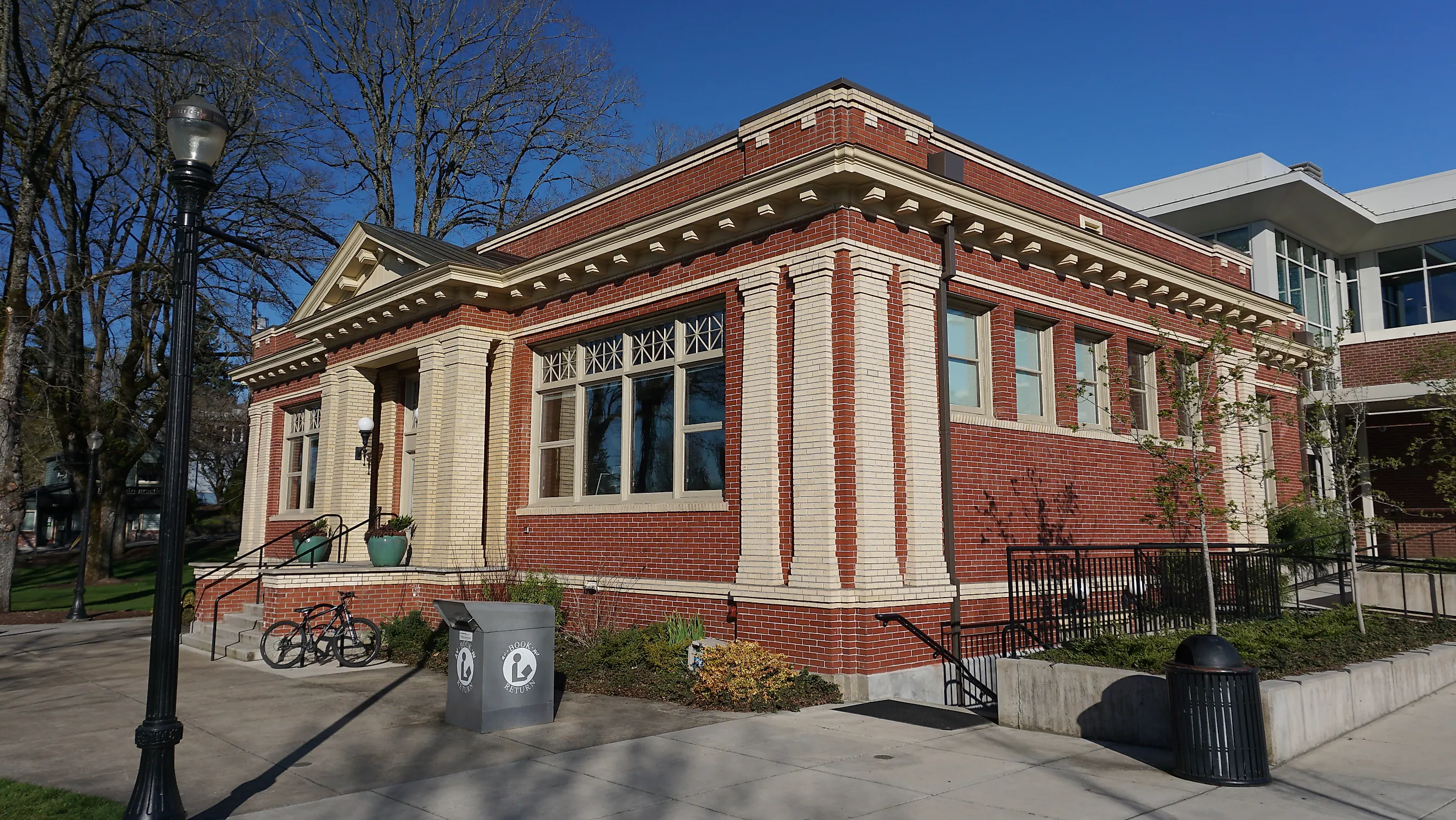
Construction of the Oregon City Carnegie Library began in 1912, with the library officially opening in 1913. The building is an example of the American Renaissance style with Georgian details. In 2014, it was added to the National Register of Historic Places, and in 2016 it underwent a major renovation and expansion to provide Oregon City with a landmark facility while preserving the history of the original building.
The two-story, 14,500 square foot addition is located behind the original 5,000 square foot Carnegie Building and draws inspiration from the original design style. A new foyer was constructed to reflect the original entry. By showcasing the exterior wall of the original building, the foyer blends past and present and serves as a transitional space between the historic structure and the new extension. The extension receives ample natural light through large windows and features suspended artwork. The library also includes a media collection, meeting rooms, a community event space, internet services, a children’s library, a teen library, and a maker space.
State Library of Oregon

The State Library of Oregon was established in 1905 in the state capital of Salem, with the goal of providing library services to all Oregonians. It is a prominent example of modernist architecture in Oregon. Both the interior and exterior of the building feature carvings by sculptor Gabriel Lavare. These carvings represent the library’s mission to further education, with nearly all of the original works still visible throughout and around the building.
The library works with local public libraries, academic libraries, school libraries, and special libraries in communities across Oregon. It provides grants and other forms of assistance that support and expand library services statewide. Due to its location opposite the State Capitol building, it also serves as the library for the state government and maintains a comprehensive collection of state publications in both print and digital form. These materials date back to the nineteenth century and include documentation of the Oregon Territory.
Lebanon Public Library

The Lebanon Public Library originally operated as the Lebanon Central Hospital before the building was later occupied by the library in 1952. An engraved cornerstone bearing the words “Lebanon Central Hospital” remains in the entry porch, along with a small shield displaying the medical insignia above the entry. The library is a single-story, rectangular building topped with a truncated hip roof.
The library promotes lifelong learning by offering equal access to informational, educational, cultural, and recreational materials, services, and programs. It houses a collection of more than 120,000 physical and digital items, including print books, e-books, audiobooks, reference materials, CDs, videos, and online resources. The library also provides access to computers for adults and children, Wi-Fi, events and programs, and spaces for reading, studying, and working.
Beaverton City Library

The Beaverton City Library was founded in 1938 and has changed locations six times across the city of Beaverton, which is part of the greater Portland metropolitan area. The library reopened in 2000 at its current site at Southwest Fifth and Hall Boulevard. In 2010, the Murray Scholls Branch opened at the Murray Scholls Town Center, with a central focus on serving children and families.
The Beaverton City Library comprises a 69,000-square-foot building, contains more than 315,000 items, and has an annual circulation of over 2.6 million items. It offers a variety of services and events open to the community, including access to computers and printing, study cubes, and meeting rooms. Events are held regularly for children, teens, and adults, both in person and virtually.
Springfield Public Library

The Springfield Public Library was initially formed in 1908 by the Ladies of Springfield. However, the group struggled to find a permanent location, which resulted in the library moving 11 times over a period of 50 years. The library became part of the city government in 1947, and in 1981, it found a permanent home inside Springfield City Hall, where it remains today. It is operated by a staff of 16 and is open six days a week.
Library cardholders may borrow a wide range of books, audiobooks, CDs, DVDs, video games, and other materials. The Springfield Public Library also operates a virtual library that allows patrons to place holds, download e-books, and access online resources. Visitors also use the library to attend events and programs, access computers, and make use of study and meeting spaces.
Ashland Public Library

The Ashland Public Library was founded in 1912, when Ashland residents showed strong support for a Carnegie Library. Over the years, the library has undergone renovations that have provided the community with additional rooms, spaces, and resources. Expansions have included large windows that offer mountain views from within the library, along with the use of locally sourced materials that give the interior a warm, welcoming feel.
Despite these changes, the library’s exterior retains a courthouse-style façade. The surrounding grounds further enhance its visual appeal, with the Mickelson-Chapman Fountain situated on the front lawn as a tribute to Michael Mickelson and Victoria Chapman Mickelson. The library maintains a substantial collection of books and serves as an inviting space for all ages, offering reading areas, computer access, and rooms for meetings, events, and educational programs.
Public Libraries as Lasting Community Spaces
Oregon’s libraries are cornerstones of communities across the state, offering resources, events, programs, and spaces to spend time. From the Oregon City Carnegie Library, which has been carefully restored to reflect both past and present, to the Lebanon Public Library, housed in a former hospital, and the Ashland Public Library, known for its natural setting and welcoming interior, these six libraries reflect the variety and character of public libraries in Oregon.