6 Most Beautiful Gothic Churches In New Hampshire
New Hampshire presents an often-overlooked chapter of American Gothic revival architecture, where stonework, stained glass, and soaring towers carry stories of faith, community, and skilled artisanship. The state features churches designed by architects who shaped Gothic taste in the United States, including works by Ralph Adams Cram and Charles C. Haight, as well as school chapels, parish churches, and a diocesan cathedral. Travelers who favor history, music, and quiet architectural study will discover active worship communities, preserved interiors with choir stalls and altars, and examples of 19th- and early 20th-century Gothic styles translated into New England materials.
All Saints' Church, Peterborough

Ralph Adams Cram designed All Saints' Church in Peterborough as a compact, stone English country parish church rendered in the Gothic Revival style. The parish was organized in the early 20th century, and Cram began design work in 1912. The building’s first services took place in 1920, and the congregation has used the structure continuously since then. Historically, the church was financed by a local donor whose legacy guided the building’s careful detailing; the interior benefited from collaborations with notable artisans for carved woodwork and stained glass.
Architecturally, the church emphasizes rough-hewn local granite, a central tower above the crossing, a rose window on the west façade, and a cruciform plan that evokes medieval English prototypes while remaining modest in scale. The sanctuary retains a finely carved rood screen and choir furnishings, which speak to the early 20th-century interest in integrating craft into church interiors. At present, the parish is active in traditional Episcopal liturgy, music programs, and occasional community concerts, and the building has seen preservation work that respects the original materials and canon of Cram’s style.
The Chapel of St. Peter and St. Paul, St. Paul’s School, Concord

In Concord, St. Paul’s School’s Chapel of St. Peter and St. Paul began as Henry Vaughan’s English-Gothic conception in the closing decades of the 19th century, and the chapel was consecrated in June 1888, with later enlargements in the early 20th century by Ralph Adams Cram. In its early history, the chapel anchored the new boarding school’s spiritual and social life; the tower was not added until several years after the initial consecration, when donors and school leaders funded memorial elements.
Vaughan’s vocabulary (brick and brownstone masonry, traceried windows, a steeply pitched roof, and richly carved woodwork) was adapted to a campus setting where the chapel occupies a central lawn and provides a dramatic vertical marker. The chapel interior preserves high, timbered vaulting, carved choir stalls, and an ornate reredos, and the building’s modification in 1928 expanded seating, added a chantry, and installed sculptural memorials by prominent artists.
Present-day use includes daily chapels, school convocations, musical recitals, and rites such as weddings and memorial services. The space has undergone careful restoration and system upgrades to safeguard the historic fabric while meeting contemporary needs.
St. John the Baptist Church, Wakefield

St. John the Baptist Church in the Sanbornville village of Wakefield was built in 1876-1877 as a wooden, board-and-batten expression of Carpenter Gothic and was consecrated on September 14, 1877. Mrs. Rebecca Maria Phippen Dow provided the principal bequest that launched the project, and architect Charles C. Haight designed the church with pointed-arch windows, steeply pitched gables, and an asymmetrical cruciform plan anchored by a projecting tower, features that adapt English Gothic motifs to New Hampshire’s rural materials and scale. The rectory followed in 1881, and a parish hall was added in 1894, creating a cohesive ecclesiastical complex that reflects late Victorian campus planning.
The building was long a mission of the Episcopal Diocese of New Hampshire before achieving parish status on June 14, 1961, and the congregation has carried out preservation campaigns that have kept original exterior sheathing, significant stained glass, and interior woodwork intact. At present, the church serves as an active Episcopal parish offering regular worship, seasonal music programs, and community outreach, and its listing on the National Register of Historic Places recognizes the structure as one of New Hampshire’s finest late-19th-century Gothic Revival wooden churches.
Chapel of the Holy Cross, Holderness (Holderness School)

The Chapel of the Holy Cross at Holderness School was designed by Charles Coolidge Haight and completed in 1884 as the school’s signature Gothic Revival structure. The chapel’s initial funding came from a private donor, and the early program emphasized an intimate yet dignified worship space for the academic community. Haight chose brick masonry with a square, three-stage tower and an octagonal steeple, and the chapel displays pointed-arch fenestration, buttressing, and period stained glass. The building’s stained-glass program evolved during the 20th century, when several windows were replaced or added by studios including the workshop of Charles Jay Connick; some windows were adapted from other regional churches in careful reinstallation.
Historically, the chapel served both campus worship and local commemorations. Over the decades, the school expanded the organ wing and upgraded interior systems while retaining the chapel’s late 19th-century character. Today, the chapel continues to host regular worship services, concerts, visiting ensembles, and school ceremonies, and it is listed on the National Register of Historic Places for its architectural significance.
St. Joseph Cathedral, Manchester

St. Joseph Cathedral in Manchester began as a 19th-century parish church to serve immigrant communities and was designed by Patrick Charles Keely, an architect noted for his Catholic churches across the United States. The parish was established in the late 1860s to serve a growing urban population, and the building was consecrated on April 16, 1894, when the diocese had crystallized its identity in the region. Keely’s plan used red brick with pointed-arch openings, a prominent corner tower and spire, interior ribbed vaulting, and an ornate high altar, combining Roman Catholic liturgical requirements with Gothic Revival aesthetics.
Over the years, the cathedral experienced interior restorations that focused on decorative polychromy, renewed liturgical furnishings, and conservation of stained glass. In the present moment, the cathedral serves as the diocesan seat for Manchester, hosting major liturgies, diocesan gatherings, choral concerts, and civic events. Regular mass attendance remains strong, and the cathedral’s interior has been occasionally opened for historical tours and educational programs that explain its 19th-century origins and later renovations.
St. Andrew’s-by-the-Sea, Rye

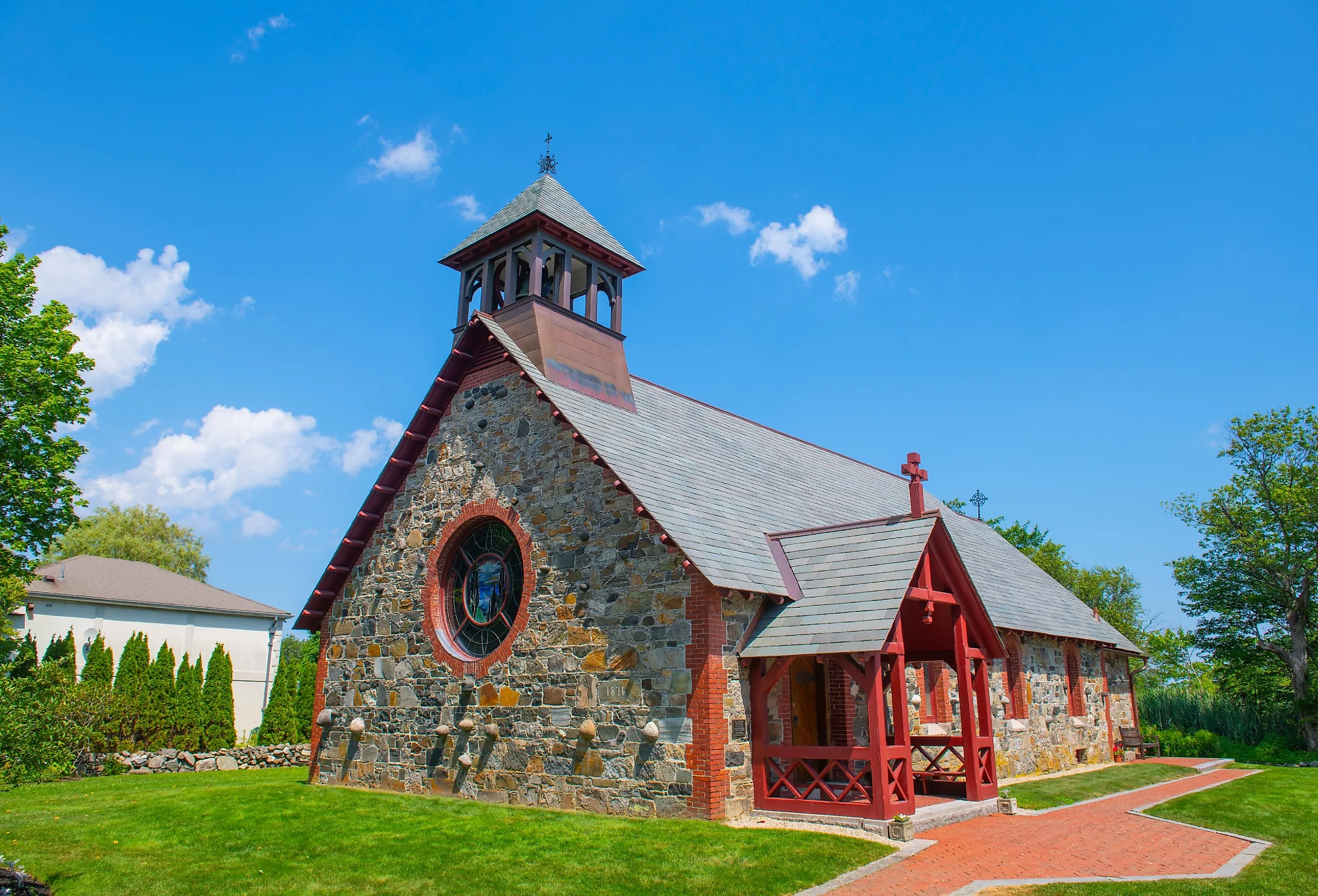
St. Andrew’s-by-the-Sea began as a summer chapel for Rye Beach visitors and held its first services in 1876. The stone-and-timber building, designed by Boston architects Walter T. Winslow and George H. Wetherell, was later documented in the National Register of Historic Places for its distinctive hybrid of Stick Style and late Gothic Revival detailing. Historically, summer worship at the chapel responded to the town’s growth as a coastal resort in the late 19th century, and the congregation raised funds for a rubblestone exterior, exposed heavy timber roof trusses, and a hand-carved oak pulpit that reflects both vernacular materials and fashionable ecclesiastical tastes of the era.
Architecturally, the chapel is notable for its multicolored fieldstone façade with brick quoining, a shallow rose window set in the gable, a small open belfry, and porches and trim executed in wood that translate Gothic forms into seaside scale. In the present moment, the chapel operates as a seasonal Episcopal chapel offering summer services, weddings, and music, and local stewards have mounted periodic preservation campaigns to conserve the La Farge, Connick, and Tiffany studio windows and the original fabric.
Plan a Gothic Trail Through New Hampshire Today
Visitors will find New Hampshire’s Gothic churches telling stories that are rooted in the state’s geography and history: local granite and brick speak to central New Hampshire quarries and Merrimack River mill towns, while boarding school chapels reflect the region’s long tradition of collegiate patronage. For the traveler, paying attention to material, acoustics, and setting reveals how New Hampshire’s landscapes shaped Gothic form and how these buildings continue to anchor civic rituals, musical life, and local memory.