5 Most Beautiful Public Libraries In Mississippi
Mississippi is home to a diverse array of public libraries, each reflecting the state’s rich history, culture, and architectural heritage. From the historic Houston Carnegie Library, the first Carnegie library in Mississippi, to university and presidential libraries that serve as research and community hubs, these institutions blend functionality with aesthetic appeal. Many incorporate architectural styles ranging from Spanish Colonial Revival to mid-century modern, with thoughtful interior design that enhances natural light, open spaces, and reading areas. Beyond their collections, these libraries provide vital community resources, from genealogy and archival materials to children’s and teen programs, making them central to learning, cultural preservation, and civic engagement across the state.
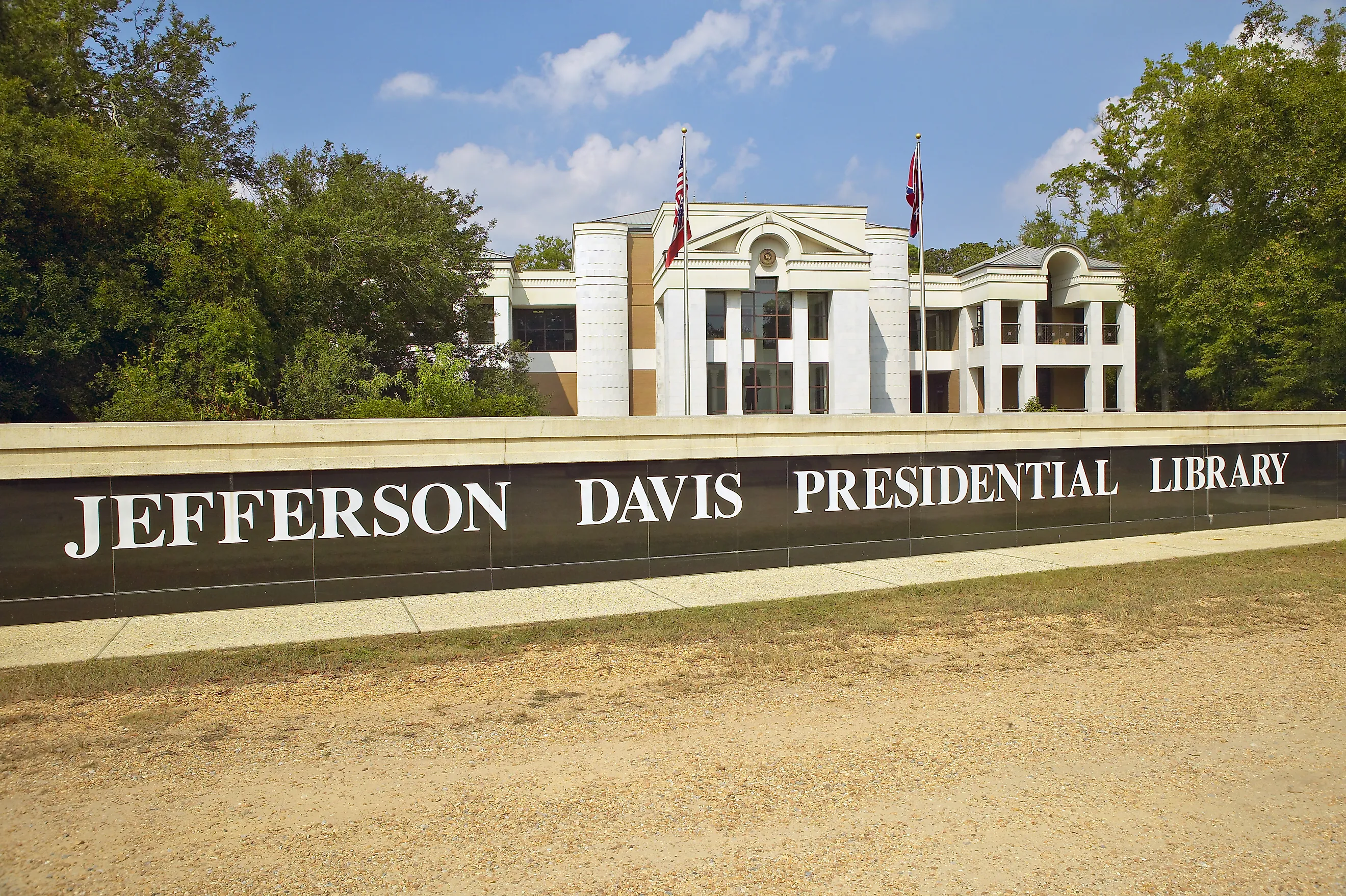
Jefferson Davis Presidential Library

The Jefferson Davis Presidential Library, located at the Beauvoir site in Biloxi, a National Historic Landmark listed on the National Register of Historic Places, is one of Mississippi’s most prominent libraries. The current building is the second presidential library at Beauvoir, replacing the original structure that was destroyed by Hurricane Katrina in 2005. The new facility, which opened in 2013, is the culmination of a multi-year effort to restore Beauvoir’s buildings and exhibits.
The library highlights the life of Jefferson Davis, the first and only president of the Confederate States of America. Designed by architect Larry Albert of Albert & Associates in Hattiesburg, it incorporates architectural elements from both the demolished 1996 library and the Beauvoir Mansion and 52-acre grounds. Salvaged features include the bronze statue of Davis, the bronze Confederate Seal, the front entry quote wall, and guardrail designs. The white brick exterior honors the Confederate Hospital while maintaining visual continuity with other structures on the property.
Inside, the Jefferson Davis Presidential Library features research stations, an extensive genealogy section with books on soldiers and families from Confederate states, and computers for accessing military records. It also houses legal resources, cartography books, and a broad military history collection spanning from the American Revolution onward.
Biloxi Public Library

A short drive from the Jefferson Davis Presidential Library, the Biloxi Public Library has served the Mississippi Gulf Coast since 1898, when the King’s Daughters established Mississippi’s first free public library. After a fire destroyed the original building around 1900, services continued in the historic Creole Cottage before relocating in 1925 to a Spanish Colonial Revival-style structure on Lameuse Street designed by architect Carl E. Matthes, noted for its stucco walls, terracotta roof tiles, and graceful arches. That building served the community for decades until the Biloxi Public Library & Cultural Center opened in 1977.

The library’s exterior gives way to airy, light-filled interiors accented with warm wood and flexible program spaces, including reading areas, classrooms, meeting rooms, and a dedicated Young Adult Area. Like much of Biloxi, the library was heavily affected by Hurricane Katrina, which damaged facilities and displaced collections across the region, including flooding the local history collection before it was relocated and rebuilt. In 2011, the library reopened at its current location on Howard Avenue, designed in harmony with the adjacent Biloxi Civic Center.
Today, the Biloxi Public Library is a key branch of the Harrison County Library System, offering extensive print and digital collections, robust programming for all ages, and a strong Local History & Genealogy Department supporting research into family histories and the region’s rich heritage.
Houston Carnegie Library

Located in downtown Houston, Mississippi, the Houston Carnegie Library opened in 1909 as the first Carnegie library in the state and the second public library in Mississippi. Funded by a $6,000 grant from philanthropist Andrew Carnegie, the building was constructed after local school superintendent L. B. Reid petitioned Carnegie for support, with the town agreeing to maintain the facility. The Houston Carnegie Library was added to the National Register of Historic Places in 1978 in recognition of its historical and architectural significance.
Designed as a one-story brick building with a cross-shaped layout, the library incorporates elements of the Prairie School and Western Stick styles, including a low hip roof, overhanging eaves, and an emphasis on horizontal lines. The front entrance features tall glass-paneled doors and decorative brickwork, while a 16-pane skylight illuminates the central hall. Interior details include oak trim and classical-style mantels.
Today, the Houston Carnegie Library offers services, including a circulating collection, public computers, and wireless internet access, continuing its role as a community resource.
J.D. Williams Library

Nestled on the picturesque campus of the University of Mississippi, commonly known as Ole Miss, in Oxford, the J.D. Williams Library, also called the John Davis Williams Library, was completed in 1951 and named in honor of Chancellor John Davis Williams. A west wing was added in 1970, and a major renovation and expansion in 1996 increased the library’s total space to nearly 200,000 square feet, solidifying its place as the university’s central research hub. It houses millions of materials, from books and periodicals to manuscripts, audiovisual media, maps, and microforms, making it a vital resource for students, faculty, and researchers.
J.D. Williams Library’s mid-century modern design, large windows, and open interior spaces create a bright, welcoming environment, complemented by comfortable seating, public computers, free internet access, and even a Starbucks coffee shop. Its Archives & Special Collections are a particular highlight, preserving rare books, manuscripts, photographs, film, and sound recordings that reflect the history and culture of Mississippi and the American South. Additionally, rotating exhibits throughout the building offer an engaging and educational experience, while its role as a Federal Depository Library ensures access to extensive federal and state government documents.
Judge George W. Armstrong Library

Long before the Judge George W. Armstrong Library opened its doors, the concept of libraries was already taking root in America. Subscription libraries date back to 1732, when Benjamin Franklin founded the first, allowing members to pay a modest annual fee to fund book purchases. Inspired by this model, a group of local men in Natchez established a reading room in January 1883, and by April, the Natchez Library officially opened. In 1891, it was renamed the Alvarez Fisk Memorial Library & Museum.
In the 1930s, Natchez opened a county library, which operated until 1943, when its collection and equipment were merged to form the Fisk Memorial Library. That library served the community until 1965, when the Judge George W. Armstrong Library was completed. The building is admired for its stately red‑brick exterior with a symmetrical façade and welcoming design. Inside, open reading rooms fill the library with natural light, creating a calm, inviting atmosphere for reading, studying, and community programs.
The Judge George W. Armstrong Library is also recognized with a marker on the Mississippi Writers Trail, honoring Natchez’s lasting influence on generations of writers, including the acclaimed Richard Nathaniel Wright.
Mississippi's Most Iconic Libraries
The Jefferson Davis Presidential Library, Biloxi Public Library, Houston Carnegie Library, J.D. Williams Library, and Judge George W. Armstrong Library show that Mississippi’s public libraries are more than repositories of books. Their distinctive architecture, inviting interiors, and comprehensive collections create spaces that educate, inspire, and foster community connection. Each library, whether a historic landmark, a university research hub, or a modern community center, contributes to preserving local and state heritage while offering programs and resources for all ages. These institutions highlight Mississippi’s commitment to accessible knowledge, cultural preservation, and spaces that are as beautiful as they are functional.