5 Most Beautiful Gothic Churches In North Carolina
Gothic architectural styles in church construction in North Carolina emerged as settlers established communities throughout the Piedmont Plateau and the Blue Ridge Mountains. Congregations that grew due to immigration from England, Scotland, Ireland, and Germany helped shape the types of churches built, as they brought building techniques and aesthetic expectations for ecclesiastical design. In many western structures, granite was used, while churches built in forested regions relied on timber to create Gothic expressions. Designers and congregations employed pointed arches, and steep rooflines to illustrate permanent sacred order based upon structural elements rather than ornate decoration. Each of the 5 churches described here demonstrates how regional geology and local identity contributed to the expression of Gothic architecture. Visitors may view these churches on site to appreciate how environmental context and historical development influenced their design.
St. Matthew’s Episcopal Church, Hillsborough

Warren LeMay from Cullowhee, NC, United States - St. Matthew's Episcopal Church, Hillsborough, NC. Wikimedia Commons.
The old clock now in the Hillsborough Courthouse was originally a royal gift from King George III to the earliest St. Matthew’s Church in town, tying the church to trans-Atlantic history when North Carolina was still a British colony. St. Matthew’s developed over time under the supervision of architect William Nichols. As the congregation expanded, it incorporated Gothic elements such as the entrance tower, interior gallery, and exposed beams, creating vertical emphasis in the sanctuary. The present steeple atop the tower was rebuilt to be longer and narrower, reinforcing upward visual movement within the Gothic language. The exterior masonry consists of brick laid in Flemish bond, pointed window arches, and a modest scale that reflects the adaptation of the Gothic Revival style for a Southern parish. St. Matthew’s is listed on the National Register of Historic Places, and the surrounding churchyard contains older graves and memorials that visibly connect the past residents to the church.

Warren LeMay from Cullowhee, NC, United States - Cemetery, St. Matthew's Episcopal Church, Hillsborough, NC. Wikimedia Commons.
Visitors entering the church will see many interior details that maintain a sense of historical continuity. The marble plaque in the narthex provides insight into part of the church’s history, and visitors are permitted to ring the bell in the tower, which replaced an earlier bell installed soon after the Civil War. The 1883 Hook and Hastings tracker-action pipe organ is noted for its tonal quality and soft voice and was purchased through a fundraising effort organized by the Ladies of the Sewing Society. The reproduction chandeliers, modeled after a 19th-century fixture from Philadelphia, illuminate the exposed beams and highlight the geometric roof structure. The architectural and historical components together provide a rich sense of heritage and liturgical continuity.
Duke University Chapel, Durham

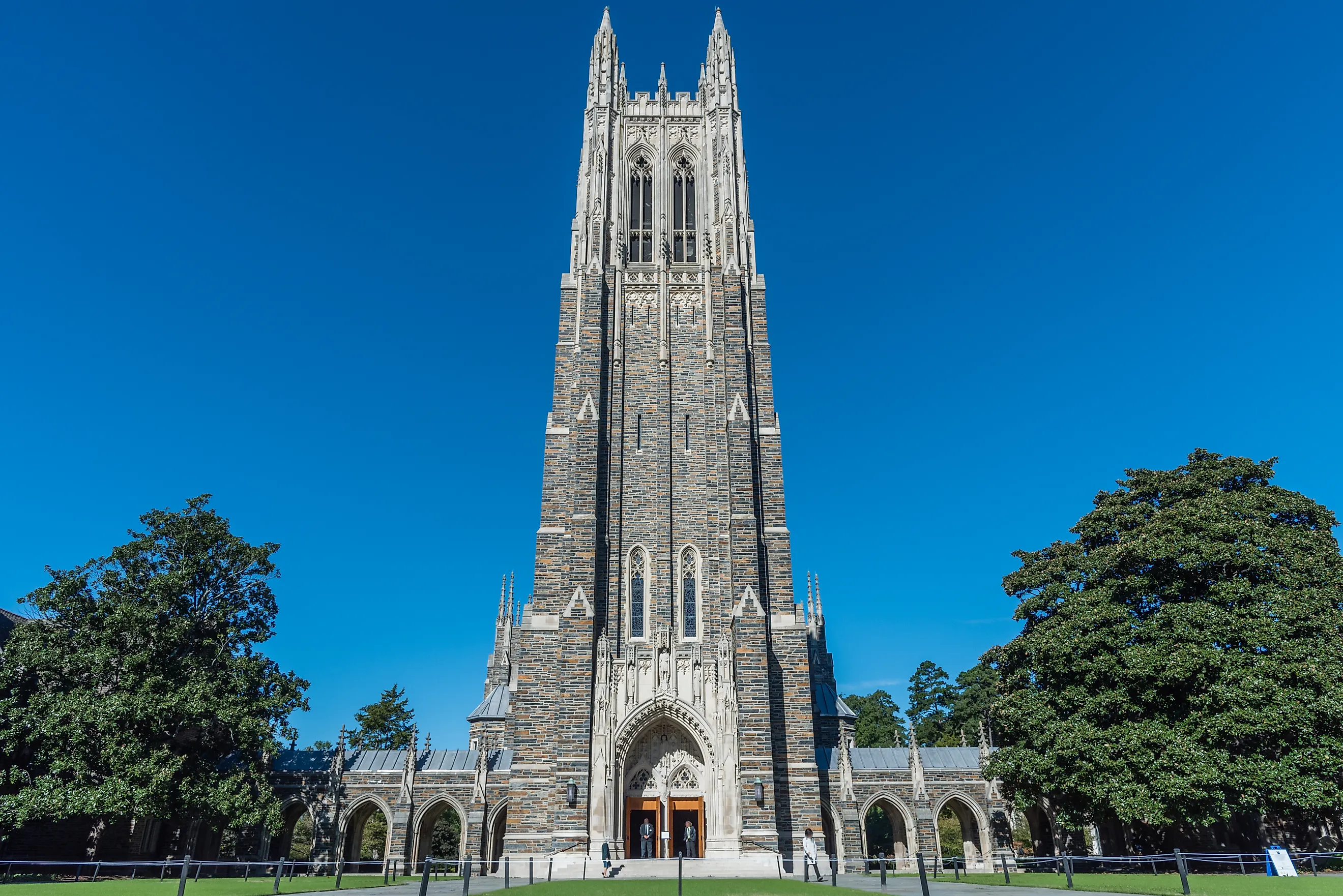
Duke University invested $19.2 million in restoring Duke Chapel between 2015 and 2016 to maintain its structural integrity and the intricate details of the interior. The chapel is a dominant feature of West Campus at Duke University and remains one of the most recognizable examples of Collegiate Gothic architecture in the American South. Completed in the 1930s as the focal point of the university’s expansion, it features a 210-foot tower that defines the shape of the main quadrangle, accommodating nearly 1,800 people. The design incorporates English Gothic architectural elements, including a tower modeled on traditional English church design, ribbed vaults, pointed arches, and narrow lancet windows. According to the Duke University Chapel website, James Buchanan Duke expressed his intention clearly when he said, “I want the central building to be a great towering church which will dominate all of the surrounding buildings…”

The majority of photographers and visitors enjoy the church from the stairs leading to the front door, capturing the verticality of the tower. Others take images from shaded paths that run along the buttresses and clerestory windows of the chapel’s nave. Visitations are also possible inside the chapel to view the colored light from the tall windows of the sanctuary. The placement of the chapel at the end of the central axis provides opportunities to photograph it from a distance, framing the tower through other Gothic buildings on campus. The chapel is open daily to the public, and docent-led tours are offered every Sunday after the 11:00 a.m. service.
Christ Episcopal Church, Raleigh

Often referred to simply as Christ Church on Capitol Square, it is the oldest Episcopal parish in Raleigh and the mother parish to several others in Wake County. It is also one of the three largest parishes in the Diocese of NC. The granite building that houses Christ Episcopal Church was built in the Early English Gothic style, designed by Richard Upjohn, an English-born architect and a founder of the American Institute of Architects. Construction of the main structure was completed in the mid-19th century, and construction of a stone bell tower followed shortly after. Together, they form a Latin-cross floor plan that has remained unchanged. As one of the four ecclesiastical anchors of Capitol Square, the church is listed as a National Historic Landmark.

From several corners of Capitol Square, the clarity of the design is apparent. Most photographs show the main façade and tower framed by open lawns and mature trees. The stone walls, stepped buttresses, and narrow lancet windows remain essentially unchanged from the church’s early years. This consistency creates a stable presence in the square, and the long-standing role of Christ Church provides a valuable reference point for the study of Gothic Revival architecture in North Carolina.
St. Luke’s Episcopal Church, Asheville

This is an image of a place or building that is listed on the National Register of Historic Places in the United States of America. Its reference number is 97001198 (Wikidata).
St. Luke’s is a clear representation of Carpenter Gothic architecture. This style evolved by incorporating Gothic Revival elements into wood, rather than stone, and featuring decorative scroll-sawn details. The style became prevalent in the United States during the 19th century because local carpenters could produce the effect economically. St. Luke’s specifically was built by a member of the congregation, E. J. Armstrong, and was completed in 1894. The use of board-and-batten siding, pointed arch windows, and a steep roof gives the church its Gothic silhouette, while also reflecting the scale and materials of a mountain parish. In 1997, St. Luke’s was added to the National Register of Historic Places, recognizing its architectural significance and the importance of its preservation.

Today, the parish has approximately 58 active members who attend Holy Eucharist each Sunday. The church grounds feature a cemetery dating back to the early 20th century, as well as a Garden of Resurrection for cremated remains located on the south lawn. Inside, the warm wood ceiling rises through exposed rafters and draws the viewer’s gaze upward. Large windows filter sunlight through surrounding trees, producing soft, dappled illumination. The bell tower is commonly photographed in different lighting conditions, especially during seasonal changes. St. Luke’s demonstrates how congregations utilized local carpentry and available timber to construct a Gothic-inspired church, adapted to the natural setting of western North Carolina.
Grace Episcopal Church, Morganton

A small foothill congregation founded in 1845 eventually built one of the region’s most distinctive Gothic stone churches. The present building is constructed of local granite and displays Gothic architectural elements consistent with the style. Inside, the stained-glass windows provide warm color and natural light for worshippers.

The public can tour the building, which stands as a local historic landmark. It is part of the South King Street Historic District, which comprises 10 buildings constructed between 1893 and 1939. The church continues its parish role with Sunday worship services and a weekly healing service on Wednesdays. The surrounding grounds include a cemetery that predates the present church building, connecting the current congregation with earlier members. Visitors often photograph the church from different angles, showing features such as the crenellations at the top of the tower, the long south side elevation, and the granite tracery of the windows. Light passing through the stained-glass windows creates an atmosphere that is suited for intimate worship. Grace Episcopal demonstrates how Gothic architecture in North Carolina was executed, utilizing local stone, a modest scale, and a strong geographic connection.
The Gothic style of church buildings in North Carolina reflects how congregations used local materials and continued an architectural tradition suited to their environment. Duke Chapel displays Collegiate Gothic in large stone academic form. Christ Church in Raleigh maintains the early Gothic Revival style through its granite construction and long Episcopal presence. St. Matthew’s in Hillsborough shows early brick development and links to colonial history. St. Luke’s in Asheville interprets Gothic construction in timber. Grace Episcopal in Morganton uses granite to establish a strong mountain parish identity. Each church illustrates how regional context and construction shaped Gothic design in North Carolina.