5 Most Beautiful Gothic Churches In Nevada
Nevada is home to a remarkable collection of Gothic-style churches, each telling a story of faith, craftsmanship, and local history. From the soaring spire of St. Mary’s in the Mountains in Virginia City to the Carpenter Gothic design of St. Peter’s Episcopal Church in Carson City, these buildings feature pointed arches, intricate woodwork, and architectural details that have endured for more than a century. Many were constructed during the mining boom or early settlement periods, and some even continue to serve their communities today. Beyond their architectural beauty, they provide spaces for worship, learning, and gathering, preserving both spiritual and cultural traditions across the state.
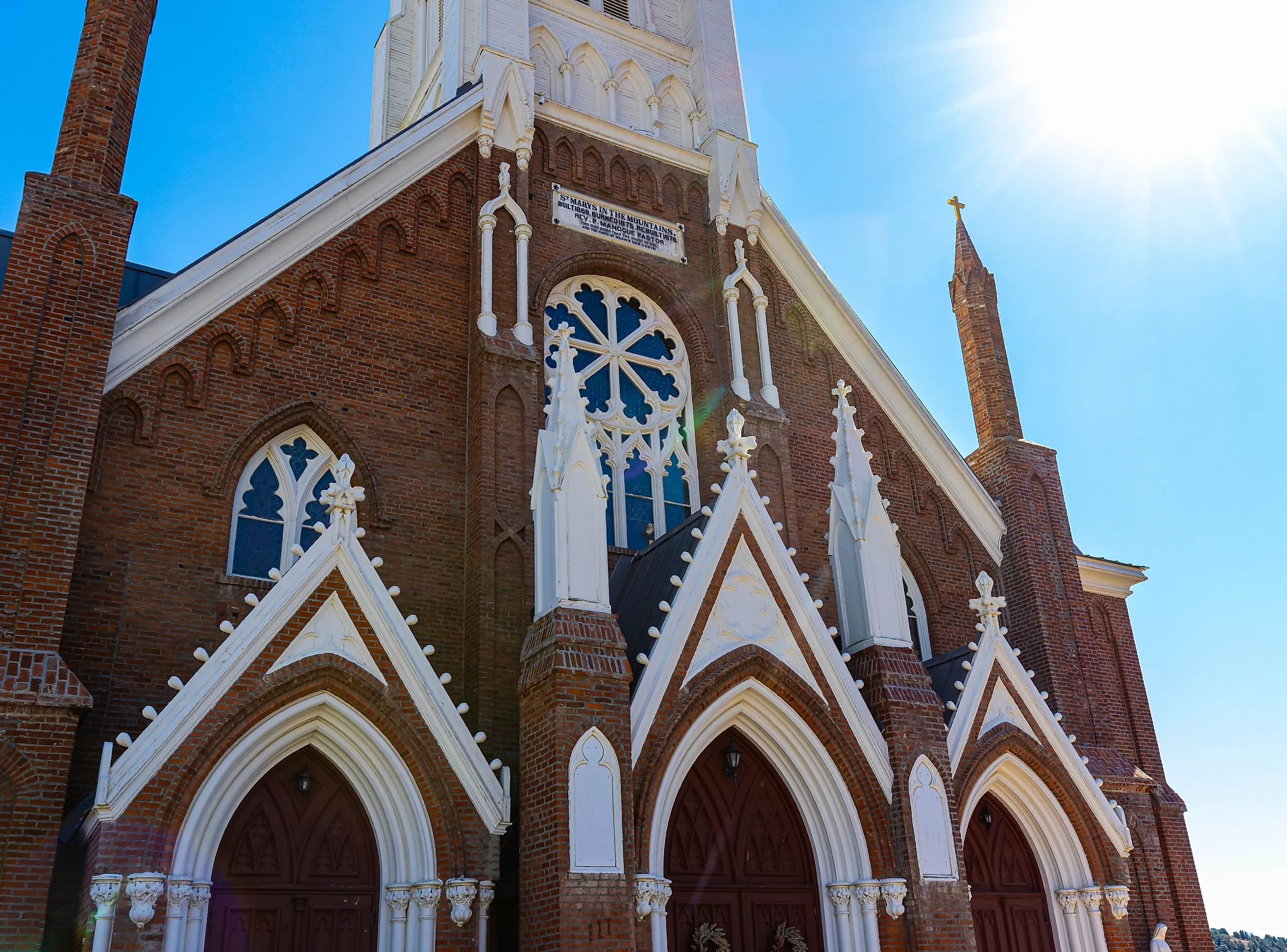
St. Mary’s In The Mountains Catholic Church, Virginia City

St. Mary’s in the Mountains Catholic Church in Virginia City is one of northern Nevada’s most striking examples of Gothic Revival architecture. Built in the late 19th century on the site of earlier churches destroyed by fire, this brick structure features a tall spire and pointed-arch windows that dominate the skyline of the historic mining town. The interior is crafted from wood and plaster, with intricate carvings painted in white and gold. A highlight of the sanctuary is the 21-foot-tall altar, imported from France, which adds a dramatic focal point to the space. Another remarkable feature is the church’s bell, once the largest in the region, with a clapper weighing 100 pounds.
Today, St. Mary’s In The Mountains Catholic Church continues to serve its community, hosting Mass on Wednesdays and Sundays, as well as special services at Christmas. Visitors can explore guided tours, learn about the church’s history in the museum, and browse a gift shop that carries a variety of religious items.
Trinity Episcopal Cathedral, Reno

In Reno, Trinity Episcopal Cathedral stands as a notable example of historic church architecture and reflects more than a century of parish history. The congregation was formed in 1870, initially meeting in a schoolhouse before building its first church soon afterward. By the early 1920s, plans were underway for a new structure, and although construction was delayed, the lower level opened in 1929 and served the parish for two decades. The completed cathedral, located along the south bank of the Truckee River, was finished in 1949.
Trinity Episcopal Cathedral is Reno’s only poured-concrete church in the Late Gothic Revival tradition. Its exterior features a tall gabled façade, buttressed side aisles, and a square bell tower. Pointed-arch doors and windows, stained-glass panels, and carved wooden entrances further define the Gothic style. Inside, smooth plaster walls, arcaded aisles, and large arched trusses frame the nave, creating an expansive and reverent interior space. Listed on the National Register of Historic Places in 2020, the cathedral continues to hold regular worship services, weekday morning prayer, and a variety of programs that engage the local community.
St. George's Episcopal Church, Austin

St. George’s Episcopal Church, located in central Nevada in Austin, is a notable example of Gothic Revival architecture, built between 1877 and 1878. The one-story brick building sits on a granite foundation at the base of Pony Canyon and features a prominent corner bell tower, lancet-arched windows, and a front-gable metal roof. Its design reflects a simplified Lombard Gothic style, blending elegance with practical use of local materials.
Inside, the nave is framed by a hammerbeam-scissor truss roof with polished redwood boards and intricately carved pine braces. The original 296-pipe Mills organ, along with custom black walnut altar and chancel furnishings, enhances the historic character of the church. Rehabilitated in 1982, the building retains its 19th-century charm. When it was added to the National Register of Historic Places in 2003, St. George’s Episcopal Church was the only historic church in Austin still serving its original denomination.
Wadsworth Union Church, Wadsworth

Wadsworth Union Church, built in 1888 in the town of Wadsworth in northern Nevada, is a small but significant Gothic Revival church. Covering 1,120 square feet, the front-gabled building is clad in clapboard siding, topped with a composition-shingled roof, and features three pointed-arch windows along each side. A modest vestibule at the west entrance supports the belfry and steeple, where the church’s bell still rings clearly. Above the double doors, a Gothic-style window divided into three sections by tracery adds subtle detail.
Inside, two rows of pews flank a central aisle, and a wooden chancel screen separates the congregation from the pulpit and organ. Though repainted, re-roofed, and updated with new amber glass in the 1970s, Wadsworth Union Church maintains its 19th-century character. It was added to the National Register of Historic Places in 2004 for both its architectural style and its role in the social life of the railroad town during the late 19th and early 20th centuries.
St. Peter's Episcopal Church, Carson City

In Carson City, St. Peter’s Episcopal Church is a notable example of Carpenter Gothic architecture, incorporating design elements inspired by both Medieval and Classical styles. The parish was organized in 1863, and the church building, completed around 1868, is the oldest Episcopal church in Nevada still in use. Inside, the ceiling resembles the inverted hull of a ship, and the pews are arranged in three sections rather than a central aisle. Following an expansion in 1874, the church added an auditorium with spaces for a lecture room and Sunday school.

The chancel is supported by fluted Roman Corinthian columns, and the wood-framed building rests on a low sandstone ashlar foundation. St. Peter’s Episcopal Church was listed on the National Register of Historic Places in 1978. Today, it serves the community with Bible study, healing services, midweek coffee gatherings, Sunday worship, and special holiday services on Christmas Eve and Christmas Day.
Nevada’s Most Stunning Gothic Churches
The Gothic churches of Nevada, including St. Mary’s in the Mountains in Virginia City, Trinity Episcopal Cathedral in Reno, and St. George’s, Wadsworth Union, and St. Peter’s Episcopal Churches, showcase the state’s rich architectural diversity and history. From soaring spires and pointed-arch windows to intimate wood-framed interiors, each structure combines design, craftsmanship, and community purpose. Beyond their beauty, many of these churches continue to serve as active centers for worship, education, and social gatherings. They allow visitors and congregants to experience their historic charm firsthand and continue to meet the spiritual and cultural needs of communities throughout Nevada.









.jpg)
