Top 8 Civil War Monuments In Tennessee
During the American Civil War, Tennessee was more hesitant to join than others. In fact, it didn't officially join the Confederacy until June 8, 1861, a few months after the attack on Fort Sumter in April 1861, which began the war. This is because the state held a sizeable population of pro-Unionists, many of whom would end up serving in the Union Army. Abraham Lincoln's second VP, Andrew Johnson, was himself a pro-Union Tennessean.
Despite this, after joining, Tennessee would provide 135,000 soldiers for the Confederacy. After the war ended, Tennessee organizations such as the United Confederate Veterans and especially the Daughters of the Confederacy raised funds to raise many monuments honoring these Confederate veterans. Many of these monuments teach the Lost Cause myth: the idea that the Civil War was not caused by a conflict over slavery, but rather states' rights. They often praise the Confederates as defenders of freedom and their homes from the Union.
You can learn a lot about both the Civil War and how it was remembered by visiting these top Civil War monuments in Tennessee.
Confederate Private Monument, Nashville

Don't let the name fool you, this isn't a private monument, but rather a monument honoring the average infantryman, the private within the Confederate army. Located in Centennial Park in Nashville, this monument has a bronze statue of a Confederate soldier resting on a rock while holding onto his rifle. Below him is a plaque with 540 names of the Frank Cheathem Bivouac of the United Confederate Veterans.
This monument received masonic honors and was officially dedicated in 1909. Multiple public figures, including the sculptor George Julian Zolney and Judge S. F. Wilson, gave speeches at its dedication, and a large crowd of people sang the popular Confederate song Dixie.
The monument has received pushback in recent years as people reexamine both the role of the Confederacy and the racist undertones present in many such statues. In 2019, vandals spray-painted the words "They were racists" over the names of the veterans. Despite efforts to have it removed, the Tennessee Historical Commission has rejected all motions to move the statue, so it remains to this day.
Confederate Soldiers Memorial, Murfreesboro

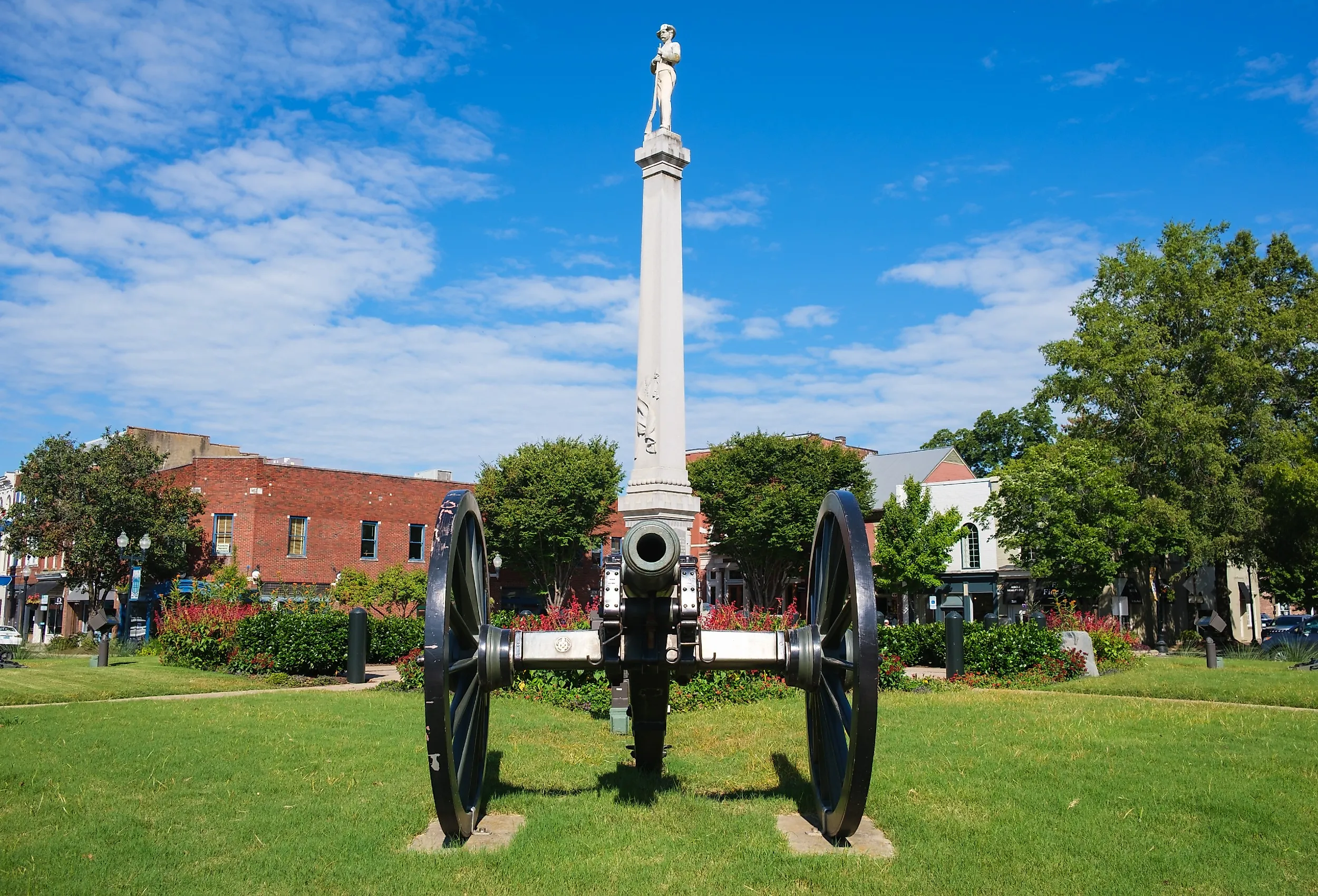
This memorial sits in the Rutherford County Courthouse Square in Murfreesboro. The United Daughters of the Confederacy petitioned for a monument to be raised in honor of the local soldiers who fought in the Civil War. In 1897, the Rutherford County Court approved the construction of the monument, which was completed in 1900.

It has a limestone base with four polished granite sides. On top of it stands a bronze Confederate soldier statue. The monument serves two primary purposes. The first is to honor the memory of soldiers who died in the Battle of Stones River, along with other skirmishes. The second is to simply provide a "monument for our soldiers built of a peoples love," according to an inscription on the monument. In addition, the Sons of the Confederate Veterans placed another inscription at the foot with a list of all the units that residents of Rutherford County served in.
However, African American residents of Rutherford County have argued that the county ignores their history, especially of slavery. And there is now a new marker that honors all the people who were sold as slaves right on the grounds of the courthouse.
First Monument to Unknown Confederate Dead, Union City

Many of Tennessee's Confederate monuments were raised in the generation after the Civil War, as their descendants attempted to honor their dead and defend their legacy, often by insisting on the courage and valor of Confederate troops and ignoring the institution of slavery.
Some, however, were raised a few years after the Civil War ended, such as the First Monument to Unknown Confederate Dead in Union City, Tennessee. Also referred to as the Confederate Monument, it was dedicated in 1869 and claims to be the first of its kind.
This 40-foot-tall brick monument was painted white. It is an obelisk with several half-rounded recesses, one of which has an engraving of a broken sword and the words "Unknown Confederate Dead on it." There are 30 graves surrounding the monument, all of them unknown Confederate soldiers.
While other monuments have a strong agenda, this one is far more muted in its approach. Perhaps this is because the wounds of the Civil War were so fresh that people simply wanted to remember the dead.
Battle of Nashville Monument, Nashville

In a state like Tennessee, you can expect to find monuments honoring the Confederacy, but you can also find places that honor both sides. Right within the city of Nashville, you can find the Battle of Nashville Monument, located within a park of the same name. The monument commemorates the Battle of Nashville on December 15, 1864, when the Union forces under George H. Thomas completely routed the Confederate troops under John Bell Hood within the borders of Nashville.
This monument was commissioned by the Ladies Battlefield Association, a type of memorial association that was popular within the South. Italian sculptor Giuseppe Moretti designed the sculpture, which included an angel at the top of a 30-foot obelisk with a young man controlling two horses, representing the North and the South. The original monument was dedicated in 1927, but after a tornado destroyed it in 1974, the monument was rebuilt to its former specifications in 1999.
The monument's original purpose was to honor both Confederate and Union dead, along with Tennessee soldiers who died in World War 1. The south face of the monument states, "The Spirit Of Youth Holds In Check Contending Forces That Struggled Here At The Fierce Battle Of Nashville, Dec. 16th, 1864, Sealing Forever The Bond Of Union By The Blood Of Our Heroic Dead Of The World War 1917 - 1918."
The north side of the monument praises the "valorous gray and glorious blue" and argues to let the "past be past: let the dead be dead. Now and Forever American!"
It should be noted that such sentiments, while honorable of their own, do hide a more sinister motive: the Lost Cause Myth. This myth argues that the war was an unfortunate tragedy with heroes on both sides that was caused by the Union's refusal to accept the state's rights of the Confederacy. This myth aims to either deny or downplay the role slavery played in the conflict.
Tennessee Confederate Women's Monument, Nashville

This 1926 statue sits in one of the most significant spots in Tennessee: the Tennessee State Capitol in Nashville. This should show just how strong the Lost Cause was, as it was able to lay claim to public spaces of significant symbolic importance.
The United Confederate Veterans raised the funds to erect the statue to honor women who helped support Confederate soldiers while at war. It is a bronze statue of a Southern Woman who is aiding a wounded Confederate soldier, while the Greek god Fame crowns her with a laurel.
Interestingly enough, the United Daughters of the Confederacy opposed the monument, as they believed that the money should be used to support women of the Confederacy or for other causes such as orphanages and women's clubs. Also, the original design for the statue was rejected as the woman was originally shown with her head down. The accepted design shows her with her head up, showing strength and confidence.
Confederate Monument, Franklin

This is one of the most beautiful monuments in the state of Tennessee. It features a 6-foot-6-inch-tall statue of a Confederate soldier, made of Italian marble, standing atop an ornate 32-foot-tall column. The column is made of a mixture of granite and marble and stands by the Williamson County Courthouse in Franklin, Tennessee.
This statue was erected by the United Daughters of the Confederacy in 1899, making it slightly older than other monuments in the state. It commemorates the Battle of Franklin on November 30, 1864. This was a major defeat for the South, as the Confederates took more than 6,200 casualties in multiple frontal assaults on fortified Union positions, and even saw six Confederate generals killed. Confederate General John Bell Hood was unable to prevent the Union army from withdrawing to Nashville, where he faced his final defeat at the aforementioned Battle of Nashville.
The monument states that "No country ever had truer sons, no cause nobler champions, no people bolder defenders than the brave soldiers to whose memory this stone is erected."
There have been numerous legal challenges to have this statue removed due to its praise of the Confederacy. At the moment, the issue is unresolved.
Confederate Monument, Shiloh National Military Park

The Battle of Shiloh was one of the most significant military engagements in Tennessee during the Civil War, raging for two days on April 6 and 7, 1862. Here, in a bloody conflict that causes nearly 24,000 casualties on both sides, Union forces of the Army of the Tennessee and the Army of the Ohio clashed with the Army of the Mississippi. Union troops under Ulysses S. Grant gained the upper hand and defeated the Confederates, clearing the way for Union forces to control all of Western Tennessee.
Today, the battlefield is maintained under the Shiloh National Military Park and includes multiple small markers honoring the individual units from both sides of the battle. The United Daughters of the Confederacy raised funds to erect a monument in honor of the Confederate side in 1917. There are a large number of statues and symbols on this monument. In the center is the bust of Gen. Albert Sidney Johnston, a commander who was killed during the battle. Right above his bust is a figure surrendering a laurel of victory to Death standing to its left, while Night stands at its right, representing the Union reinforcements that arrived on the night of the 6th.
On the left, there is a frustrated cavalryman unable to cut through the undergrowth with an officer behind him, with his head bowed in defeat. On the right is an infantryman raising the Confederate flag with an artilleryman standing behind him.
There are also engravings of heads on the left and right sides of the monument. The right side features 11 Confederates running into battle, while the left has only 10 leaving the battlefield in defeat.
Confederate Monument, Fort Donelson National Battlefield, Dover

The Battle of Fort Donelson was the event that sent Ulysses S Grant on a path from a relatively unknown commander to the man who would defeat the Confederacy. In February 1862, the Union Army was advancing through Northern Tennessee, fighting the Confederate Army of Central Kentucky.
The army surrounded Fort Donelson. At first Brig. General John B Floyd of the Confederacy attempted to break out of the encirclement to reach Nashville, but Grant counterattacked, forcing him back. Floyd escaped the fort and left command to Brig. Gen. Simon Bolivar Buckner, who would accept Grant's demand of unconditional surrender that same day. With this victory, the Union had complete control of Kentucky and was able to capture Nashville.
Today, Fort Donelson is a part of the Fort Donelson National Battlefield and is home to one Confederate Monument, raised by the Daughters of the Confederacy of Tennessee. It has two shafts, a long one and a smaller one with a statue of a Confederate soldier standing at the ready. An inscription below it reads, "There is no holier spot of ground than where defeated valor lies."
Both sides of the monument feature words of high praise for these soldiers. On the left side, it states, "I who was born by the battlefields cannot escape a sorrow that dwells, a valor that lingers, a hope that spoke on lips now still."
The right side is more direct, saying that people should, "honor their valor, emulate the devotion with which they gave themselves to service of their country, let it never be said that their sons in these southern states have forgotten their noble example."
Unlike some of the other monuments, this one is far more explicit in its praise of both the Confederate soldiers and the cause they fought for.
Can the Past be Past?
The Battle of Nashville monument urges its readers to let the past be past. But is that a reasonable request? How we remember the past can often inform our futures. For example, these monuments often showcase the Confederates as bold defenders of freedom who tragically lost, but they ignore one unfortunate truth: the Confederacy was founded to defend the institution of slavery.
Alexander Stephens, the VP of the Confederacy, said that slavery and white supremacy were the very "cornerstone" upon which the nation was built. In light of this fact and the ugly history of slavery, it makes sense that these monuments have been fraught with controversy, with some arguing for them to be removed or simply to have the other story told, such as that of enslaved people.
Regardless of the history, anyone with an interest in the Civil War and how it is remembered should check out these Civil War monuments. The past, after all, is never truly past.