Towns That Sit Entirely Inside a National Park
School buses and porch lights glow deep inside some of North America's wildest national parks. Ten communities in the United States and Canada sit fully encircled by parkland, complete with property deeds, working ZIP codes, and Canadian postal codes. Bush pilots haul groceries to one Alaskan village 250 miles beyond the nearest road. Park rangers in Texas send their kids to a school district serving a single desert settlement. In Banff, Alberta, a full-service mountain town of hotels, homes, schools, and traffic lights operates inside Canada's oldest national park. The ten communities below claim permanent mailing addresses inside North America's most protected landscapes.
Anaktuvuk Pass, Alaska: Gates of the Arctic National Park and Preserve

The village sits at 2,200 feet on the divide between the Anaktuvuk and John Rivers, deep in Alaska's Brooks Range, with Gates of the Arctic National Park and Preserve wrapped around it on every side. Its roughly 400 residents are almost all Nunamiut Iñupiat, descendants of nomadic inland caribou hunters who chose this spot in 1949 and incorporated a city a decade later. The name translates to "place of caribou droppings," a nod to the migration route that has funneled herds through this valley for thousands of years. When Congress created the park in 1980, the village became a private enclave inside 8.4 million acres of protected wilderness. Bush planes from Fairbanks, roughly 250 miles away, deliver everything the community needs, and day visitors come for the Simon Paneak Memorial Museum and its collection of caribou-skin masks, hunting tools, and Nunamiut oral history.
Dune Acres, Indiana: Indiana Dunes National Park

A staffed gatehouse guards the only road into Dune Acres, which says a lot about how this Indiana town of 234 people has kept its character since 1923. Platted that year as a lakeside resort village on the southern shore of Lake Michigan, it occupies some of the tallest wooded dunes in the state, with a historic clubhouse perched on a summit that offers views clear to the Chicago skyline. In 2019, Congress upgraded the surrounding Indiana Dunes National Lakeshore to full national park status, and Dune Acres found itself encircled by Indiana Dunes National Park. Residents here earned that border the hard way: generations of them fought to preserve the dunes from industrial development long before federal protection arrived. Today the town's winding lanes thread between blowout dunes, oak savanna, and the celebrated Cowles Bog wetland complex, where botanist Henry Chandler Cowles pioneered the science of ecological succession.
Wawona, California: Yosemite National Park

Galen Clark got here first. In 1856, the future guardian of the Yosemite Grant built a way station along the South Fork of the Merced River, a rest stop for travelers making the dusty stagecoach run toward the valley. The Washburn brothers bought him out and opened the Wawona Hotel in 1876, a white Victorian confection that still takes guests and still lacks televisions in its rooms. The federal government absorbed the Wawona basin into Yosemite National Park in 1932, but a patchwork of private cabins and homes survived the transfer, leaving a functioning town of roughly 160 year-round residents inside park boundaries. Visitors crossing the restored covered bridge at the Pioneer Yosemite History Center walk past relocated cabins from the park's earliest days, and the Mariposa Grove of giant sequoias stands a short drive up the road. Wawona also fields something few park towns can claim: its own golf course, opened in 1918.
Wilsonia, California: Kings Canyon National Park

Roughly 200 privately owned cabins stand beneath old-growth trees at Wilsonia, a summer colony completely enclosed by Kings Canyon National Park in California's Sierra Nevada. The community exists because of timing. Developers subdivided this forested tract at about 6,500 feet elevation shortly after World War I, when the land sat just outside tiny General Grant National Park. Families bought lots, hammered together modest wood cabins, and named their retreat after President Woodrow Wilson. Then, in 1940, Congress folded General Grant into the vastly larger Kings Canyon National Park, and Wilsonia became an island of private property in a sea of federal wilderness. The district's rustic architecture earned it a listing on the National Register of Historic Places, and its lucky owners wake up a short stroll away from the General Grant Tree, the sequoia designated as the Nation's Christmas Tree. Only a handful of hardy residents stay through the snowbound winters.
Panther Junction, Texas: Big Bend National Park

Panther Junction has its own ZIP code, its own post office, and one of the smallest public school districts in Texas, yet nearly everyone who lives there works for the same employer: the National Park Service. This is the administrative heart of Big Bend National Park, a purpose-built settlement at the meeting point of the park's main roads, named for Panther Peak rising in the Chisos Mountains behind it. Rangers, biologists, maintenance crews, and their families occupy the housing area, their kids attend the little school run by the San Vicente Independent School District, and the mail arrives at ZIP 79834. For travelers, Panther Junction serves as the essential stop in a park bigger than Rhode Island. The main visitor center sits here, along with a gas station that rescues many an under-fueled road tripper, since the nearest full-service towns lie dozens of miles beyond the park boundary across the Chihuahuan Desert.
Apgar Village, Montana: Glacier National Park

Stand on the pebbled beach at Apgar Village and the whole sweep of Lake McDonald unrolls in front of you, ten miles of glacially carved water pointing straight at the peaks of the Continental Divide. This tiny Montana community occupies the lake's southwestern foot inside Glacier National Park, just two miles past the busy West Entrance. Homesteaders arrived in the 1890s after the Great Northern Railway reached nearby Belton, and Milo Apgar, the settler who lent the place his name, was renting out cabins to tourists well before Congress established the park in 1910. Those early property claims explain why private businesses still operate here on inholdings surrounded by federal land. Summer crowds fill Eddie's Café, browse the gift shops, rent kayaks, and board shuttles for the climb up Going-to-the-Sun Road. Come January, cross-country skiers glide through a village that has gone almost silent under the snow.
Furnace Creek, California: Death Valley National Park

The hottest air temperature ever officially recorded on Earth, 134 degrees Fahrenheit, was measured at Furnace Creek on July 10, 1913. People live here anyway, and they have for a very long time. The Timbisha Shoshone called this spring-fed oasis home for centuries before borax prospectors founded Greenland Ranch in 1883 and hauled their ore out of Death Valley behind the famous twenty-mule teams. Today the settlement, 190 feet below sea level, functions as the headquarters of Death Valley National Park, and its 136 residents counted in the 2020 census include park staff, resort workers, and members of the Timbisha Shoshone tribe, whose reservation within the park was formally recognized by the Timbisha Shoshone Homeland Act of 2000. Date palms shade the grounds of the Oasis at Death Valley resort, and golfers tee off at 214 feet below sea level on the lowest course in the world.
Kantishna, Alaska: Denali National Park and Preserve

Mile 92 of the Denali Park Road dead-ends at Kantishna, an old gold camp that time and geography turned into the most remote town in the American national park system. Prospectors stampeded into these Alaskan hills in 1905, and a few stubborn characters stuck around after the easy gold played out, none more famous than Fannie Quigley, the pint-sized miner, hunter, and legendary cook who held court here until her death in 1944. When the Alaska National Interest Lands Conservation Act tripled the size of the park in 1980, the private claims at Kantishna were swallowed whole by Denali National Park and Preserve. The former diggings now host wilderness lodges near Wonder Lake, where the reflection of North America's tallest peak draws photographers from around the world. The Pretty Rocks landslide has kept the road closed at mile 43 since 2021, so current guests arrive the frontier way: by bush plane. Full road access is expected to return in 2027.
Banff, Alberta: Banff National Park

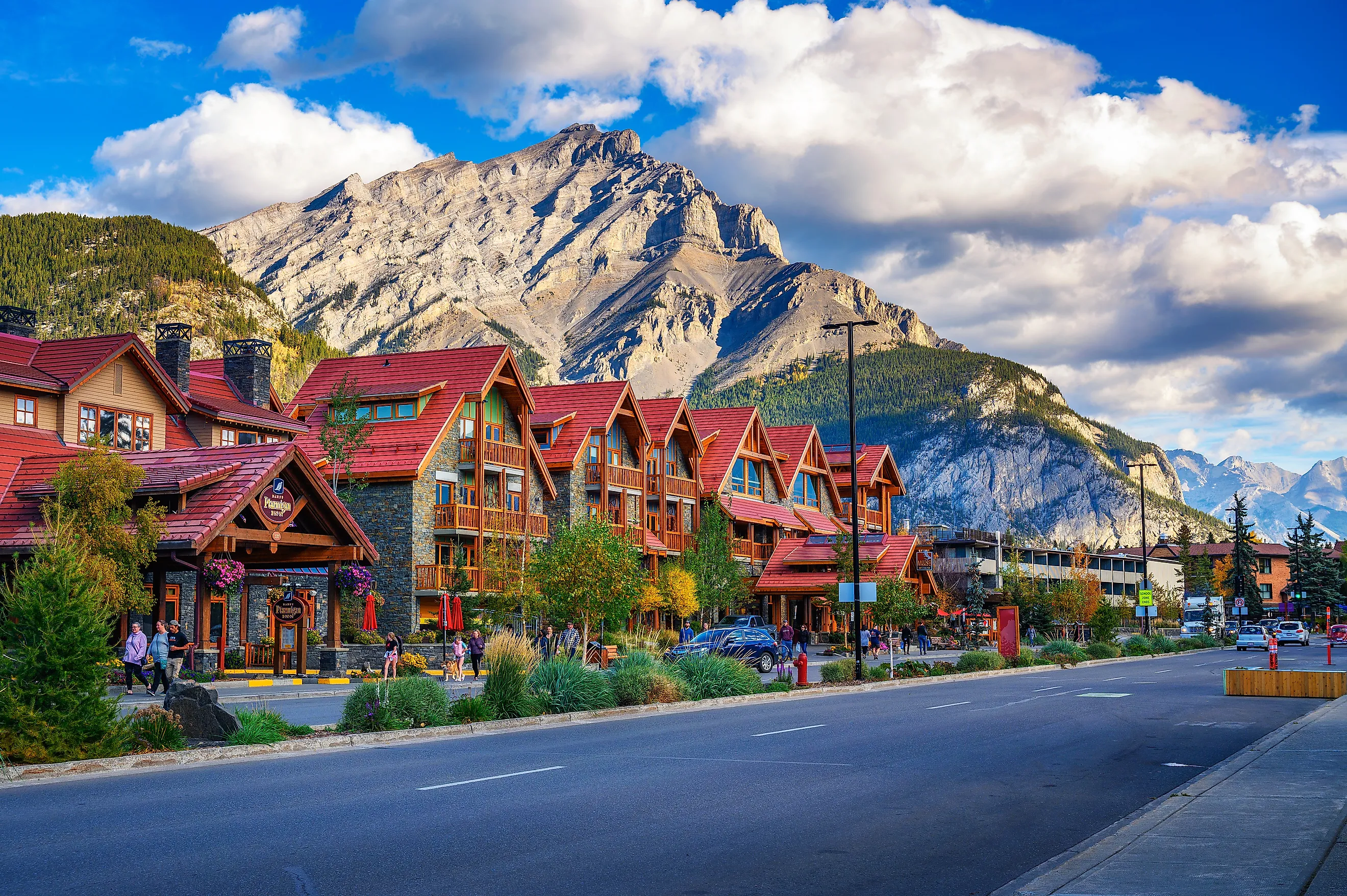
Banff is not a gateway town pressed against a park entrance. It is the park town itself, a municipality of more than 8,000 permanent residents tucked into the Bow Valley and surrounded on every side by Banff National Park. The townsite covers only a small fixed footprint inside Canada's oldest national park, established in 1885 after hot springs near Sulphur Mountain drew national attention and helped launch the country's park system. Banff incorporated as a municipality in 1990, becoming the first community in Canada to do so inside a national park, but growth remains tightly controlled by federal park rules. Visitors arrive by the millions for Banff Avenue, the Cave and Basin National Historic Site, the Banff Upper Hot Springs, and the castle-like Fairmont Banff Springs, while residents live with an everyday backdrop of elk on side streets, avalanche paths above town, and peaks rising straight from the end of the block.
Jasper, Alberta: Jasper National Park

Jasper sits where the Athabasca and Miette River valleys meet, a railway-born mountain town enclosed by Jasper National Park, the largest national park in the Canadian Rockies. The name reaches back to Jasper House, a fur trade post associated with Jasper Haws, and the modern townsite took shape after early twentieth-century rail lines pushed through the valley. Jasper became a specialized municipality in 2001, with local government sharing unusual authority with Parks Canada because every street, business, and backyard remains inside the national park boundary. Its roughly 5,000 residents support a year-round visitor economy built around Maligne Lake, the Icefields Parkway, Marmot Basin, and the historic Jasper Park Information Centre. The town's park-in-town identity became especially visible after the 2024 Jasper Wildfire, which swept through the Athabasca Valley, destroyed about 30% of structures in town, and left residents rebuilding in full view of the wilderness that defines their home.
Life Inside the Boundary Line
Each of these ten towns and settlements beat the boundary lines through luck, stubbornness, treaty rights, municipal compromise, or a homestead deed signed before the surveyors arrived. Wilsonia's cabin owners simply bought in early. The Nunamiut at Anaktuvuk Pass held ancestral ground that predates the very idea of a national park. Banff and Jasper show how Canada made room for full-service municipalities inside landscapes managed first for national preservation. Their reward is a front porch view most travelers spend thousands to glimpse for a single week. Next time a park map shows a tiny cluster of streets in a sea of green, remember that somebody gets their mail there every day.