This Illinois Town Instantly Transports You To The Past
If you've ever pulled up a photo of a tiny Midwestern town and thought, "There's no way it really looks like that," Galena will prove you wrong. With a population of just over 3,300, this small northwest Illinois town is tiny by city standards, but its historic district feels surprisingly grand, like someone preserved a whole 19th-century commercial hub under glass.
The first time you walk across the pedestrian bridge from Grant Park and see downtown spread out along the Galena River, it doesn't feel like arriving in the Midwest at all. It feels like stepping into an old engraving. On one side, the water curls quietly past; on the other, brick buildings in shades of rust and cream stand shoulder to shoulder, most dating back to the 1800s.
And Galena isn't alone. Later on, we'll look at other Illinois towns such as Geneva and Woodstock, along with a few national counterparts, that share this same frozen-in-time energy. But Galena is the one that hooks you first.
Stepping Into Yesterday in Galena, Illinois

Galena's past is literally built into its name. The word refers to a form of lead ore that Indigenous peoples mined here long before European Americans arrived; once white settlers realized how rich the deposits were, this bend in the river turned into a frontier boomtown. By the mid-1800s, Galena was a major port on the Upper Mississippi Valley, a place where steamboats stacked with cargo and passengers lined up along the riverfront.
Those boom years paid for the elegant architecture visitors now come to admire. A 581-acre swath of town is listed as the Galena Historic District, which means that as you walk downtown you're surrounded by original 19th-century buildings, no faux-vintage replicas, just the real thing carefully restored.
Galena also has a presidential claim to fame. Ulysses S. Grant moved here in 1860 to work at his family's leather goods store, left to fight in the Civil War, and returned as a national hero. Today you can tour the U.S. Grant Home, where rooms are furnished as they would have been when the future 18th president entertained guests and looked down over the same streets you're walking.
Walking a Main Street That Still Looks Like the 1800s

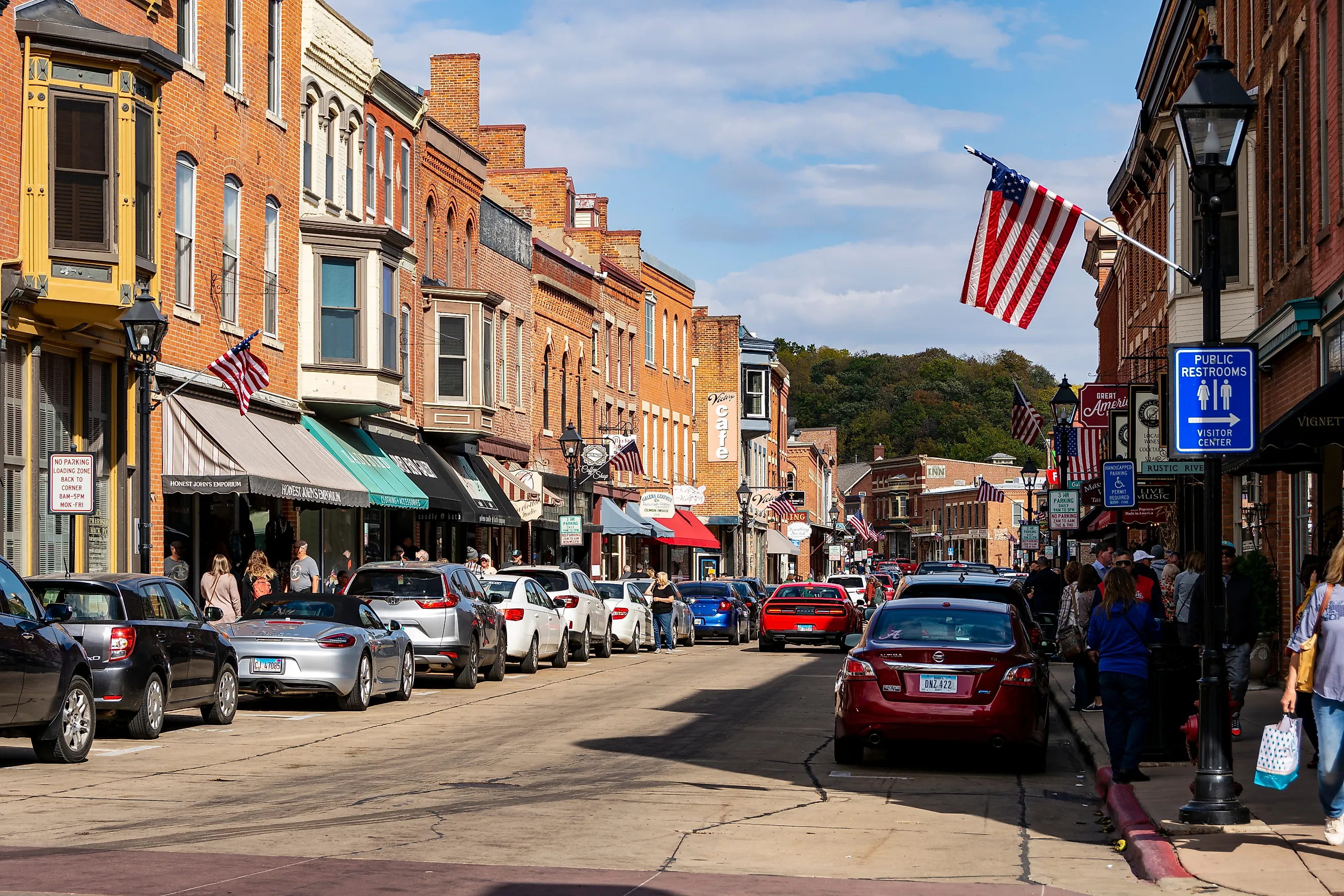
Galena's Main Street is where most visitors fall in love for good. It's a gently curving, almost canyon-like street framed by three- and four-story brick buildings whose cornices and arched windows seem designed for close-up admiration. Many of these buildings now hold more than 125 shops and restaurants, but their bones are unchanged, which is why they photograph so well.
Walk it slowly. Step into a candy store perfumed with caramel where taffy is pulled behind a glass window or browse a bookstore with creaky floors and shelves tucked into brick alcoves. On North Main, Goerdts' Brewhaus has become the essential stop, a Bavarian-style brewpub pouring its own craft beers and barbecue while carrying on Galena's 19th-century brewing tradition, when the town supported nine breweries. The current incarnation pours small-batch beers just a few doors down from antique shops and boutiques.
Even the accommodations keep you rooted in the past. The DeSoto House Hotel, which opened in 1855 and calls itself Illinois' oldest operating hotel, still anchors Main Street. Its lobby staircase and high-ceilinged ballroom feel like they should be filled with hoop skirts and brass bands, yet upstairs you find comfortable, updated rooms.
From Lead Mines to Limestone Walls: Galena's Oldest Corners

To really feel the town's age, you need to leave Main Street for a moment and seek out the places where Galena was born. One of the most evocative stops is Dowling House, a limestone structure built in 1826-27 and widely regarded as the town's oldest building. The Dowling family lived upstairs while the ground floor served as a trading post, the only one for quite a distance in those early days.
Today, stepping through its low doorway feels like stepping into the 1820s. The rooms are furnished with period pieces: simple wooden tables, narrow rope beds, and a reconstructed trading counter that lets you picture fur trappers and miners negotiating over supplies. Docents walk you through the house's stories, from John Dowling's role in early town politics to the building's later decades of abandonment and eventual rescue in the 20th century.
Food, Views, and Staying the Night

For a different angle on town, cross the pedestrian bridge to Grant Park. This small, elevated park gives you that classic Galena shot: the river in the foreground, brick rooftops stacked behind it, and church steeples poking up over the bluff.

Staying overnight is essential if you want to feel the town exhale after day-trippers leave. You can book a room at the DeSoto House and watch the last shoppers wander past your window, or choose a bed-and-breakfast in a restored 19th-century home up the hill, where front porches catch the evening breeze.
Moreover, the Belvedere Mansion shows the other side of Galena's 19th-century story. This Italianate mansion, built in 1857, is all about prosperity, ornate plasterwork, richly decorated rooms, and gardens that feel like a formal European estate overlooking the river valley.
Easy Trip Planning Tips for a Galena Getaway

Galena works beautifully as a long weekend, especially if you're driving from Chicago, Madison, or the Quad Cities. From Chicago, it's roughly a three-hour drive that shifts gradually from flat cornfields to unexpectedly hilly country as you approach Jo Daviess County, one of the most scenic corners of Illinois.
While Galena is a year-round destination, your experience changes with the season. Autumn is the showstopper, with blazing foliage framing the river and the bluffs, and it's when those Grant Park overlook photos practically compose themselves. Winter brings a more hushed kind of magic, especially when snow settles on Main Street balconies and the town leans into holiday lights. Summer is ideal if you want to combine in-town browsing with time on the Galena River Trail, an 8.8-mile path that follows an old rail line and offers long, peaceful views of town and countryside.
Other Towns That Feel Just As Timeless

Once Galena gets under your skin, it's hard not to look for other places that give you that same time-travel jolt. Within Illinois, Geneva is an easy next stop. About an hour west of Chicago on the Fox River, Geneva's historic downtown centers on Third Street, where Victorian houses have been converted into boutiques, chocolatiers, and restaurants. The Geneva Chamber describes the area as a shopper's paradise with more than a hundred specialty shops in historic storefronts and converted homes, and that's exactly how it feels when you wander past places like Livia Italian Eatery, which serves crafted Italian dishes inside a charming brick building just steps from the Metra station.

Farther northwest, Woodstock offers a different flavor of nostalgia. Its Victorian town square, framed by the Woodstock Opera House and the Old McHenry County Courthouse, is so cinematic that Hollywood literally turned it into the fictional Punxsutawney in the film Groundhog Day. The square still hosts festivals and, around February, walking tours of the movie's filming locations, so you can stand on the same corner where Bill Murray's character repeatedly bumps into Ned Ryerson and look up at the Opera House that doubled as a grand Pennsylvania hotel.

If you want to expand the theme beyond Illinois, you can easily build a road trip around small American towns with preserved cores and layered histories, places like Deadwood, South Dakota, with its restored Wild West main drag, or coastal cities such as Savannah and Charleston that pair cobblestone streets with deep, sometimes complicated histories. But Galena is a perfect starting point: compact, visually rich, saturated with stories, and instantly recognizable whether you're standing on Main Street in person or scrolling through a grid of photos that all look like they were taken a century ago.