9 Stunning Small Towns In Iowa
Some of Iowa's stunning small towns occupy the most magical settings, including cliff-draped waterfalls, century-old streetscapes, and lakeshores shimmering at the edge of the prairies. Towns like Decorah, crown forested bluffs of the Driftless Area, where Norwegian heritage runs deep. Others, like Winterset, unfold amid Madison County's rolling hills, their covered bridges lending cinematic charm. A few, like Arnolds Park, hug glacier-formed lakes, blending amusement-park nostalgia with vast summer skies. Across the state, several towns boast a sense of place so beautifully formed, it needs no embellishment.
Decorah

Decorah is a culturally layered small town built on Norwegian immigrant roots that still shapes life more than a century later. Vesterheim Norwegian-American Museum is complete with over 33,000 artifacts, including the 25-foot sailboat TradeWind and intricately carved folk art. Heritage Park, which sits on the grounds of the museum, holds 12 historic structures set within a landscaped woodland designed to echo Norwegian forests.
Decorah's parks deliver the kind of natural beauty that stops people in their tracks. Decorah Ice Cave State Preserve adds a geological surprise, where cool air seeps from a natural hillside formation even in the heat of summer. Water Street draws the eye with its 19th-century storefronts, now home to independent boutiques and warm brick facades that give the downtown its quiet charm.
The Trout Run Trail gives the town an extraordinary outdoor backbone, looping 11 miles through forested bluffs and river valleys. It offers breathtaking views of the Upper Iowa River.
Pella

Set in central Iowa, Pella was founded in the 1840s by Dutch immigrants, a heritage that shapes its downtown symmetrical brickwork and landmark structures. In the central square, the Klokkenspel (a Dutch carillon clock tower) rises with carved figures that appear at set intervals. Nearby, the Molengracht Canal cuts through downtown with a narrow European-style waterway where people can enjoy shopping and paddleboat rides. On Franklin Street, the Pella Opera House, a beautifully restored 1900 Victorian Romanesque Revival landmark, hosts live performances to this day.
The Pella Historical Village & Vermeer Windmill brings a cluster of preserved 19th-century buildings together, offering a vivid glimpse into the town's Dutch founding era. A majestic working windmill rises above the site and is visible from several surrounding streets.
Sunken Garden Park, near downtown, uses geometric planting beds and defined walkways where people can rest and unwind. West Market Park on Franklin Street adds broad lawns and a castle-style playground within a landscaped setting.
Dyersville

Dyersville in eastern Iowa is structured around a compact limestone downtown that meets open farmland at the town's edge. In that historic downtown, the Basilica of St. Francis Xavier rises above surrounding blocks with twin Gothic spires, one of the most striking Catholic churches in the Midwest and a designated national basilica. The National Farm Toy Museum has displays tracing the history of American agricultural life. The Textile Brewing Company, set in a restored industrial building, is a lively spot to sample craft beers within the town's stone-and-brick streetscape.
Just beyond the edge of town, the landscape opens quickly into Iowa farmland, where one of the region’s most recognizable landmarks stand. Field of Dreams Movie Site opens into uninterrupted cornfields where visitors can walk the diamond and farmhouse made famous by the 1989 Kevin Costner film, a pilgrimage spot for baseball fans and movie lovers alike.
The town's outer boundary rewards those who venture beyond the center. The Heritage Trail follows a former rail corridor through trees and open countryside, offering walkers, runners, and cyclists a scenic and peaceful escape.
Winterset

Winterset is a historically layered town with a beautiful courthouse square, a historic theater, and connections to Hollywood fame. The Madison County Courthouse sits at the center of the square and is built of limestone, topped by a prominent central dome. Around it, the Iowa Theater and adjoining buildings form a historic character that defines the downtown core. Just off the square, the John Wayne Birthplace Museum preserves the modest home where the Hollywood icon was born in 1907, offering fans an intimate look at his early life.
Winterset also draws visitors as the setting of the novel and film The Bridges of Madison County. The Roseman Covered Bridge, about 8 miles southwest of town, is where some key scenes from the film were shot.
The town's parks add a quieter dimension to a visit. In Winterset City Park, the Clark Tower rises above layered woodland and stonework, rewarding those who climb it with sweeping views over the surrounding hills and tree cover.
LeClaire

LeClaire is a compact Mississippi River town where history, food, drink, and riverfront views come together within easy walking distance. The Cody Road Historic District forms the town's core with a continuous line of well-preserved 19th-century buildings along a narrow street grid. At the riverfront, the Buffalo Bill Museum combines frontier exhibits with a docked non-functioning wooden-hull steamboat The Lone Star, set against a wide, slow-moving river. A short walk away is the vintage shop Antique Archaeology, which was made famous by the History Channel's American Pickers. Visitors can browse an eclectic collection of vintage finds in its restored building.
Just off Cody Road, a cluster of drink and dining spots adds a relaxed river-town atmosphere. "Libation Lane" places the Wide River Winery, Green Tree Brewery, and Mississippi River Distilling Co. within a short, walkable run of closely spaced buildings.
LeClaire opens directly into broad Mississippi River views at the edge of town. About 4 miles downstream, Lock & Dam No. 14 offers a rare chance to watch massive river barges navigate through the lock system, set against long, open stretches of water and sky
Burlington

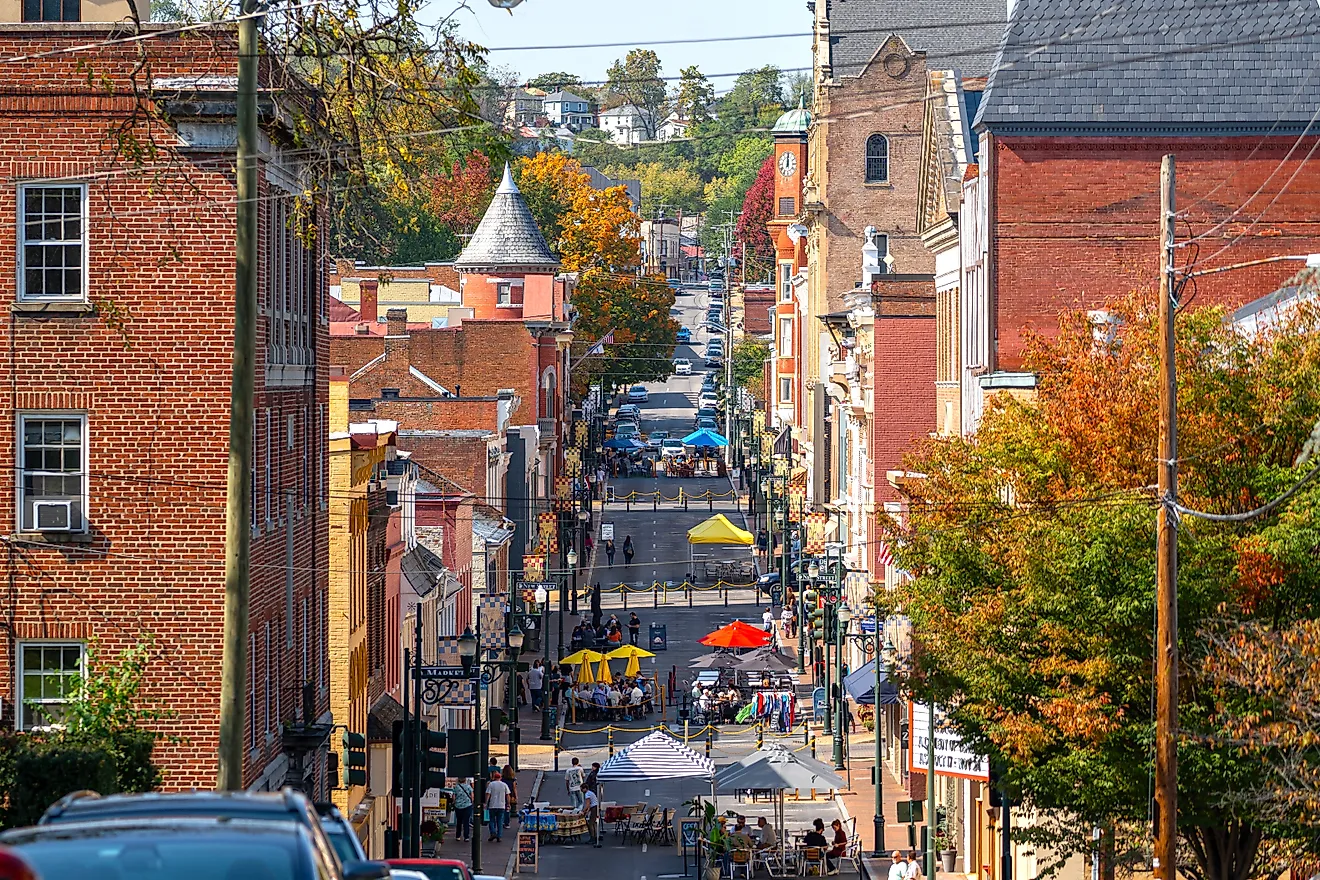
Burlington is a town of crooked brick streets, Victorian mansions, and Mississippi River bluffs that give it a dramatic, layered skyline. Snake Alley winds 275 feet down the bluff in a serpentine descent of five half-curves and two quarter-curves. It leads into the Heritage Hill Historic District, a dense collection of well-preserved 19th-century homes where ornate facades and period architecture line every block.
The town's history comes alive through two landmark buildings worth stepping inside. The Garrett-Phelps House Museum an 1851 Italianate mansion displays medical artifacts from its years as a hospital. The Capitol Theater, a restored 1930s movie palace, still glows with its original marquee and hosts live performances downtown.
Crapo Park stretches along the Mississippi riverbank, giving people a place to bike, walk, and picnic with sweeping river views. A manicured arboretum and ornamental gardens run through the park alongside open Mississippi panoramas.
Elk Horn

Elk Horn is a prominent rural Danish settlement in the United States, and its windmill and restored homes make that imprint tangible at every turn. A restored 1848 windmill, dismantled in Nørre Snede, Denmark, shipped across the Atlantic, and rebuilt by 300 volunteers in 1976, rises above the town's rooftops. The Danish Windmill complex also holds the tiny Morning Star Chapel and VikingHjem, a sod-roofed replica of a 900 AD Viking smithy's home complete with a blacksmith shop and living quarters.
The town preserves its Danish immigrant history through museums and homes. The Museum of Danish America traces the Danish immigrant experience through thousands of artifacts. A few blocks away, Bedstemor's House is a beautifully preserved 1908 Danish-American home furnished exactly as it would have appeared when a young immigrant family lived there.
Elk Horn's prairie landscape unfurls in timeless beauty, woven with indigenous vegetation. The Jens Jensen Prairie Landscape Park wraps around the Museum of Danish America with 30 acres of recreated native Iowa prairie.
Guttenberg

Guttenberg stretches along the Mississippi River where German settler heritage, limestone bluffs, and waterfront scenery grace the town. The Guttenberg Historic River Walk threads past public art, riverside gazebos, and sweeping river views that change character with every season. The town preserves its 19th-century German footprint through a concentration of historic structures that rewards careful attention.
The Guttenberg Fish Hatchery and Aquarium, a free attraction right on the waterfront, brings you face to face with catfish, walleye, snapping turtles, and other Mississippi River wildlife. Lock & Dam No. 10 cuts across the Mississippi in spectacular fashion, and beside it stands the last remaining lockmaster's house on the Upper Mississippi River, now open as the Lockmaster's House Heritage Museum.
The town saves striking scenery for its edges. The Big Springs Nature Area just north of town sends a cold-water spring cascading over 100 feet down bedrock shelves through the Driftless Region of its 11-acre wooded canyon.
Arnolds Park

Arnolds Park is on the glacially carved, mirror-still shores of West Lake Okoboji, and its combination of sparkling blue water, vintage amusement rides, and frontier history gives it a personality entirely its own. The Arnolds Park Amusement Park has graced this lakeshore since 1889. Its 1930 wooden roller coaster The Legend, freshly retracked and running smooth, rattles above the lake with a nostalgic thunder that carries across the glittering, open water.
The town holds a frontier past as gripping as any in the state. The quietly captivating Iowa Great Lakes Maritime Museum near the amusement park traces over a century of lake navigation and boatbuilding through restored wooden vessels and archival photographs.
Where Beauty Holds Its Ground
Some of Iowa's towns hold a striking mix of beauty, history, and cultural depth. Decorah combines waterfalls and Norwegian influence within limestone river valleys that feel unchanged over time. Elk Horn reassembled an authentic Danish windmill shipped from Denmark and made it part of the town's identity. Burlington sets crooked brick streets and Victorian homes along Mississippi bluffs with striking confidence. Taken together, these towns highlight Iowa's most stunning places.