9 Prettiest Main Streetscapes In Nevada
Beyond the bright lights of the Vegas Strip, Nevada's small towns are home to some of the prettiest streetscapes in the state, where the main street still does what it always has: it tells the story of the people who live there and those who came before. These are places shaped by mining booms, railroad stops, cattle drives, and long desert roads, with brick storefronts that lean slightly with age, and saloon doors that are still functional, rather than decorative. Some streets feel frozen in time, others quietly adapt, but all of them reward a slow walk and a curious eye. From silver-rush strongholds like Eureka, Tonopah, and Virginia City, to railroad towns like Caliente backed by mountains, these nine Nevada main streetscapes prove that a town's inherent beauty lies in its history, good bones, and unique sense of place.
Caliente

Caliente’s main street is appealing because it feels largely unchanged, staying true to its railroad roots rather than catering to tourists. Low desert hills frame the street, and the historic Caliente Railroad Depot immediately draws the eye. Built in a Mission Revival style, the depot’s arched windows and red-tiled roof give the street a strong sense of character and make it one of the most distinctive buildings in southern Nevada. The town itself sits almost exactly halfway between Los Angeles and Salt Lake City, which historically made it an important stop on the rail line connecting the two cities. Today, the depot serves as Caliente's Town Hall.
Right beside the depot, the Caliente Heritage Box Car Museum adds even more texture to the streetscape. Housed in a collection of vintage boxcars with Union Pacific and Amtrak memorabilia inside, the museum tells the story of the town’s heyday as a bustling rail hub and gives travelers something truly unique to explore right on the main drag. From there, the street unfolds with a small collection of brick storefronts. The spacing between buildings, open sidewalks, and lack of visual clutter make it easy to take in the details and the surrounding landscape. Grab a bite at Knotty Pine Restaurant and Lounge, located just across from the depot with country cooking, cold beer, and gaming tables, and for a bit of recreation, head slightly out of town to Kershaw-Ryan State Park, where shaded picnic spots meet desert canyon trails.
Ely

Ely’s Aultman Street features brick buildings, vintage signage, and murals that give the downtown a sense of continuity rather than a polished urban feel. The street serves daily needs, yet its historic details remain visible. The 100-year-old Hotel Nevada & Gambling Hall, once the tallest building in Nevada and still the tallest in town, stands out immediately, while smaller storefronts and local businesses line the street around it.
Art and heritage are woven directly into the atmosphere through more than 20 murals and sculptures scattered throughout downtown. These works are tied together and accessible by the self-guided Ely Mural Walking Tour, which encourages visitors to explore the streets on foot. The Renaissance Village, a cluster of restored early-1900s cabins representing the town’s diverse immigrant past, lies just off the main drag and adds cultural depth to a stroll through town. Meanwhile, at the Nevada Northern Railway Museum, restored locomotives and railcars reflect the role rail once played in shaping the town.
Eureka

Eureka sits along US Route 50, often called the Loneliest Road in America, and its main street was built to serve a booming mining town. During the late 19th century, silver and lead mining made Eureka one of Nevada’s most important cities, and Broad Street developed with substantial stone and brick buildings to match that prosperity. Many of those structures remain, giving the downtown a well-preserved Old West look and feel.
Two landmarks define the street. The Jackson House Hotel, dating back to 1877, is one of the oldest operating hotels in Nevada and still functions much as it always has, with rooms featuring period furnishings, like claw-foot tubs. Nearby, the Eureka Opera House is one of the best-preserved historic theaters in the state and continues to host concerts, plays, and community events. The Eureka Sentinel Museum, housed in the former newspaper office, adds context with antique printing presses, mining artifacts, and photographs that help explain how this remote town once played an important role in Nevada’s history.
Genoa

Genoa’s downtown feels like a preserved slice of 19th‑century Nevada, where historic buildings and simple façades give the town an authentic Old West vibe. Many of the wood and stone structures along the main thoroughfare date back to the era when Genoa was a trading post and stagecoach stop on the Carson Route of the California Trail. The town’s origins can be traced to Mormon Station, Nevada’s first permanent settlement, and today, a reconstructed trading post and state park with an interpretive site invite exploration.
The Genoa Courthouse Museum, housed in the former territorial courthouse, offers a window into pioneer life with engaging exhibits on local government and early settlers. Across the street, the Genoa Bar & Saloon, Nevada’s oldest continuously operating bar, features Old West memorabilia, vintage décor, and a pool table, giving visitors a tangible sense of the town’s frontier past. Seasonal events like the Candy Dance, a century‑old festival that began as a fundraiser to install streetlights, draw thousands for arts and crafts, food, and live music. Each fall, the event turns Genoa’s main street into a lively marketplace, celebrating the town’s history and community spirit.
Goldfield

Goldfield grew rapidly during a gold rush that began in 1902, quickly becoming one of Nevada’s largest and most prosperous mining towns. Its main street still shows traces of that boom with brick façades, historic storefronts, and weathered buildings that hint at its bustling past. The Goldfield Hotel, built in 1907, dominates the streetscape, a lasting reminder of the town’s brief but intense wealth.
Other historic landmarks along the main drag include the Esmeralda County Courthouse, also built in 1907 and still in use, and several original office buildings and schools from the mining era. Visitors can download a booklet and map to follow a self-guided historic walking tour that highlights nearly 200 sites around town. Goldfield also has unique contemporary touches. Rocket Bob’s Art Cars, decorated with trinkets and found objects, add unexpected color to the main street, and a short drive out of town brings you to the International Car Forest, where vehicles are planted in the desert as outdoor sculptures.
Tonopah

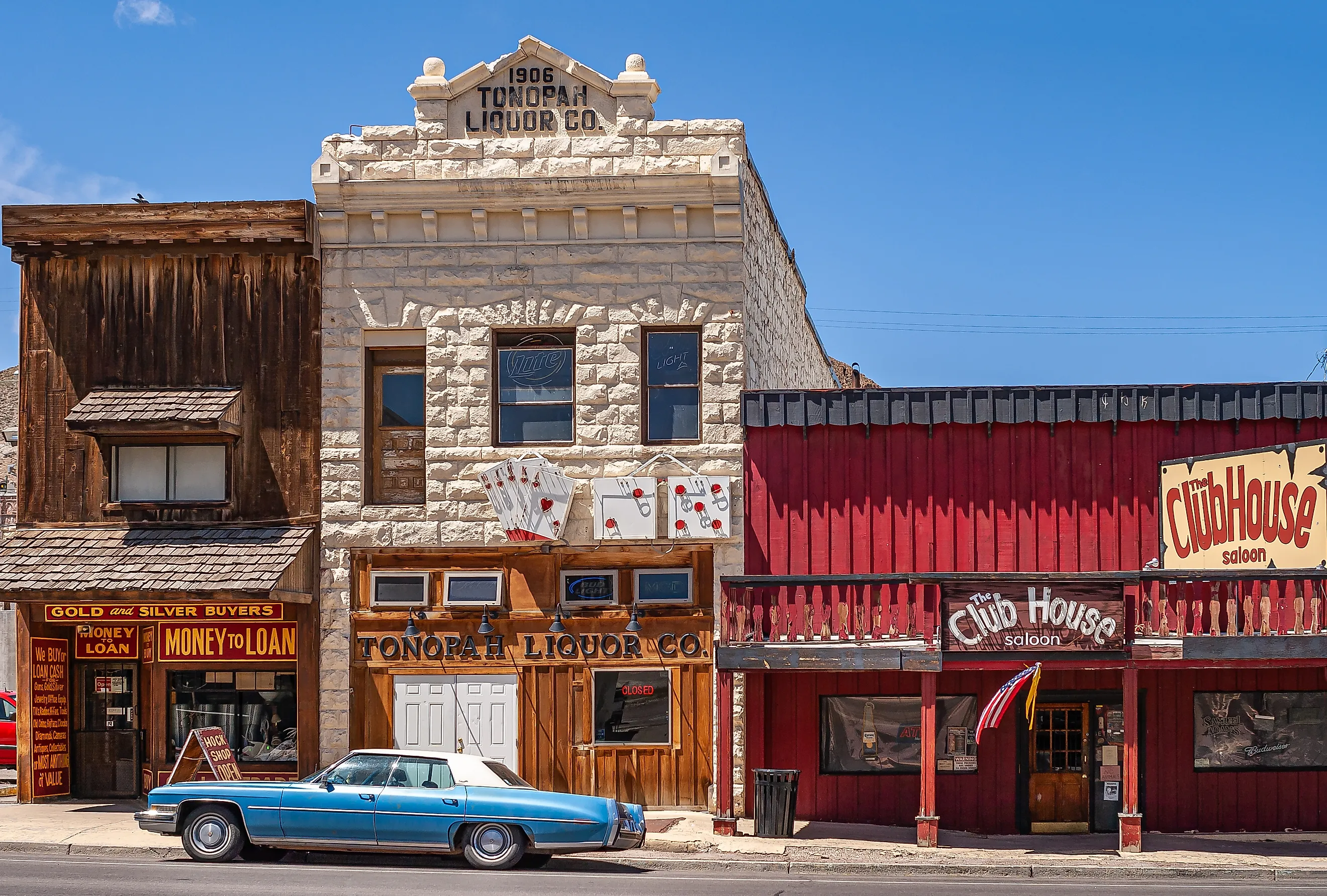
When silver was discovered in 1900, Tonopah transformed from a desert outpost into one of Nevada’s liveliest mining towns. The main street still carries echoes of that era, with early 20th-century landmarks like the 1906 Tonopah Liquor Company Building and the H.A. McKim Building, built the same year and once home to the largest store in Central Nevada. Visitors can feel the energy of the boom years as they explore these surviving commercial spaces, many of which retain original architectural details.
At the heart of downtown stands the Mizpah Hotel, which opened in 1907. At five stories, it was Nevada’s tallest building at the time, later surpassed by Ely’s Hotel Nevada & Gambling Hall, and today it remains a centerpiece for visitors seeking a bit of history and vintage charm. A short walk brings you to the Central Nevada Museum, where mining tools, pioneer artifacts, and local stories bring the town’s past to life. For a quirky detour, the Clown Motel, located next to the old Tonopah Cemetery, adds a bit of humor to the mix, and nearby, the Tonopah Historic Mining Park lets visitors explore preserved shafts, equipment, and sweeping desert vistas that recall the mining boom.
Virginia City

Virginia City’s 150-year-old main street, C Street, looks and feels every bit its age. Boardwalk‑style sidewalks and façades rebuilt after the Great Fire of 1875 give the street a lived‑in Wild West character that hasn’t been smoothed over. Many of the buildings standing today date from that reconstruction era and host a lively mix of historic saloons, restaurants, and shops. Saloons, in particular, are a central part of the street’s personality. The Bucket of Blood, Delta, and Silver Queen Hotel saloons all combine genuine 19th‑century history with modern food, drinks, and live music.
Also on the main drag, handcrafted sweets and treats at Grandma’s Fudge Factory and old‑time photo studios like Silver Sadie's and Priscilla Pennyworth's offer playful detours that feel right at home among the historic storefronts. For a deeper dive into local history, the Fourth Ward School Museum preserves a rare four‑story wooden schoolhouse from 1876, and a network of small museums and guided tours spreads the story of the Comstock Lode across town.
Winnemucca

Located roughly halfway between San Francisco and Salt Lake City, Winnemucca has long served as a natural crossroads in northern Nevada, and its downtown reflects the generations of travelers, traders, and locals passing through. Bridge Street forms the historic core of downtown, where early banks, mercantiles, and hotels clustered near the Humboldt River. Buildings like the Turin-Brown Mercantile, dating to 1898, with the original building still serving as a business, give this stretch a strong sense of continuity. Nearby, the site of George Nixon’s First National Bank recalls the town’s brush with outlaw lore during a 1900 robbery linked to Butch Cassidy’s Wild Bunch.
The landmark Martin Hotel remains a fixture of Railroad Street. Once a rooming house for sheepherders working in the surrounding mountain ranges, the Basque restaurant still offers the same hearty, family-style meals it has been serving for generations. Nearby cafés, casinos, and small shops line Winnemucca Boulevard, creating a stretch that feels busy and functional without losing its local character. Just north of downtown, the Humboldt Museum adds broader context with self-guided exhibits on Indigenous history, railroads, mining, and regional fossils.
Yerington

As the seat of Lyon County since the early 20th century, Yerington’s Main Street developed around government, commerce, and community gathering, where broad sidewalks and low historic buildings open onto long views of the surrounding farmland and distant hills. The Lyon County Courthouse, a Beaux-Arts building constructed in 1911‑12, has a stately presence, with classical columns in a park-like setting, while the nearby Post Office, built in 1939, remains a Depression-era landmark and features the mural Homestead on the Plain, one of only three US Post Office murals created in Nevada.
Social life centers on Dini’s Lucky Club, one of Nevada’s oldest family-owned casinos, where locals gather for food, drinks, and a bit of play. Further down the main drag, the Lyon County Museum showcases pioneer artifacts, and the Yerington Theater for the Arts, housed in the restored Yerington Grammar School, hosts performances and exhibitions that bring history and culture to life.
Exploring Nevada’s small towns reveals a state where history and everyday life coexist against wide desert valleys, mountain backdrops, and stretches of open sky. Main streets here reflect the legacy of mining booms, railroad hubs, and agricultural centers, yet each retains its own rhythm and character. Even modest streets carry a sense of purpose and identity, offering a window into the resilience and continuity that define Nevada’s towns decades after the mining and railroad booms that built them.