10 Offbeat West Virginia Towns To Visit In 2026
A 12-foot steel cryptid greets visitors at the edge of Point Pleasant. That sets the tone for West Virginia's offbeat towns. Helvetia burns an effigy of Old Man Winter every winter in a Swiss festival the Alps would recognize. Moundsville grew up around a 2,000-year-old burial mound and a shuttered Gothic prison across the street. Bramwell once held more millionaires per capita than any town in the country. Each of these places earns its strangeness through coal or rivers or stubborn local memory.
Matewan

On May 19, 1920, a shootout on Matewan's main street left ten people dead, including the town's pro-union mayor, and turned this Tug Fork coal town into the flashpoint of the West Virginia Mine Wars. The Battle of Matewan pitted local miners against private detectives hired to evict union families, and it set off a chain of events that ended at the Battle of Blair Mountain a year later. The West Virginia Mine Wars Museum, opened in 2015 in the downtown historic district, tells that story with artifacts and firsthand accounts. The brick storefronts along the thoroughfare still stand, though these days the foot traffic competes with riders fresh off the nearby Hatfield-McCoy Trails, the ATV network named for the feud that also ran through this corner of the state.
Helvetia

Swiss and German immigrants settled Helvetia in 1869, and the Randolph County village has held onto that heritage in a way few American towns manage. The clearest display is Fasnacht, the pre-Lenten celebration held the Saturday before Ash Wednesday, when masked revelers parade through town and the night ends with the ceremonial burning of an Old Man Winter effigy. Outside festival season, the draw is quieter: traditionally painted buildings, an Alpine-Appalachian square dance at the Community Hall, and the aptly named Cheese Haus. Getting here means a long drive on mountain roads with spotty cell service, which is part of why the place has stayed itself.
Thurmond

Thurmond is what a railroad boomtown looks like a century after the boom. Set along the New River inside New River Gorge National Park and Preserve, the town moved enormous tonnage of coal in its heyday and counted hundreds of residents. Today the year-round population is in the single digits. The 1904 Thurmond Depot survives as the centerpiece, restored by the National Park Service into a visitor center with exhibits on the coal-and-rail era that built and then abandoned the place. Even when the depot is closed, the gorge is not, and the town makes a quiet base for whitewater trips and the cliffside trails above the river.
Point Pleasant

Point Pleasant built a tourism economy on a winged monster. Between 1966 and 1967, residents reported sightings of a red-eyed creature near an old World War II munitions site north of town, and the Mothman legend was born. The Mothman Museum downtown catalogs the eyewitness accounts and props from the 2002 film, and out front stands a 12-foot stainless steel statue that artist Bob Roach unveiled in 2003. It has become one of the most photographed landmarks in the state.

The town's older history runs deeper than its cryptid. Point Pleasant sits at the confluence of the Kanawha and Ohio rivers, a strategic meeting point for centuries. On October 10, 1774, Virginia militia under Colonel Andrew Lewis defeated a Shawnee and Mingo force led by Chief Cornstalk here in the Battle of Point Pleasant, the major engagement of Lord Dunmore's War. A local tradition holds it up as the first battle of the American Revolution, though most historians treat that as folklore rather than fact. Tu-Endie-Wei State Park and a granite obelisk mark the ground today.
Moundsville

Grave Creek Mound is the reason Moundsville has its name. The Adena people raised the conical earthwork between roughly 250 and 150 BC, moving more than 57,000 tons of soil to build what is now one of the largest mounds of its kind in the country, 62 feet tall and 240 feet across. The adjacent Delf Norona Museum interprets the finds and the culture that left them. Directly across the street looms the other half of Moundsville's reputation: the West Virginia Penitentiary, a Gothic Revival prison that operated from 1876 until it closed in 1995 and now runs history tours and overnight ghost hunts. The town fills in around these two landmarks with everyday Main Street life and older buildings like the restored Strand Theatre.
Bramwell

At the turn of the 20th century, Bramwell reportedly held more millionaires per capita than any town in America, somewhere between thirteen and seventeen of them at its peak. The coal barons of the Pocahontas field banked their fortunes at the Bank of Bramwell and built mansions along the Bluestone River, and many of those houses still line the brick streets. Guided walking tours run in spring and at Christmas, with interpreters telling the stories behind the Thomas, Hewitt, and Mann homes. The town has not modernized much, which is part of its appeal, and its narrow grid now doubles as an ATV-friendly gateway to the Pocahontas and Hatfield-McCoy trail systems.
Cass

Cass was a company town built around lumber, and its old Shay locomotives still climb the mountain. At Cass Scenic Railroad State Park, the same geared engines that once hauled timber to the mill now carry passengers up to Bald Knob, one of the highest points in the state, on grades steep enough to make the climb an event in itself. The restored company store sells souvenirs where it once sold goods to mill workers on credit, and the surrounding village preserves the worker housing and the history of an industry that shaped the region. For a more recent slice of the past, Shay's Restaurant and Soda Fountain leans into 1950s Americana.
Berkeley Springs

Where much of this list runs on coal, Berkeley Springs runs on water. Warm mineral springs bubble up at a constant 74 degrees here, and people have come to soak in them since colonial times, which is why the town bills itself as America's first spa. The bathhouses at Berkeley Springs State Park sit in the center of town, alongside a stone basin labeled George Washington's bathtub, a modern monument to the future president's repeated visits rather than the actual tub he used. Up on the hill above the park sits the Berkeley Springs Castle, a Norman-style stone house from the 1880s, and the Ice House Arts Center anchors a small but real arts scene downtown.
Harpers Ferry

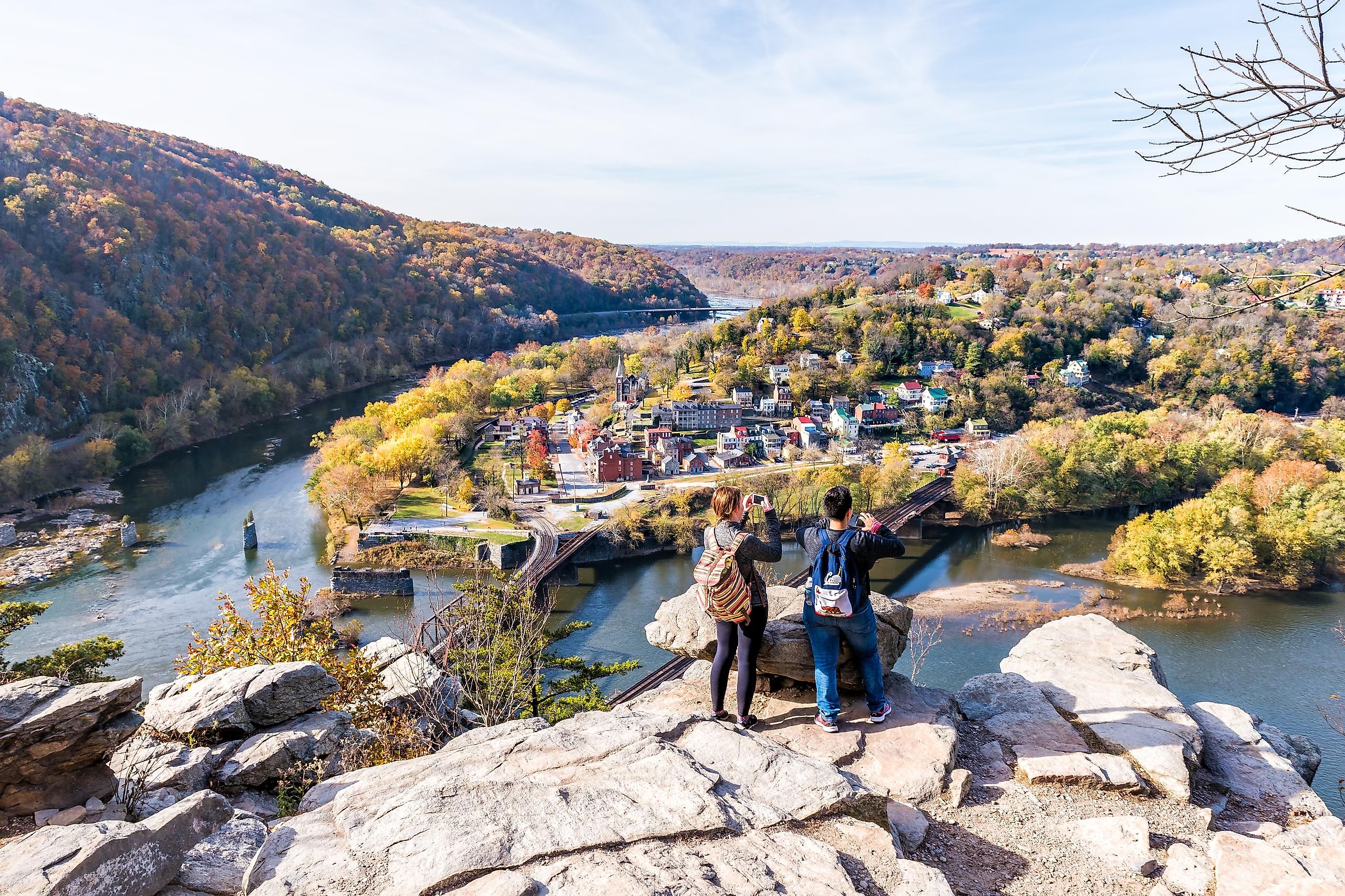
Most of West Virginia's lowest point is a ghost town the National Park Service decided to keep. Harpers Ferry sits at the confluence of the Potomac and Shenandoah rivers, where West Virginia, Maryland, and Virginia meet, and the lower town that floods kept wrecking through the 20th century was never rebuilt as a living place. After the 1936 flood crested more than 18 feet above flood stage, the surviving stone-and-brick storefronts were folded into Harpers Ferry National Historical Park instead, so the streets a visitor walks now are a preserved 19th-century industrial town with almost no permanent residents. Fewer than 270 people live in the actual incorporated town. On October 16, 1859, the abolitionist John Brown seized the federal armory here in a doomed bid to arm an uprising against slavery. He was cornered in the armory fire-engine house, captured by US Marines under Colonel Robert E. Lee, and hanged weeks later, and the raid is widely counted among the sparks of the Civil War. That engine house, since moved and rebuilt, still stands as John Brown's Fort.
The stranger history sits up the hill, away from the crowds. Storer College opened on Camp Hill in 1867 to educate formerly enslaved people and grew into one of the region's few colleges open to Black students before closing in 1955; its buildings survive under the Park Service. In 1906, W.E.B. Du Bois brought the Niagara Movement here for its first meeting on American soil, and the civil rights campaign that gathered at Storer became a forerunner of the NAACP. Just downhill, the headquarters of the Appalachian Trail Conservancy marks what thru-hikers treat as the trail's psychological midpoint, where they stop to have their photo taken on the porch. For the industrial ruins, the trails out to Virginius Island lead through the foundations of a vanished mill village the floods erased.
Thomas

Thomas traded coal and lumber for art and music. The industries that built this small Tucker County town have largely moved on, and what filled the vacuum was a creative community centered on a single block of Front Street. The Purple Fiddle is the anchor, a music venue and cafe that books regional and touring acts for all ages and draws crowds far larger than the town's population. Galleries and studios occupy the brick storefronts along Front and East avenues. The setting still does heavy lifting, too: Blackwater Canyon and Douglas Falls sit just outside town, close enough that a gallery afternoon and a waterfall hike fit in the same day.
The Common Thread Through West Virginia's Oddities
What links these towns is not scenery but the way each one turned an industry or an accident of geography into an identity. Matewan and Bramwell carry the weight of the coal years in opposite directions, one through labor history and one through inherited wealth. Point Pleasant and Moundsville built attractions out of legend and prehistory. Cass and Thurmond preserve the railroads that made them and then left, and Harpers Ferry preserves the rivers and the raid that put it in the history books. Visit a few in sequence and the state's larger story, of extraction, boom, bust, and reinvention, reads clearly in miniature.