9 Offbeat Alaska Towns To Visit In 2026
Alaska's offbeat towns reward visitors willing to move past the cruise ports and well-worn highway corridors. Whittier is reachable only through a mountain tunnel shared with freight trains. Palmer produces cabbages that exceed 90 pounds. Seldovia has no road connection to the state highway system at all. Utqiagvik is the northernmost place in the United States and is reachable only by air. The nine towns ahead each show a stranger, more specific side of small-town Alaska.
Utqiagvik

Overlooking Utqiagvik, Alaska.
Utqiagvik is the northernmost city in the United States and one of the most geographically isolated communities in North America. It sits above the Arctic Circle on the edge of the Arctic Ocean. It is only reachable by air. The town experiences polar night, roughly 65 consecutive days of darkness each winter and a similar stretch of midnight sun in summer. It is one of the premier places in Alaska to observe the aurora borealis.
Sea ice covers the Arctic Ocean shoreline from around October through June. If you time it accordingly, you can walk to the water's edge across frozen ground. Utqiagvik is also home to a significant Iñupiat community whose traditions are found nowhere else in the state. This includes the spring whaling festival, Nalukataq. It features the blanket toss, a practice rooted in the community's whaling heritage, along with traditional drumming and dance ceremonies.
The town also holds one unlikely culinary distinction: a Japanese restaurant called Osaka Restaurant. Some sushi reviewers describe it as competitive with anything found in larger Alaska cities, a remarkable claim for a community this far from the nearest supply chain.
Glennallen

Glennallen, Alaska Texaco. Editorial credit: Wikimedia Commons
Glennallen's offbeat nature comes from its role as a highway junction with a deeper Alaska story. The town sits at the junction of the Glenn and Richardson Highways. It has long functioned as a supply stop and staging point rather than a destination. Its population reflects two distinct eras: Jesuit missionaries and settlers who arrived with the opening of a church school in 1956, followed by pipeline workers who moved in during the late 1970s to support construction of the oil line from Prudhoe Bay to Valdez.
The contrast between those two groups is still visible in the town's mix of churches and roadhouses that line the highway. Mount Drum, a dormant volcano rising to 12,010 feet, is 25 miles to the east and is part of the Wrangell volcanic field. It also includes Mount Sanford, Mount Blackburn, and the still-active Mount Wrangell. The local visitor center preserves an Ahtna Native place name map tracing the Indigenous geography of the surrounding Copper River Watershed.
Talkeetna

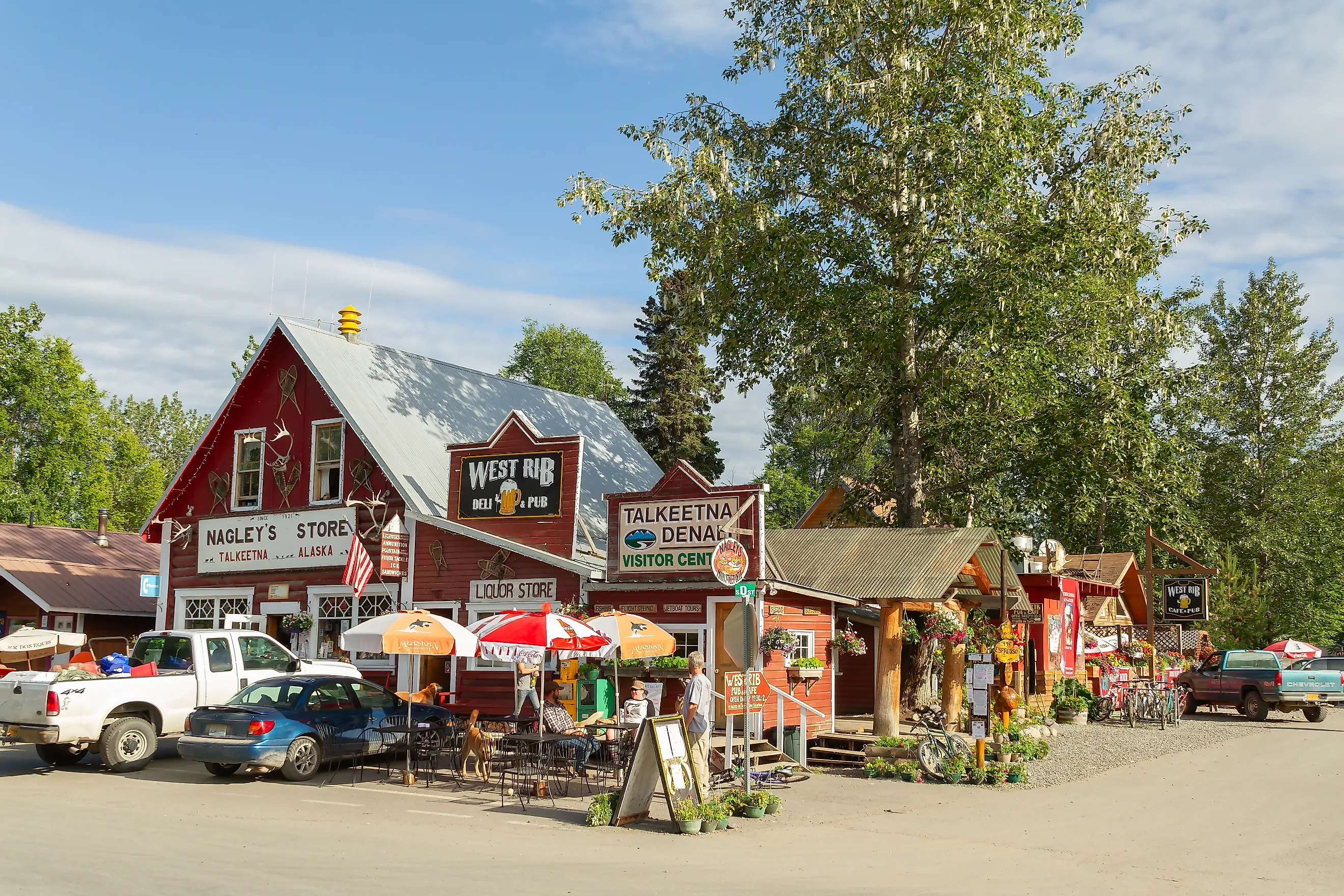
Talkeetna, a community of around 800 residents, is one of Alaska's most genuinely eclectic small towns. The town sits at the confluence of the Talkeetna, Susitna, and Chulitna Rivers. It serves as the primary staging and registration point for mountaineering expeditions headed to Denali. Climbers fly from Talkeetna directly onto the Kahiltna Glacier, which forms the base of the standard route up the 20,310-foot summit.
The town also gained international attention when a cat named Stubbs served as its honorary mayor. The story is documented as one of the town's most recognized conversation starters. Nagley's General Store, open since 1921, features a wall covered in dollar bills left by travelers over the decades.
Palmer

Palmer Visitor Information Center and a view of the Chugach Range in Palmer, Alaska.
Palmer is a significant agricultural town in Alaska, known for the oversized vegetables produced in the Matanuska Valley each summer. The midnight sun delivers nearly 20 hours of daylight in midsummer. Combined with the valley's fertile glacial soil, it allows cabbages to grow beyond 100 pounds. These are displayed competitively each year at the Alaska State Fair, drawing visitors who would otherwise have no reason to make the drive.
North of town, Hatcher Pass draws outdoor enthusiasts year-round with hiking, skiing, and snowshoeing across open alpine terrain. The pass also preserves the remnants of the Independence Mine, a gold operation active from the 1930s through the 1940s. It is now a state historical park.
Girdwood

Resort town of Girdwood, Alaska.
Girdwood is Alaska's dedicated ski town. It is positioned in a narrow valley that captures Gulf of Alaska storm systems. It produces some of the deepest annual snowfall of any resort in the United States. Alyeska Resort averages 650 inches of snowfall annually at its summit, a total that surpasses well-known destinations like Alta, Utah, and Jackson Hole, Wyoming.
In summer, the Crow Pass Trail begins near the resort. It covers 23 miles across the Chugach Mountains before ending at the Eagle River Nature Center. The town is compact enough that most services are within walking distance of the lifts.
Whittier

Whittier is accessible by a single road that passes through the Anton Anderson Memorial Tunnel (the largest combined rail and highway tunnel in North America). The tunnel is shared with freight trains, and entry and exit times follow a controlled traffic schedule. Fewer than 300 people live in Whittier. The majority of them live in a single 14-story building called Begich Towers. This tower also has a police station, a health clinic, a church, and a bed-and-breakfast.
Whittier is a gateway to Prince William Sound, which has the densest concentration of tidewater glaciers in the world. They are accessible by day cruise through Prince William Sound, where sea otters, harbor seals, and orca are regularly sighted.
Soldotna

Overlooking Soldotna, Alaska.
Soldotna's identity is built around the Kenai River, a glacially fed waterway recognized as one of the most productive king salmon fisheries in the world. The town is tied to the sport-fishing world record. A 97.25 pound chinook salmon was caught on the Kenai River in 1985. That record still stands.
Each summer, thousands of anglers line the riverbanks during the king salmon run. The Soldotna Visitors Center displays a replica of the record fish alongside exhibits on local fishing history. Mount Redoubt and Mount Iliamna, both active stratovolcanoes topping 10,000 feet, are visible across Cook Inlet on clear days.
Homer

Shops in Homer, Alaska.
Homer sits at the end of the Sterling Highway, the last town on the Kenai Peninsula reachable by road. It is a geographic endpoint that has historically drawn artists, commercial fishermen, and people committed to going as far as the road allows. The Homer Spit extends 4.5 miles into Kachemak Bay. It concentrates most of the town's commercial activity including charter fishing operations, galleries, seafood restaurants, and the Salty Dawg Saloon.
The saloon's log cabin structure dates to 1897. It has served as a post office, railroad station, grocery store, and coal mining office before becoming the bar it is today. The Center for Alaskan Coastal Studies runs guided low-tide walks along the bay, revealing sea stars, anemones, and intertidal invertebrates otherwise invisible at high water.
Seldovia

Seldovia, Alaska.
Seldovia has no road connection to the Alaska highway system. It is reached only by small aircraft or the passenger ferry that crosses Kachemak Bay from Homer. The town's population sits below 300, and its main pedestrian route is a one-mile wooden boardwalk that follows the waterline through the older section of town.
St. Nicholas Russian Orthodox Chapel, built in 1891, reflects Seldovia's history as a trading post that predates American ownership of Alaska. At low tide, Outside Beach yields agates that residents and visitors collect along the shore, a pastime specific enough to the community that the town's own visitors bureau showcases it.
Beyond the Standard Alaska Itinerary
These nine towns share a resistance to the standard Alaska itinerary. Some are difficult to reach, requiring a tunnel, ferry, or small plane. Others are defined by a single river, a record fish, a mountain pass, or a single building where most of the town lives. All of them reward those willing to move past the cruise ports and spend time in places still shaped more by residents than by visitor counts.