9 Most Walkable Town Centers In Minnesota
In Stillwater, Main Street runs a hundred shops down to a lift bridge over the St. Croix. The historic blocks of Red Wing, Winona, and Hastings all sit a short walk from the Mississippi. The downtown grid in Grand Marais sits on a Lake Superior harbor. In Lanesboro, the whole of downtown is wrapped in a single bend of the Root River. The best walk in these 9 towns is the same each time. It is a few downtown blocks that end at the water, close enough to leave the car parked all day.
Stillwater

An 1848 convention in Stillwater started Minnesota's statehood process, and its downtown is listed on the National Register of Historic Places. Any walk in Stillwater should begin on the historic Main Street with its over 100 independently owned shops and restaurants. A dozen or so antique shops, bookstores like the Valley Bookseller, and the only Käthe Wohlfahrt Christmas store in the US all line Main Street. While shopping, pedestrians can also follow the River City Sculpture Tour, which features outdoor sculptures along Main Street, beginning near 423 Main Street S.
From Main Street, walk one block east to the riverfront at Lowell Park. Here is the historic lift bridge, now carrying only pedestrians and cyclists, crossing the St. Croix to Houlton, Wisconsin. Lowell Park has paved riverfront paths, benches, and picnic lawns directly beside the bridge. On the south end of Lowell Park, up Nelson St. E., visitors can walk up the 157-step Stillwater Stairs towards a scenic overlook of downtown and the river valley. Head up Broadway Street and take a right on Pine Street E. to locate the Washington County Historic Courthouse. The oldest standing courthouse in the state, it offers free self-guided tours and guided tours on a seasonal schedule; donations are encouraged.
Red Wing

On a sharp bend of the Mississippi River, again across from Wisconsin, is a town famous for the boots of the same name: Red Wing. The town's walkability centers on the Downtown Historic District, home to 19th-century brick storefronts and museums. The 1875 St. James Hotel is a good starting point, with its ground-floor shops and a river-view rooftop from its Main Street location. Across and a bit down the street is the Red Wing Shoe Store, whose entrance holds the world's largest boot: 16 feet tall, 20 feet long, size 638½ D, with the shoe museum on the floors above. Admission to the boot and museum is free.
The Downtown Historic District covers Main Street and Bush Street, both walkable streets with Victorian storefronts and the century-old Sheldon Theatre. Many independent shops are here, like the Scandinavian Uffda Shop and Fair Trade Books. Three blocks north of the bookstore is Levee Park, a riverfront park built in 1904, sitting behind the historic train depot. Heading in the opposite direction from the bookstore, enthusiastic walkers can go east on Fifth Street to the trailhead for He Mni Can/Barn Bluff Regional Park. The trail climbs the 340-foot limestone bluff, which is held sacred by the Dakota, has ancient burial mounds over 1,000 years old, and overlooks downtown, the Mississippi, and Lake Pepin.
Winona

An hour's drive south of Red Wing, still on the Mississippi River across from Wisconsin, Winona's historic downtown core sits around Second and Third Street. To start with the area's history, the Winona County History Center is just off Third Street on Johnson Street. Located in a 1915 castellated Gothic Revival National Guard armory, it has exhibits covering lumber-era Winona, a recreated old Main Street, and a noted Native Americana collection. From the History Center, visitors can walk the surrounding blocks, following a self-guided mural trail along independent shops and the Acoustic Cafe, popular for coffeehouse music.
Walk east on Broadway, about half a mile from the downtown core, to the corner of Laird, and visitors will see locals stopping at Bloedow Bakery. Winona's hometown bakery, since 1924, is famous for the maple long john and was voted best donut shop in Minnesota by WCCO and named one of Saveur's 50 finest donut shops in America. A bit farther out but reachable on foot along the river, by bike, or by the Winona Transit Devlin Dial-A-Ride, is the Minnesota Marine Art Museum. It has six galleries on a seven-acre riverside campus, featuring classic and contemporary marine-themed paintings and sculptures, with the Mississippi running along the campus.
Northfield

With Bridge Square at its heart and the Cannon River running through it, the downtown of Northfield is a ten-square-block area around Division Street. This compact downtown has the riverwalk, numerous independent shops, and the Northfield Historical Society. Housed in the 1868 Scriver Building, it is the actual site of the Northfield Raid, the failed 1876 bank robbery by the James-Younger gang that is considered the downfall of Jesse James. The museum has the original bank office, the original vault with a restored gilt door, and guns used in the raid. Bridge Square sits right next to the museum, where the town's first bridge crossed the Cannon River.
From Bridge Square, step down to the riverside path sitting behind the Division Street storefronts. The colorful Riverwalk Poetry steps, a collaboration of 17 poets, descend to it. The path follows the Cannon River in both directions, with pedestrian bridges, and the 1919 Ames Mill dam, where water spills beside the historic mill. Back on Division Street, the blocks are full of buildings from the 1870s. Now they hold cafes, Northfield Yarn, the Rare Pair clothing store, and the Content bookstore. Capping the south end of the stroll at Division and Sixth Street is Imminent Brewing, serving local beers, alcoholic and non.
New Ulm

At the confluence of the Minnesota and Cottonwood rivers is New Ulm, founded in 1854 by German immigrants and still repeatedly cited as the most German-American town in the US. The historic central business district runs along Minnesota Street, starting around the Glockenspiel in Schonlau Park. The 45-foot carillon has 37 bells and 12 rotating figurines that show scenes from the town's history, with free performances several times a day. Walking down Minnesota Street brings visitors past German-style facades and murals. A block over on Broadway Street is the Minnesota Music Hall of Fame and the Brown County Historical Museum, housed in a 1910 German Renaissance Revival former post office. The visitor center at 1 North Minnesota Street supplies walking-tour brochures for those who like a map.
To finish the German experience, dinner should be at the New Ulm Turner Hall. The Rathskeller, German for "council's cellar," refers to a basement beer hall or tavern traditionally located inside or near a city hall. This Rathskeller in Turner Hall is billed as the oldest bar in Minnesota, at the heart of New Ulm since 1856. The restaurant serves German and American fare beneath more than 70 feet of hand-painted murals of Switzerland, Italy, and Germany. These murals were first painted in 1873, then added to in 1901 by later artists. They were restored in 1999 after being painted over during WWI to prove loyalty to America.
Lanesboro

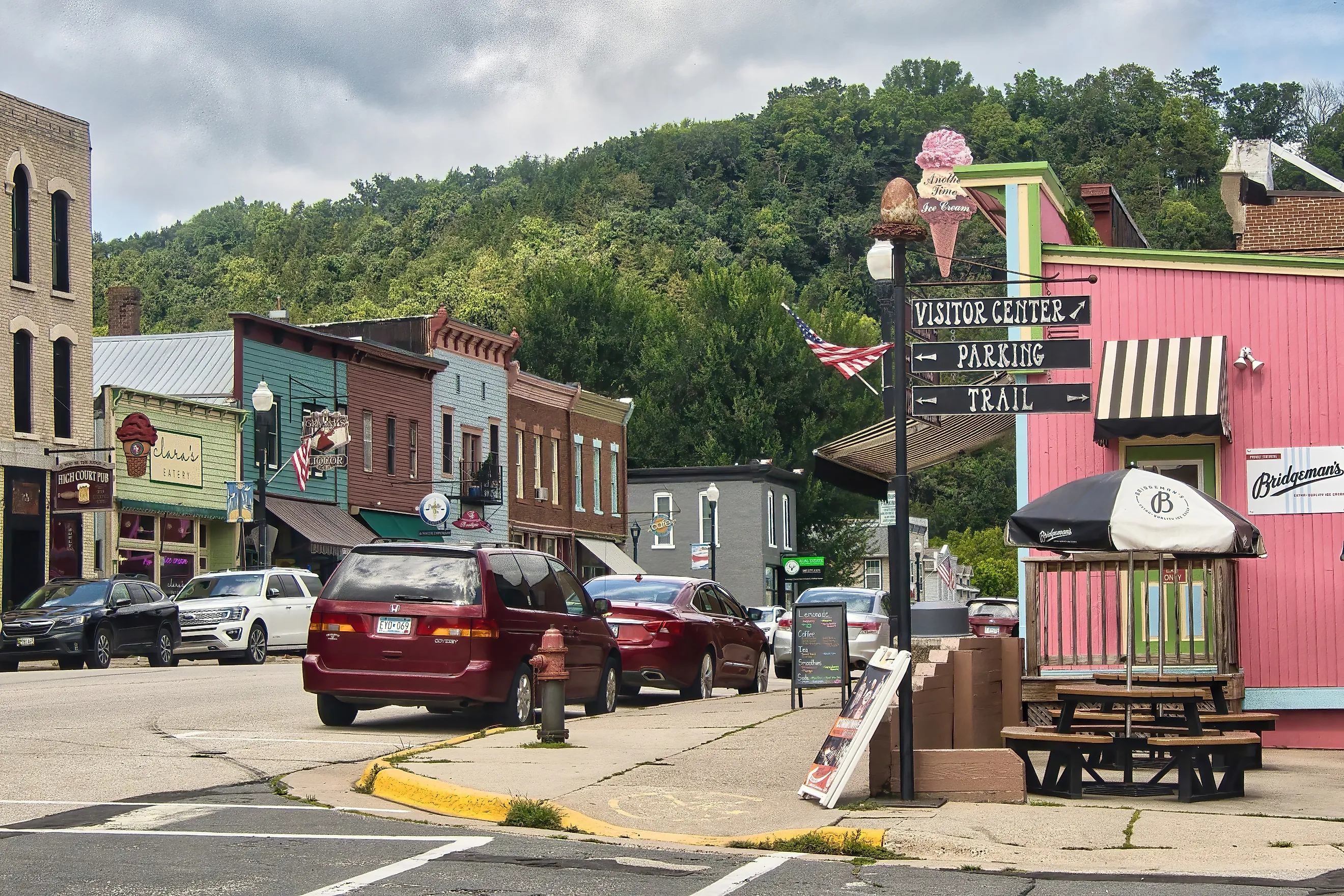
The entire 1870s downtown of Lanesboro is on the National Register of Historic Places, and with a population of just over 700, it covers just a few blocks. The Root River State Trail runs directly through the center of town, and everything lies within a five-minute walk. Parkway Avenue is the main street, and strolling down it will take you past the Old Village Hall, galleries like Lanesboro Arts, the Little General Store, and numerous cafes. Pedal Pushers Cafe and Juniper's, with its riverfront patio, cover dinner. Another Time Ice Cream Parlor is nearby for dessert.
St. Mane Theatre, also on Parkway Avenue, was originally built as a furniture store in 1897. It became the Elite silent-film theater in 1915 before reopening as the St. Mane in 1984, with Lanesboro Arts presenting a year-round professional programming series of concerts, theater, and documentary films. South of downtown, along Parkway Avenue, is Sylvan Park with its picnic grounds, two stocked fishing ponds, the short Bunny Trail, and a Saturday farmers market from May to October. The Lanesboro Stone Dam is across the street from the park on the South Branch of the Root River. Built by immigrant craftsmen in 1868, it remains one of only six historic gravity-arch stone dams left standing in the United States.
Grand Marais

On the northeast tip of Minnesota, just 40 miles from the border with Canada and sitting on Lake Superior's North Shore, is the small town of Grand Marais. The downtown grid along Wisconsin Street and Broadway sits directly on the harbor, creating a walking circuit of about a mile along the shoreline for all the major sights. Start the morning at World's Best Donuts (the shop's name, not designation), frying cake donuts since 1969 and usually selling out quickly each day. After breakfast, check out local art at Sivertson Gallery and Johnson Heritage Post Art Gallery, before walking towards the water to the North House Folk School. Founded in 1997, it runs hundreds of hands-on courses each year in traditional northern crafts, including boatbuilding, timber framing, blacksmithing, and basketry.
From the folk school campus, follow the harbor shoreline southeast along the cobblestone beach to reach Grand Marais' best-known natural feature: Artist's Point. Jutting into Lake Superior, this peninsula has two paths. Bear left for a dense, mossy boreal forest trail that ends on volcanic rocks battered by open lake waves. Bear right for the concrete harbor breakwater wall extending into the bay. An easy 0.8-mile out-and-back stroll brings pedestrians to the base of the Grand Marais Lighthouse, with views back across the harbor to the town and the Sawtooth Mountains.
Hastings

Back on the Mississippi, the town of Hastings has a historic business district running along Second Street. These contiguous blocks of 19th-century brick architecture include the 1863 IOOF Hall, an Italianate building locally recognized as one of the oldest surviving three-story commercial brick buildings in the state. Today, the street has numerous antique shops and the Spiral Brewery. Named after the historic Spiral Bridge that brought traffic into downtown until 1951, the dog- and family-friendly community brewery is the place for a beer before heading to Levee Park and the riverfront.
Just behind the brewery, Levee Park sits right along the Mississippi River and has views of the modern tied-arch Hastings Bridge. The riverside trails, part of 30 miles of paved community trails, run along the river, out towards Lake Rebecca and the US Lock and Dam No. 2 that stretches across the Mississippi. Back in Levee Park is the open-air Rotary Pavilion, which hosts the Music + Market series and free outdoor movies during the warmer months.
Excelsior

Excelsior sits on the south shore of Lake Minnetonka and has a compact, highly walkable downtown covering about one square mile, if not less. The main street of Water Street starts at the Excelsior Commons and the Port of Excelsior, then runs south through downtown. Excelsior Commons is a 13-acre community park with two swimming beaches, playgrounds, picnic areas, and a band shell with free summer concerts. From the docks, visitors can view yachts or step back in time by boarding a restored 1906 steamboat named the Minnehaha, which cruises the lake in summer and ferries passengers across the water to Wayzata.
The historic blocks are full of independent boutiques, galleries, vintage shops, and Excelsior Bay Books. Midway down Water Street, the Minnesota Streetcar Museum operates the Excelsior Streetcar Line. Here, visitors can buy a token at the old-fashioned station and ride a restored wooden streetcar down a half-mile piece of the historic lakeside tracks. Paralleling this vintage line is the Lake Minnetonka LRT Regional Trail, a 15-mile crushed-limestone multi-use path built over an old railroad bed between Hopkins and Carver Park Reserve, an easy walk straight from downtown shopping into open parkland.
Minnesota's Best Towns to Explore on Foot
Each of these 9 walkable towns keeps its major landmarks within a few blocks. A lift bridge in Stillwater, a bluff trail in Red Wing, a lighthouse breakwater in Grand Marais, a 37-bell carillon in New Ulm: the car can stay parked all day at any of them. What they share is a compact, historic core built to be crossed on foot. Pick a main street, park once, and walk it end to end.