9 Most Walkable Town Centers In Michigan
Meandering through Michigan’s small towns, one can feel the omnipresent Great Lakes swirling their fresh breeze, the echoes of mining or maritime histories, and the present pulse of independent commerce. The dependably simple layout of these communities makes it easy to walk without a plan, letting the waterfront parks, renovated alleys, and weathered relics of the 1800s guide each curious step. So if you’re the type of person who prefers self-propelled exploration, then these nine Michigan towns have the most walkable cores.
Traverse City

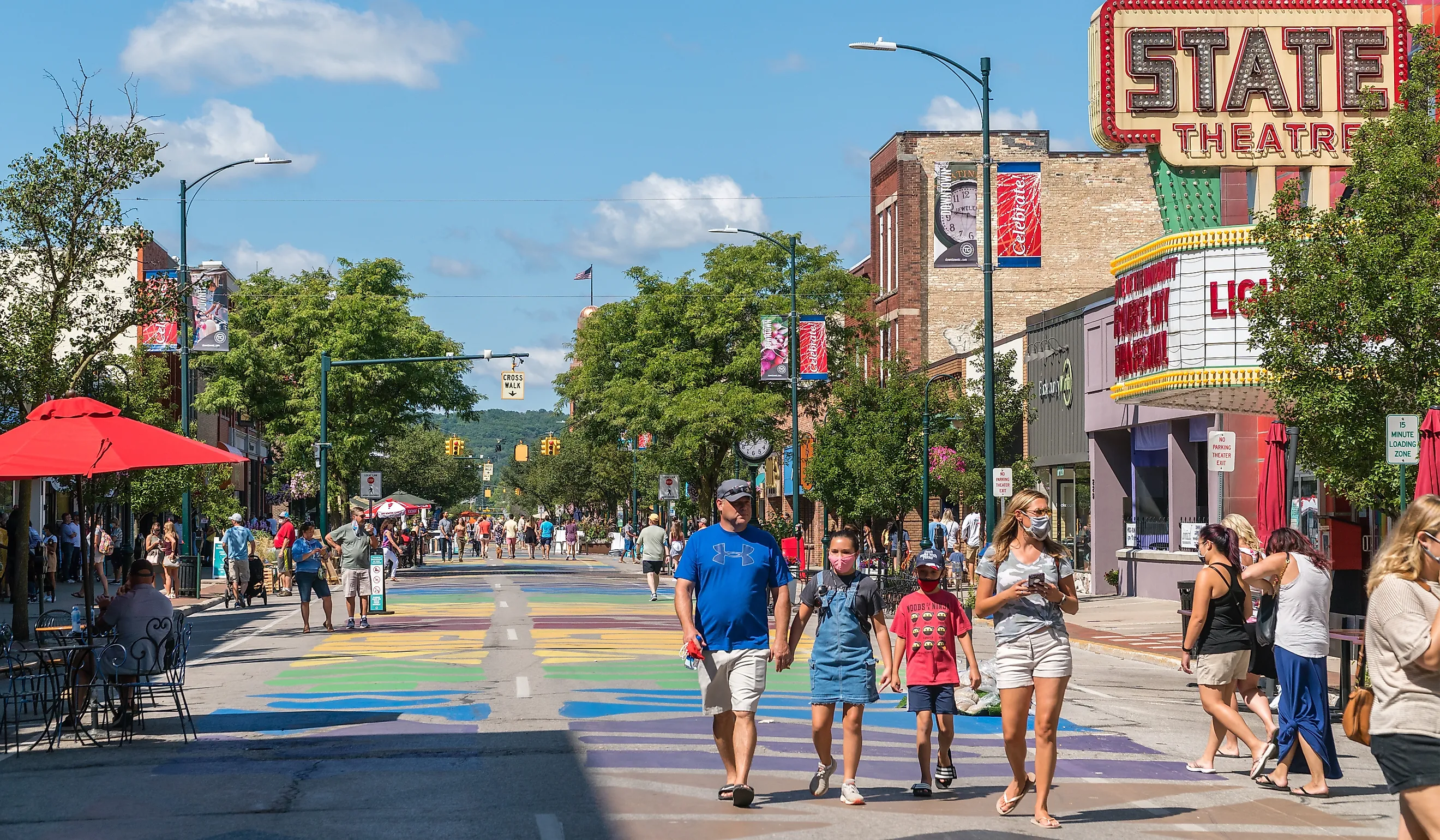
Blending distinct districts via a series of lightly trafficked streets, wide sidewalks, and waterside paths, Traverse City is as walkable as it is novel. Beginning on one of the standout main streets in Michigan, Front Street, spend some time getting to know Traverse City's elegant downtown core - noting the multiple cafes, book stores, City Opera House, and State Theatre along the way. From Front Street, you may wish to tread west into the Warehouse District. Here, boxy industrial buildings have been painted and repurposed into everything from craft breweries to art studios and even a sizable artisanal candle store. For a synergy of experiences under one roof, check out Warehouse MRKT.

From the Warehouse District, you can follow the paths and trails of the Boardman River, emerging in the Old Town District, where dressed up anachronistic structures and tasteful street murals once again strike a unique chord. Alternatively, you may feel drawn to the waters of the West Arm of Grand Traverse Bay, in which case, all that separates you from the beaches, parks, and walking paths is a simple traffic light crossing of Grandview Parkway (US 31).
Charlevoix

Just 50 miles north of Traverse City, the small city of Charlevoix is compartmentalized in a similar manner. To begin the well-rounded walking adventure, I suggest parking somewhere near Bridge Street. This primary thoroughfare is where you'll find the bulk of Charlevoix's commercial and culinary assets. These take the form of bespoke businesses, but also come the Thursday morning Farmers Market, pop-up produce and handicraft vendors (and even some buskers). Watch for Bridge Street's offshoot alleys, as they harbor some treasures of their own.

From Bridge Street, do a walk-by of Round Lake, where you can watch the boats come and go from Charlevoix Marina, and then pivot West, toward the waters of Lake Michigan. Before you know it, a series of earthy, hobbit-like residences will present themselves, capped off by a massive, mushroom-shaped house. These enigmatic creations were birthed by architect Earl Young. Charlevoix offers guided trolley tours of the Earl Young Local Historic District, but anyone is free to walk the area at their own leisure (just be mindful that ordinary people live in these quirky homes). After checking off all of the "mushroom" homes, end your Charlevoix walkabout at the bright-red South Pier Lighthouse, where you can gaze out into the Great Lake, or back over the sands of Michigan Beach.
Mackinac Island

Thanks to the fact that it has been car-free since the turn of the 20th century, Michigan's Mackinac Island (pronounced Mackinaw) is easily one of the most walkable towns on this list. Mackinac Island, as a whole, occupies a little over 4 square miles at the precipice of the Upper and Lower Peninsulas, as well as the hand-off between Lake Huron and Lake Michigan, and falls largely under the domain of Mackinac Island State Park. With that said, there is also the titular Victorian village that eagerly greets seasonal passenger ferries from St. Ignace and Mackinaw City. Upon disembarking, you'll have free rein of Lake Shore Drive and Market Street, as well as the side streets that connect these two thoroughfares. On any given day, there are likely to be a fair number of other pedestrians, and you'll want to be mindful of cyclists (there are rental shops all over) and horse-drawn carriages (there are more working horses than permanent residents), but even so, in the absence of modern machines, walking around Mackinac is a delight.

Trending in a northeasterly direction, you'll encounter living museums such as the Biddle House and Stuart House, as well as various peddlers of Mackinac Island's world-famous fudge. Soon, the expansive Fort Mackinac will beckon from atop Marquette Park. But before witnessing the musket-firings from yet more period actors, avid walkers should pop into the Mackinac Island State Park Visitors Center in order to learn about the various wooded paths and viewpoints that occupy the other 80% of the island.
St. Ignace

Speaking of St. Ignace, this Upper Peninsula ferry port is quite walkable in its own right. In fact, St. Ignace is an official Michigan Trail Town, owing to its position along the roughly 4,800-mile North Country National Scenic Trail. And while there will still be about 4,799 miles remaining after walking St. Ignace's waterfront, this is certainly a worthwhile sample. The slim town center picks up shortly after the northern terminus of the iconic Mackinac Bridge, following North State Street along the contours of East Moran Bay.

The east of State Street harbors various boardwalks, piers, and spacious ferry parking lots, whereas the west side features a wide brick sidewalk and the bulk of St. Ignace's watering holes, sweet shops, and hotels. For a sense of completeness, the out-and-back stroll should begin on the shore of American Legion Park, and go all the way up to the Museum of Ojibwa Culture - housed within the Old Mission across from Kiwanis Beach.
Marquette

Now that we've touched down in the Upper Peninsula, let's push further north to the lively college town of Marquette. With its colorful murals, historic facades, inventive businesses, and natural beauty, an aimless meander is the best way to get acquainted with Marquette. The natural rallying point is Washington Street, beginning perhaps at Old Marquette City Hall and then following the gentle downhill gradient toward the captivating harbor. Here, the Marquette Yacht Club is backdropped by the massive Lower Harbor Ore Dock. But if you follow the walking path up Lakeshore Boulevard, then the Submarine Memorial, rustic Lake Superior Theater, and Maritime Museum will all present themselves on your way out to circa-1853, classic Michigan-red, Marquette Harbor Lighthouse.

For more of Marquette's youthful social scene (it is, after all, home to Northern Michigan University), force yourself to head uphill away from Washington Street to the slightly removed bounty of 3rd Street. The moderate effort is consistently rewarded with exceptional boutiques (such as the Blackbird North, Cove, and Snowbound Books trifecta), great hangout coffee shops (such as The Crib and Contrast Coffee), and finally, the live-music and burger haven that is Blackrocks Brewery.
Houghton

Even further north on the Upper Peninsula, the historic mining city of Houghton acts as the gateway to both the Keweenaw Peninsula and Isle Royale National Park. The latter can be accessed by a lengthy ferry (see the Isle Royale National Park Visitor Center for more details), and the former we will unpack at our next destination, but for now, Houghton's walkable town center stands on its own merit. Fanned across the separate, one-way lanes of US 41, as well as Lakeshore Drive, one's walk can weave up and down connecting streets in order to check off important sites, appealing establishments, and striking views.

If you're curious about Houghton's acclaimed mining history (after all, this isolated community once produced the vast majority of America's copper), or the palpable impact such an influx of wealth had on this society, then a stopover at the Carnegie Museum of the Keweenaw, or a detour to the opulent Houghton County Courthouse, might be in order. Alternatively, if you'd like to take your walk to the water's edge, gaining ever more captivating views of the Portage Canal Lift Bridge (i.e., the world's widest and heaviest double-decked vertical lift bridge on the planet) in the process, then you'll be well suited to the Waterfront Walk. And if you'd prefer to simply window-shop along Shelden Avenue (there's a nice selection of gift shops, thrift shops, and gear shops), that's a perfectly fine way to pass the day in Houghton.
Calumet

Calumet sits at the heart of the Keweenaw Peninsula National Historical Park. It is not only home to the multi-story National Park Visitor Center, but also 62 structures comprising the Calumet Downtown Historic District. As such, strolling the lengths of 5th and 6th Street is like walking back into the copper boom of the late 19th century. There is the extant Calumet Theatre, the Copper Country Firefighters History Museum (complete with old-timey fire engines), several authentic saloons, and plenty of other copper-colored brick buildings to keep the contiguous aesthetic.

These days, there are also touristic gift shops (such as Copper World and Calumet Mercantile & General) to poke your head into. So grab something to-go from Keweenaw Coffee Works and enjoy the meander through Calumet's storied town center. If you find yourself entranced by this formative era, be sure to double back on the KPNHP Visitor Center to map out the many other one-off sites scattered throughout this northernmost section of Michigan's mainland.
Holland

There's never a bad time to walk through "The Netherlands of America", but if you can synchronize your arrival with the spring blossom, then thousands upon thousands of tulips will accent Holland's already attractive town center. Beds of yellow, orange, pink, purple, and red signal the annual Tulip Time Festival, which is centered around Windmill Island Gardens (walkable from downtown) but eagerly spills over into the commercial sector. Zig and zag between 7th and 10th Street to get the full floral experience, but also to appreciate some of Holland's everyday highlights. Its Dutch heritage can be felt in places like the Holland Museum, New Holland Brewing, and Dutch Village Downtown (for all your wooden klomp needs!). And if said downtown wander happens to unfold on a Wednesday or Saturday morning, then the 8th Street Farmers Market will be sure to magnetize your gait.
Saugatuck

The small but sprightly city of Saugatuck makes for a quintessential coastal Michigan stroll. Hugging the bend of the Kalamazoo River, right where it meets Kalamazoo Lake, downtown Saugatuck is sheltered from Lake Michigan's fronts, but still intimately connected to the water. Known as "The Art Coast of Michigan," this little sliver of the Lower Peninsula has flourished as a creative haven ever since the founding of the Ox Bow School of Art back in 1910. Now, town center pedestrians will discover the Saugatuck Center for the Arts (with its sculpture garden and open-air stage) and a multitude of galleries within just a few square blocks.
Saugatuck has also created a Social District, allowing locals and visitors alike to purchase beverages from participating bars/restaurants and enjoy them in designated common areas, or even while shopping at participating businesses (look for the Social District logo on the window). This suits us wanderers particularly well, as we can dabble in the local scene without ever breaking stride.

If you find yourself smitten by Saugatuck but itching to expand beyond its small footprint, then as an added bonus, you may like to cross the Kalamazoo River into the sister city of Douglas (mere minutes away). Like Saugatuck, Douglas is a quaint and colorful community that also participates in the Social District experiment.
Like most American destinations, arriving by car is the norm. But once you’ve found a parking spot somewhere in the vicinity of downtown, these nine Michigan communities are all about shifting into slow travel. Setting forth on foot allows visitors to seek the fringes of nature and sink into the artistic yet blue-collar cultures that emanate from each precious block. For a state known for its automotive legacy, Michigan sure encourages a good walk.