8 Off-The-Grid Ohio Towns To Visit In 2026
Killbuck sits in a quiet valley west of the Amish Country Byway in Holmes County. The village gave up its own police force in 2002 to save money. Most travelers never turn off the highway to find it. The same goes for Rendville. It holds 28 residents and a civil-rights record that belongs in a textbook. These are the Ohio towns that stayed small while the tour buses went elsewhere. The eight villages below trade gift-shop crowds for empty trailheads and front porches that still know their neighbors. Each one rewards the drive it takes to reach it.
Killbuck

Killbuck names itself after a Lenape leader, Bemino, who sided with the Americans during the Revolutionary War. Settlers reached the banks of Killbuck Creek in 1809 and built a trading post where Native travelers stopped to barter. The village that grew here incorporated in 1882 and peaked as a railroad and milling town before the lines were abandoned. Around 810 residents remain, and the place is quiet enough that the village disbanded its police department in 2002 and handed patrols to the county sheriff. Locals call it one of the best-kept secrets in Holmes County, sitting just west of the byway that carries everyone else to the Amish shops.
The Killbuck Valley Museum holds the village's deepest draw. Its collection runs to stone tools and arrowheads, a room devoted to the mastodon digs of Dr. Nigel Brush, old medical instruments from a former town doctor, and local war memorabilia. The surrounding Killbuck Creek valley is prime ground for birdwatching, with wetlands north and south that attract native and migratory species. Each Labor Day weekend the Killbuck Early American Days festival fills the streets with parades and music, then the village returns to its usual calm. The Holmes County Trail passes through on its way between the farm towns, giving cyclists a flat, shaded route along the creek.
Granville

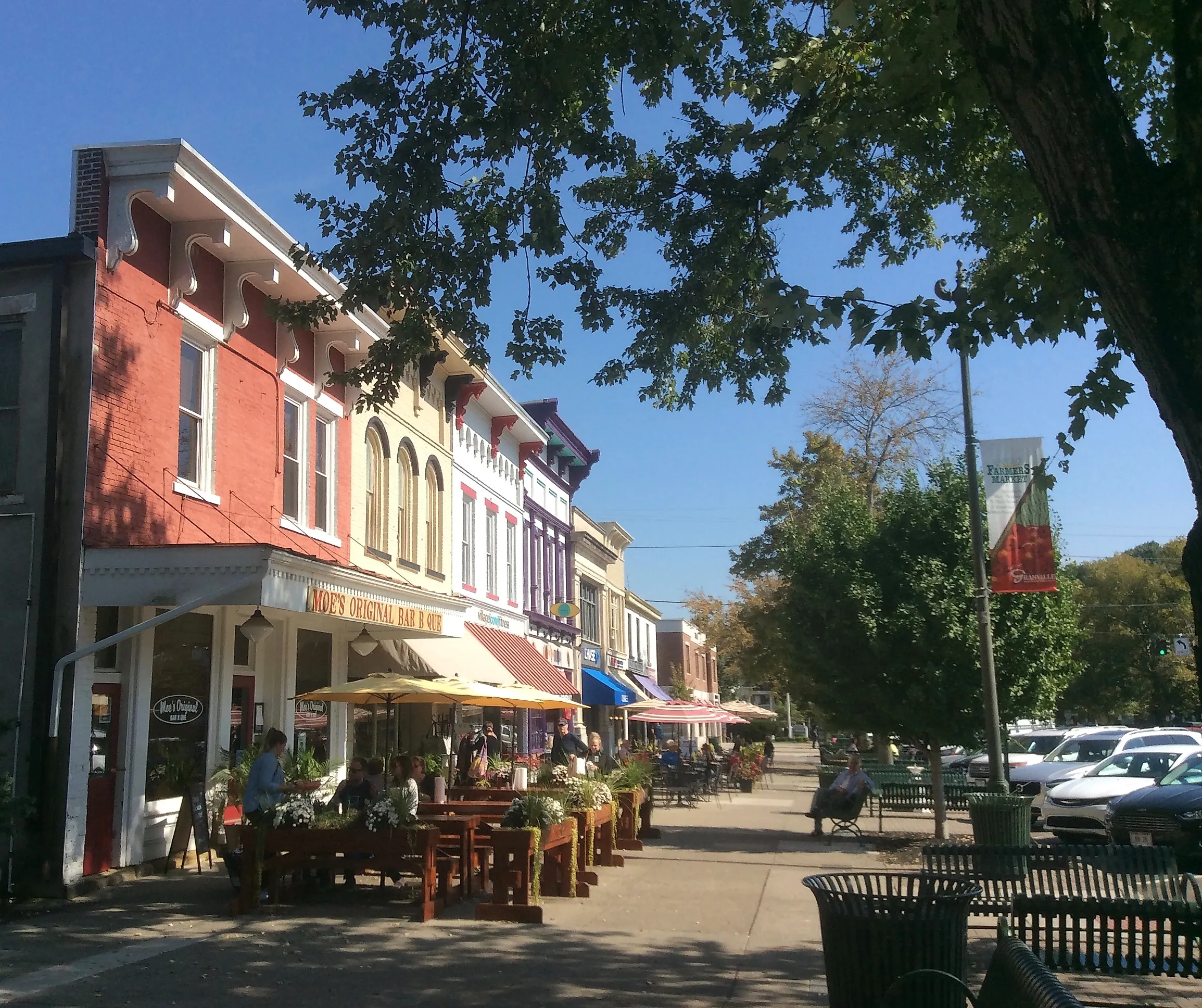
Granville's New England roots show in its architecture, town layout, and historic landmarks. Settlers from Massachusetts founded the village in 1805, and many buildings along Broadway still carry Federal and Greek Revival design. The Buxton Inn is one of Granville's most recognizable historic sites. It opened in 1812 and has hosted travelers for more than two centuries, making it one of Ohio's oldest operating inns.
History extends well beyond the downtown district. Alligator Mound preserves an effigy earthwork built by Indigenous peoples before European settlement, set on a bluff above the Raccoon Creek valley. Nearby, Denison University occupies a hilltop campus known for stone buildings, wooded paths, and views across Licking County. For outdoor recreation, Infirmary Mound Park is a 300-acre green space with hiking trails, open fields, and natural areas. The park lets visitors explore the countryside around Granville while staying close to the village's historic center.
Shawnee

Shawnee's Main Street looks like almost nowhere else in Ohio. Wooden overhanging porches and false-front facades line the street, a streetscape preserved from the village's days as a coal boomtown. Founded in 1872 when the railroad reached this part of Perry County, Shawnee swelled to nearly 4,000 people as miners arrived from Wales, Ireland, and Eastern Europe to work the Hocking Valley coalfields. Today around 505 residents remain, and the village is recognized as one of the best intact examples of Appalachian boomtown architecture in the eastern United States.
The Tecumseh Theater dominates the streetscape. The steel-frame building went up in 1907 and 1908 as Red Men's Hall, and over the decades it hosted lodge meetings, films, vaudeville, and even basketball games before a long restoration brought it back as a performance and community space. Shawnee serves as a gateway to the Little Cities of Black Diamonds, a heritage region covering the old coal communities scattered through the surrounding Wayne National Forest. The Little Cities of Black Diamonds Council maintains a local history archive in the village, and a coal-mining museum displays tools and artifacts from the mining era.
Rendville

Rendville packs more history into one block than towns a hundred times its size. With 28 residents at the 2020 census, it is the smallest incorporated village in Ohio. Businessman William P. Rend founded it in 1879 to supply workers for his nearby coal mine, and he recruited African Americans from the South alongside immigrants from across Europe. The result was one of the first integrated communities in the state, where at least seven ethnic groups lived and worked side by side.
That mix produced a remarkable civil-rights record. In 1888, Isaiah Tuppins was elected mayor of Rendville, the first African American to hold that office anywhere in Ohio. He had also earned a medical degree in Columbus, another first. Roberta Preston served here as one of the earliest African American postmistresses in the country. The labor organizer Richard L. Davis arrived in 1882 and went on to help build the United Mine Workers of America. A historic marker downtown tells these stories, and a former church now operates as Rendville Art Works. The whistle of coal trains along the valley is often the only sound that breaks the quiet.
Peninsula

Peninsula is surrounded by Cuyahoga Valley National Park, giving this village of only a few hundred residents direct access to wooded scenery, trails, and canal history. The community developed along the former Ohio and Erie Canal route. Its preserved nineteenth-century buildings reflect the importance of canal transportation in the region's history. Today the village works well for visitors interested in hiking, cycling, scenic views, and historic sites.
The Towpath Trail follows the historic Ohio and Erie Canal and gives hikers and cyclists access to miles of paths through the park. Nearby, Brandywine Falls drops 60 feet through a wooded gorge ringed by boardwalk overlooks. The Everett Covered Bridge, the last covered bridge in Summit County, sits a short drive away. The Ledges Trail leads through cool sandstone passages and rock formations that feel far removed from the surrounding farmland. Birdwatchers gravitate to the Beaver Marsh, a restored wetland where a boardwalk crosses water once occupied by a salvage yard.
Cumberland

About 136 people live in Cumberland, set deep in the reclaimed strip-mine country of Guernsey County. The drive in tells you how remote it is, since the village sits well off the interstate on winding rural routes. What put this speck on the map is its neighbor. The Wilds spreads across nearly 10,000 acres of former coal land just outside the village, making it one of the largest wildlife conservation centers in the world.
Open-range habitats here hold rhinos, giraffes, zebras, and other rare and endangered species, viewed on guided safari tours rather than from behind cage bars. The reclaimed grassland turned out to suit hoofed animals from several continents. Visitors can stay overnight in yurts and cabins at the on-site lodge for a closer look at the herds. Salt Fork State Park, Ohio's largest state park, lies a short drive north and adds hiking trails, a swimming beach, and a reservoir to the area. The combination gives this tiny village an outsized reason to visit.
Barnesville

Barnesville rises out of the Belmont County hills near the Ohio Valley, a Quaker-founded village of about 4,000 that James Barnes laid out in 1808. Its calling card is the Belmont County Victorian Mansion Museum, a 26-room Romanesque Revival house built between 1888 and 1893. The Belmont County Historical Society rescued the home from demolition in the 1960s and restored its rooms with period furnishings, woodwork, and a third-floor ballroom.
The village wears its industrial past openly. The Watt Center for History and the Arts occupies the original office of the Watt Car and Wheel Company, a foundry founded in 1862 that invented a self-oiling coal-car wheel. The Baltimore and Ohio Railroad Depot is the last remaining train station in Belmont County, and a railroad tunnel sits just down the path below the overlook plaza. The Stillwater Meeting House recalls the Quaker settlers who shaped the early village. Once a year the streets fill for the Barnesville Pumpkin Festival in late September, then return to their usual hometown quiet.
Woodsfield

Woodsfield anchors the landscape and history of southeastern Ohio through its courthouse square and the wooded hills around it. The Monroe County Courthouse clock tower rises above downtown and stands for the town's civic history. The Monroe County Historical Museum fills in the rest with exhibits on local industries, early settlements, and the traditions that shaped this corner of the state. As the only sizable town in all of Monroe County, Woodsfield has stayed genuinely remote.
Outdoor attractions spread across Woodsfield's forested ridges and farmland. Wayne National Forest provides miles of trails and scenic overlooks. The Covered Bridge Scenic Byway follows rural roads past historic bridges, farmland, and streams in the Appalachian foothills. Piatt Park sits near downtown as a longtime community gathering place. The surrounding county offers some of the darkest night skies and emptiest back roads in Ohio.
The Reward Of The Back Roads
These eight villages share a trait that the state's busier destinations lost long ago, which is the feeling of arriving somewhere overlooked. Rendville preserves a civil-rights legacy in a single block, and Shawnee guards a streetscape that vanished elsewhere a century ago. Killbuck and Woodsfield open onto trails and forests with no crowds to share them. Cumberland places one of the world's great conservation parks at the edge of a village of barely a hundred people. Reaching any of them takes a deliberate turn off the main road, and that turn is the whole point.