8 Most Eccentric Towns in the Finger Lakes
Eccentricity is what happens when a small town finds one weird thing to be good at and refuses to let go. The Finger Lakes towns below each picked a different obsession decades ago and stuck with it. Seneca Falls is where Elizabeth Cady Stanton kicked off the American women's rights movement in 1848. Hammondsport is where Glenn Curtiss built the first US airplane the Wright brothers didn't have the patents on. Trumansburg is where Bob Moog invented the modular synthesizer in the 1960s in a factory on Main Street. Each town below earned its eccentricity the long way.
Ithaca

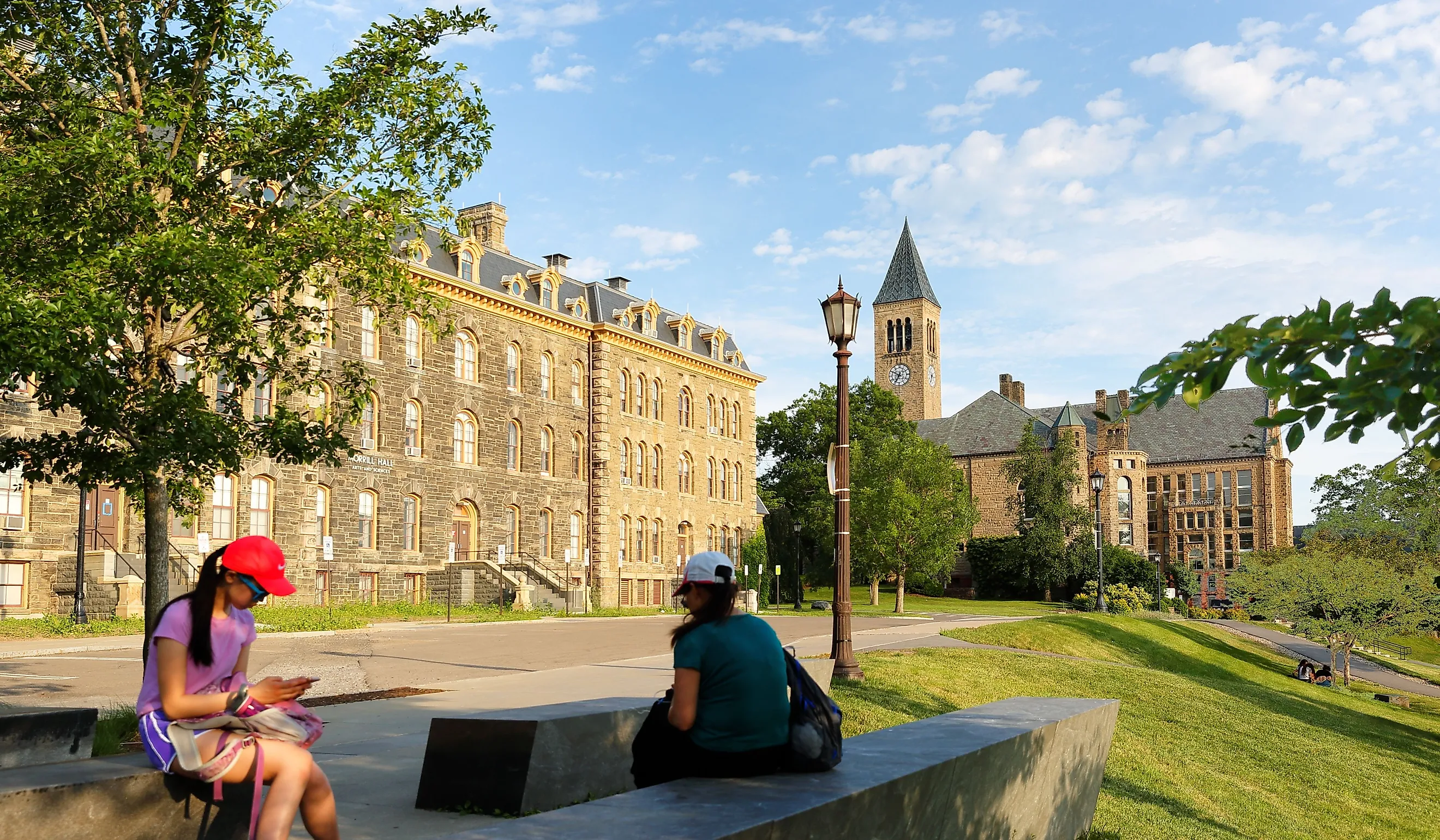
Ithaca's unofficial motto, "Ithaca is gorges," is a pun the town has carried for so long that it now appears on the official town signage. The eccentricity runs deeper: Cornell University, a founding member of the Ivy League since 1865, runs the Lab of Ornithology and its Macaulay Library, the world's largest archive of natural sounds with over 250,000 audio recordings of wildlife (the audio equivalent of the Library of Congress, basically). Cornell Botanic Gardens spread across 4,300 acres, including the F.R. Newman Arboretum.
The Ithaca Farmers Market on Steamboat Landing has run continuously since 1973 and operates out of a unique open-air pavilion on the Cayuga inlet, with vendors selling produce, hot food, and crafts from more than 150 regional growers and makers. The Museum of the Earth on West Hill displays one of the country's most important fossil collections, including the complete Hyde Park mastodon excavated locally in 1999. Even the local ice cream (Cornell Dairy) is processed on campus from milk from the university's own dairy herd.
Corning

Corning is the Crystal City and the headquarters of Corning Incorporated, the multinational glass and ceramics company that makes the cover glass on every iPhone in the world (the alkali-aluminosilicate glass branded as Gorilla Glass). The Corning Museum of Glass on Centerway is the largest museum dedicated to glass in the world, with collections spanning 3,500 years and live glassblowing demonstrations every 45 minutes inside the Amphitheater Hot Shop. Visitors can sign up for Make-Your-Own-Glass workshops where they actually shape molten glass on the steel pontil rod.
The Rockwell Museum, a Smithsonian Affiliate housed in the 1893 Old City Hall, specializes in American Western and Native American art alongside contemporary work. Downtown Corning's Market Street, completely rebuilt after the devastating Hurricane Agnes flooding of 1972 destroyed most of it, now runs as the Gaffer District (named for the master glassblowers) with locally owned restaurants, bars, and the Rosé pizzeria that draws visitors from across the region.
Skaneateles

Skaneateles sits at the north end of one of the cleanest natural lakes in the eastern United States. The water is so clean it is drawn directly into the City of Syracuse's municipal water supply with only minimal disinfection treatment, an extraordinarily rare arrangement for a public water system in the 21st century (most US cities filter their water through extensive treatment plants). The lake also draws celebrities to its shoreline: Bill and Hillary Clinton have vacationed at the lakeside cottage of Peter Wiles, founder of Mid-Lakes Navigation, for years.
The Sherwood Inn, opened in 1807 as a stagecoach stop on the route between Albany and the Niagara frontier, still operates as a hotel and tavern on the village's main intersection. Mid-Lakes Navigation runs daily mailboat cruises from Memorial Day through Labor Day, with the captain literally tossing waterproofed mailbags onto private lake-house docks as the boat passes (this is the actual US Postal Service-contracted route for Skaneateles Lake's lakefront residences). Anyela's Vineyards on the western lakeshore is the area's most-photographed winery view.
Seneca Falls

Seneca Falls is where the American women's rights movement formally began. On July 19-20, 1848, Elizabeth Cady Stanton, Lucretia Mott, Mary Ann M'Clintock, Martha Wright, and Jane Hunt organized the Seneca Falls Convention at the Wesleyan Chapel and adopted the Declaration of Sentiments, modeled on the Declaration of Independence and demanding equal rights for women including the right to vote (72 years before the 19th Amendment delivered it). The Women's Rights National Historical Park preserves the Wesleyan Chapel, the Stanton House, and a visitor center that frames the convention's national significance.
The National Women's Hall of Fame, founded in 1969, sits inside the former Seneca Knitting Mill, a renovated 1844 textile mill. The town also claims its bridge over the Cayuga-Seneca Canal as the inspiration for Bedford Falls in Frank Capra's It's a Wonderful Life; Capra is said to have visited Seneca Falls in 1945 before writing the screenplay. The It's a Wonderful Life Museum on Fall Street honors the connection with the annual It's a Wonderful Life Festival each December.
Auburn

Auburn is the small Upstate New York city that was home to two of the most consequential Americans of the 19th century at the same time. The Harriet Tubman Home for the Aged on South Street, where Tubman lived from 1859 until her death in 1913, is now a National Historical Park managed by the National Park Service; her grave at Fort Hill Cemetery still draws thousands of visitors every year. The Seward House Museum at 33 South Street, the home of Abraham Lincoln's Secretary of State (the man who negotiated the 1867 Alaska Purchase that contemporaries mocked as "Seward's Folly"), is open for tours with much of the original furniture still in place.
Auburn Correctional Facility opened in 1816 as the second state prison in New York and was the site of the first execution by electric chair on August 6, 1890 (William Kemmler was the condemned). The Cayuga Museum of History and Art on Genesee Street fills the 1830 Willard-Case Mansion with local history, and its Carriage House Theater hosts year-round performances. Emerson Park on Owasco Lake includes a historic carousel and the Cayuga Museum's outdoor venue.
Watkins Glen

Watkins Glen runs two unrelated obsessions at once: 19 waterfalls inside a single state park, and one of the most storied road-racing circuits in the country. Watkins Glen State Park's main gorge trail follows Glen Creek for 1.5 miles past a string of falls, plunge pools, and the Cavern Cascade tunnel, where the trail actually passes behind a 60-foot waterfall. The park has been a New York State park since 1906 and now draws over 1 million visitors a year.
Above the gorge, Watkins Glen International hosted Formula One's US Grand Prix from 1961 to 1980 and now runs the NASCAR Cup Series Go Bowling at The Glen each August, plus IMSA SportsCar weekends in summer. The International Motor Racing Research Center on North Decatur Street holds the largest archive of motorsports history materials in the Western Hemisphere, with over a million documents, photographs, and films. The Seneca Lake Wine Trail loops around the largest of the Finger Lakes with more than 35 family-owned wineries.
Hammondsport

Hammondsport is the small Steuben County village where Glenn H. Curtiss built the first successful American airplane flight that the Wright brothers did not control the patents on. On July 4, 1908, Curtiss flew the June Bug over a measured kilometer course in Hammondsport's Pleasant Valley to win Scientific American magazine's first aviation trophy. The Glenn H. Curtiss Museum on State Route 54 holds the largest collection of Curtiss-built aircraft in the country, along with motorcycles, cars, and the original wind tunnel he used for testing.
The Pleasant Valley Wine Company, founded in 1860 (now part of the Great Western brand), was U.S. Bonded Winery No. 1, the very first federally bonded winery in America (the bond number is permanent and survives any change of ownership). Visitors can tour the 19th-century stone cellars cut into the hillside. Hammondsport's village green at the head of Keuka Lake holds the Pulteney Square Historic District with restored 19th-century storefronts and the original 1890s gazebo bandstand.
Trumansburg

Trumansburg (population about 1,700) is where Bob Moog founded the R. A. Moog Co. in 1953 and built the original modular Moog synthesizers through the 1960s and into the early 1970s on the village's Main Street; the original factory building is still standing. Moog Music later relocated its headquarters to Asheville, North Carolina, where the dedicated Moogseum opened in 2019, but Trumansburg holds the original-instrument legacy. The annual Moogfest synthesizer festival (since 2004) eventually moved to Asheville as well, but the Trumansburg roots are baked in.
Taughannock Falls State Park, just outside Trumansburg, holds the tallest single-drop waterfall east of the Rocky Mountains at 215 feet, taller than Niagara by 48 feet. The GrassRoots Festival of Music and Dance each July is a four-day event running annually since 1991 that draws over 25,000 visitors and features more than 70 acts across multiple stages; the festival was founded by members of Donna the Buffalo, the locally based Americana band that still anchors the lineup every year. The Trumansburg Conservatory of Fine Arts inside an 1853 Greek Revival church hosts year-round music and dance programming.
Eight Towns, Eight Obsessions
The eight Finger Lakes towns above each built their identity around something the rest of the country never fully copied. Whether the obsession runs to women's suffrage, early aviation, NASCAR road racing, glassblowing, mailboat-delivered postal service, or analog synthesizers, the local commitment shows up in museums, festivals, and the kinds of weekend conversations travelers will not find elsewhere. Pick the eccentricity that fits the trip.