8 Kentucky Towns Where Time Stands Still
From its founding in 1792, Kentucky has been a place of great significance in America. Whether that's its contributions to America's drinks and cuisine, or its celebrated Kentucky Derby race, Kentucky has a lot of stories to tell. You can hear these stories most clearly at a few Kentucky small towns where time stands still.
These towns are the sites of Presidential homes, Hatfield & McCoy land feuds, a Shaker village, trailblazed pioneer paths, and a few Civil War forts. These 8 Kentucky towns where time stands still should be on your Kentucky travel plans.
Hodgenville

In some towns, time stands still because of the impact made by the people who lived there. In Hodgenville’s case, it was the birthplace of U.S. President Abraham Lincoln. He is regarded as one of America’s second founding fathers for preserving the Union and ending slavery during the American Civil War.

In Hodgenville, visitors can learn about his early life at the Abraham Lincoln Birthplace National Historical Park, which includes the Memorial Building and the Boyhood Home Unit. This unit features a log home and surrounding landscapes that shaped his earliest memories. To gain a broader understanding of his life, the Lincoln Museum presents life-sized wax figures, Lincoln-inspired artwork, and historical exhibits. After exploring Lincoln’s legacy, visitors can attend a live show at the Lincoln Jamboree, a long-running local music venue.
Harrodsburg

Harrodsburg is the oldest town in Kentucky. Established as a fort in 1774, the town reflects its early frontier origins through well-preserved buildings and historical reconstructions. Fort Harrod State Park recreates the original 18th-century settlement with log cabins, defensive structures, and military artifacts.

The park also includes the Mansion Museum, which houses Revolutionary and Civil War artifacts inside a two-story home built in 1810. Nearby is the Lincoln Marriage Temple, a simple log cabin where Abraham Lincoln’s parents were married in a traditional frontier ceremony. Harrodsburg also preserves the history of the Shakers at the Shaker Village of Pleasant Hill. This former religious community lived, worked, and worshiped on the site, which now includes restored buildings, wooded hiking trails, and a farm-to-table restaurant.
Bardstown

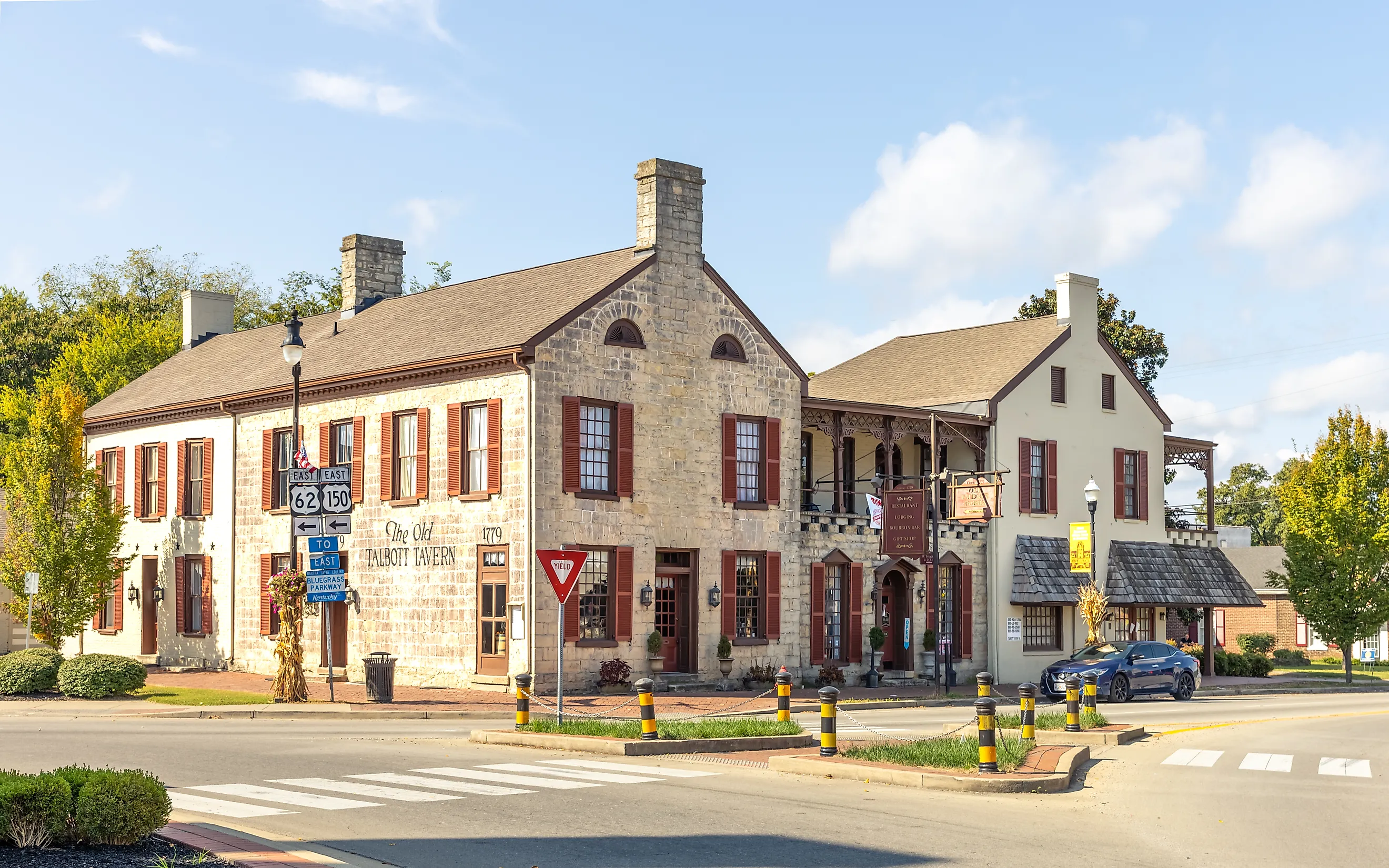
Bardstown was first settled in 1780 under the name Salem. It later became known as the Bourbon Capital of the World for its role in producing bourbon, a whiskey aged in charred new oak barrels. Several distilleries established during the town’s early years remain in operation, including Maker’s Mark, which has been in business since 1953.

The history of bourbon is presented at the Oscar Getz Museum of Bourbon History. Bardstown also has other historical sites, including My Old Kentucky Home State Park, an 1818 Federal-style mansion that inspired Stephen Foster’s song, which later became Kentucky’s state song. The town is also home to the Bardstown Village and Civil War Museum, which contains a large collection of artifacts related to the Western Theater of the American Civil War.
Pikeville

Pikeville has a history shaped by one of the most well-known family feuds in American history. Today, a quiet Appalachian town, it was once the center of the Hatfield and McCoy feud, which began after the Civil War and continued through disputes over land and livestock.
Several sites connected to the feud remain in and around Pikeville, including the Hog Trial Cabin, where the families argued over a stolen hog, and the Randolph McCoy Homeplace and Well. The Historic Pike County Courthouse is another key location, where several participants in the feud were tried and executed. Interpretive performances related to the feud and other Appalachian history are held at the Appalachian Center for the Arts. The surrounding area also includes mountain trails, such as the Real McCoy Trail in Bob Amos Park.
Winchester

Winchester was founded in 1792 by pioneers from Virginia. Before its settlement, Daniel Boone traveled through the area, leaving behind a fort in nearby Boonesboro that is now preserved as Fort Boonesborough State Park. The site reflects Kentucky’s early frontier period and the challenges faced by early settlers.
Winchester also left its mark on the state’s food history through long-standing local traditions. The town is the birthplace of Ale-8-One, a ginger ale created during Prohibition that is still bottled in Winchester, which is open for tours. Another local specialty is beer cheese, first made in Winchester and now associated with the town’s culinary history. To connect this later period to the town’s earlier past, visitors can also see Civil War-era fortifications preserved in Boonesboro.
La Grange

La Grange was founded in 1827 and developed as a railroad hub, which continues to shape the town’s identity. Trains still pass directly through Main Street, maintaining a close connection to its rail-based origins. Visitors can also watch the Main Street Train, which travels through downtown multiple times a day.
The town’s railroad history is further presented at the La Grange Railroad Museum, which displays vintage equipment, model train layouts, and restored railcars. La Grange also maintains mid-20th-century pastimes at the Sauerbeck Family Drive-In, where visitors can attend movie screenings in a traditional drive-in setting.
London

London was founded in 1826 by the Jackson family, who named the town in honor of their English heritage. Before its settlement, the surrounding land had been explored by explorer Daniel Boone, whose routes later guided early settlers into the region.
London played an important role during the early years of the American Civil War. Confederate forces clashed with Union troops at Camp Wildcat during the Battle of Camp Wildcat on October 21, 1861, one of the first Union victories of the war. The site is preserved at the Camp Wildcat Battlefield. Nearby, Boone’s Trace Trail follows the historic route settlers used to enter Kentucky through what is now Levi Jackson Wilderness Road Park. London also hosts the Red Bud Ride, a cycling event that passes through areas where redbud trees bloom each spring.
Elizabethtown

Elizabethtown, often called Etown by locals, was first settled in 1797 after Andrew Hynes and his wife Elizabeth donated land to pioneers in Hardin County. In recognition of the gift, the town was named for Elizabeth. Its quiet development was disrupted during the Civil War, when Confederate General John Hunt Morgan damaged the railroad and shelled the town in 1862.
One of the cannonballs fired during the raid remains lodged in a downtown building and is known locally as the Cannonball. Visitors can learn more about the town’s Civil War history and early settlement at the Hardin County History Museum. Elizabethtown is also home to the Swope’s Cars of Yesteryear Museum and the Summit One-Room Schoolhouse, which is often cited as a well-preserved example of a historic rural schoolhouse.
History Preserved Across Kentucky’s Small Towns
These Kentucky towns reflect different periods of the state’s past, from frontier settlements and early religious communities to Civil War conflicts and long-standing local traditions. Their histories are preserved in physical landmarks, town centers, and institutions that continue to shape daily life.
While some of these places are associated with cultural achievements and preserved architecture, others carry more difficult histories marked by conflict and division. Together, they show how Kentucky’s past remains visible in towns that have changed slowly over time, offering insight into the people and events that helped shape the state.