7 Old-Timey Mining Towns In Minnesota
If you look at Minnesota today, you probably could not imagine it as it was a hundred years ago. Instead of lakeside cabins and outdoor activities, the state was abuzz with workers mining huge deposits of iron ore. These deposits were discovered across northern and central Minnesota in the late 1800s and early 1900s, sparking the creation of dozens of mining towns almost overnight. Some of these towns expanded into cities, while others faded away as the mines eventually closed and jobs dwindled.
In 2025, many of the remaining towns have found a new purpose in offering outdoor recreation and tourism. Sadly, some exist only as ruins in the woods. But all of them still offer an incredibly fascinating look at how mining made Minnesota into the state it is today. Here are just seven of these old-timey mining towns where that history is almost palpable.
Cuyuna

The tiny town of Cuyuna emerged after the discovery of iron ore in central Minnesota, which led to the development of the Cuyuna Iron Range. Mining began here around 1911 and focused heavily on iron and manganese ore. These rocks were critical for strengthening steel. The range itself was unusual since much of the ore lay beneath glacial till and wetlands. The miners had to be innovative with their mining techniques to extract the ore. As such, underground and open-pit mines spread throughout the area, drawing more workers and solid investments. Cuyuna was incorporated just a year before mining started, and it became a much-needed residential center for miners and their families. Mining activities continued for many decades, peaking during the two world wars and then declining before the mines eventually shut down in the 1980s.
In modern times, the Cuyuna mine pits have been filled with lake water, where you can kayak, swim, snorkel, or paddleboard. You can also go mountain biking along the old miner tracks, where you will find a green trail for beginners as well as intermediate and advanced routes. After exploring the trails, hike up to Miner’s Mountain Overlook in the Cuyuna Country State Recreation Area to hear the loons calling as you watch the sunset illuminate the landscape below. Last but not least, one can grab a quick drink at the rustic Woodtick Inn.
Trommald

Trommald is even smaller than Cuyuna, with a population of around 100 people, according to the 2020 census. However, in the early 1900s, Trommald was a significant player in the mining industry. The town was always smaller than the nearby cities of Crosby or Ironton, but Trommald served the miners and their families well. These miners worked in underground and surface mines in the Trommald Formation area. Trommald was incorporated in 1917 at a time when railroads, drilling, and mining infrastructure were pushing deeper into the iron deposits. The mining economy sustained the town for many years, but ore production inevitably declined, and operations consolidated elsewhere.
Trommald is a twelve-minute drive from Cuyuna, so there are several things to see and do between the two towns. You can visit the Historic Cuyuna Iron Range Water Tower in nearby Ironton, which was built between 1912 and 1918 to support mining communities across the Cuyuna Iron Range, including Trommald. Trommald is also part of the broader outdoor recreation region centered on the Cuyuna Country State Recreation Area, and you can go biking or ATV riding on the state forest lands near the town. Plus, the nearby Rabbit Lake and other water bodies created by long-ago mining activities are great for fishing and boating.
Chisholm

The town of Chisholm was founded in 1901 on Minnesota’s Mesabi Iron Range. This range became the most productive iron-mining region in the U.S. Chisholm developed at a fast pace after the discovery of high-grade iron ore nearby. As such, it became a major mining center supported by railroads and large open-pit and underground mines. The town housed several thousand miners, many of them immigrants from Europe. These immigrants worked for companies supplying iron ore to steel mills across the country. Mining influenced every part of life in Chisholm, from housing and labor unions to schools and local politics. Mining also supported the town’s economy for a large part of the 20th century.
It is important to note that a massive forest fire destroyed Chisholm’s entire business district and two-thirds of the residential homes in 1908. With help from neighboring towns, new homes, churches, businesses, a library, and parks were built in Chisholm, and the area became known as the ‘Cradle of Minnesota’s Mining Heritage.’ You can visit these buildings in downtown Chisholm today and also view the Iron Man Statue at the entrance to the Minnesota Discovery Center. The statue honors the contributions of the local mining industry to ensure an Allied victory in WWII. You can also learn more about Chisholm’s mining history at the Minnesota Museum of Mining.
Eveleth

Eveleth is another historic mining town that was a significant hub of activity on the eastern Mesabi Iron Range. The town’s growth was driven by iron ore mining and rail lines transporting ore to processing facilities and a Great Lakes shipping port. Over time, Eveleth became known not only for mining but also for being a working-class town. Mining remained the largest player in the Eveleth economy for many decades, particularly during the world wars, when demand for iron ore was at its peak. This was an incredible turnaround considering that the early settlement saw residents surviving on moose meat due to a lack of resources.
If you visit Eveleth today, you will find more of a hockey vibe than a mining one. But the town combines these two concepts to live up to its nickname, ‘Hockey Heart of the Iron Range.’ The town is also home to the United States Hockey Hall of Fame, where you will find exhibits, tributes, and memorabilia galore. Remember to stop by the World’s Largest Authentic Hockey Stick in downtown Eveleth. The stick, which weighs 10,000 pounds and is 110 feet tall, is accompanied by a giant puck. If you want to see something related to the town’s mining past, drive to the Leonidas Overlook, where you can look out over both active and historic mine sites.
Crosby

Crosby was established as a mining town named for George H. Crosby. He was a central figure in bringing mining investment to the Cuyuna Iron Range. The mines in the Crosby area produced iron and manganese-rich ore that fed steel mills across the U.S. One of the region’s most defining, but also tragic, moments happened in 1924 with the Milford Mine disaster. Water from the nearby Foley Lake rushed into an underground mine shaft after a new tunnel was blasted too close, killing 41 miners and creating the worst mining tragedy in Minnesota history. Still, the town picked itself up and carried on after the disaster, and mining continued in the area for many years to come.
Today, tourists can swim in one of Crosby’s mining lakes, with some of them being as deep as 450 feet. Many of the lakes have trails, allowing you to bike around them. You can also paddleboard or kayak on these lakes. And, since Cuyuna Lakes is right next to the town, you can hit the red gold trails with a mountain bike. To find out more about the mining activities and history of the area, including the Milford disaster, head to Milford Mine Memorial Park to have a look at the interpretive displays. You can also explore the artifacts and photos from the local mining era at the Soo Line Depot Museum.
Ironton

Ironton sprang up around 1911 just west of Crosby as a result of the growth of mining along the Cuyuna Iron Range. Like Crosby, Ironton’s economy was anchored in iron ore extraction and manganese mining, and the town was quickly established to support miners and processing facilities. By 1924, a group of industrial buildings had been constructed to form the Ironton Sintering Plant Complex north of Crosby. The complex was used to process lower-grade iron ore into suitable materials for the production of steel. The ability to sinter, or agglomerate, ore made it financially viable to ship iron products from the range. Mining operations closed in the 1980s, and Ironton then worked to become a tourist attraction within the Cuyuna Country State Recreation Area.
If you visit Ironton now, you can go swimming in crystal blue mine lakes or paddle along the shoreline while looking out for abandoned mining equipment. You can even catch a fish or two since these lakes are full of sunfish, bass, and walleyes. When you leave the water, head to the Cuyuna Lakes State Trail for a walk to enjoy the peaceful atmosphere and beautiful views.
Gilbert

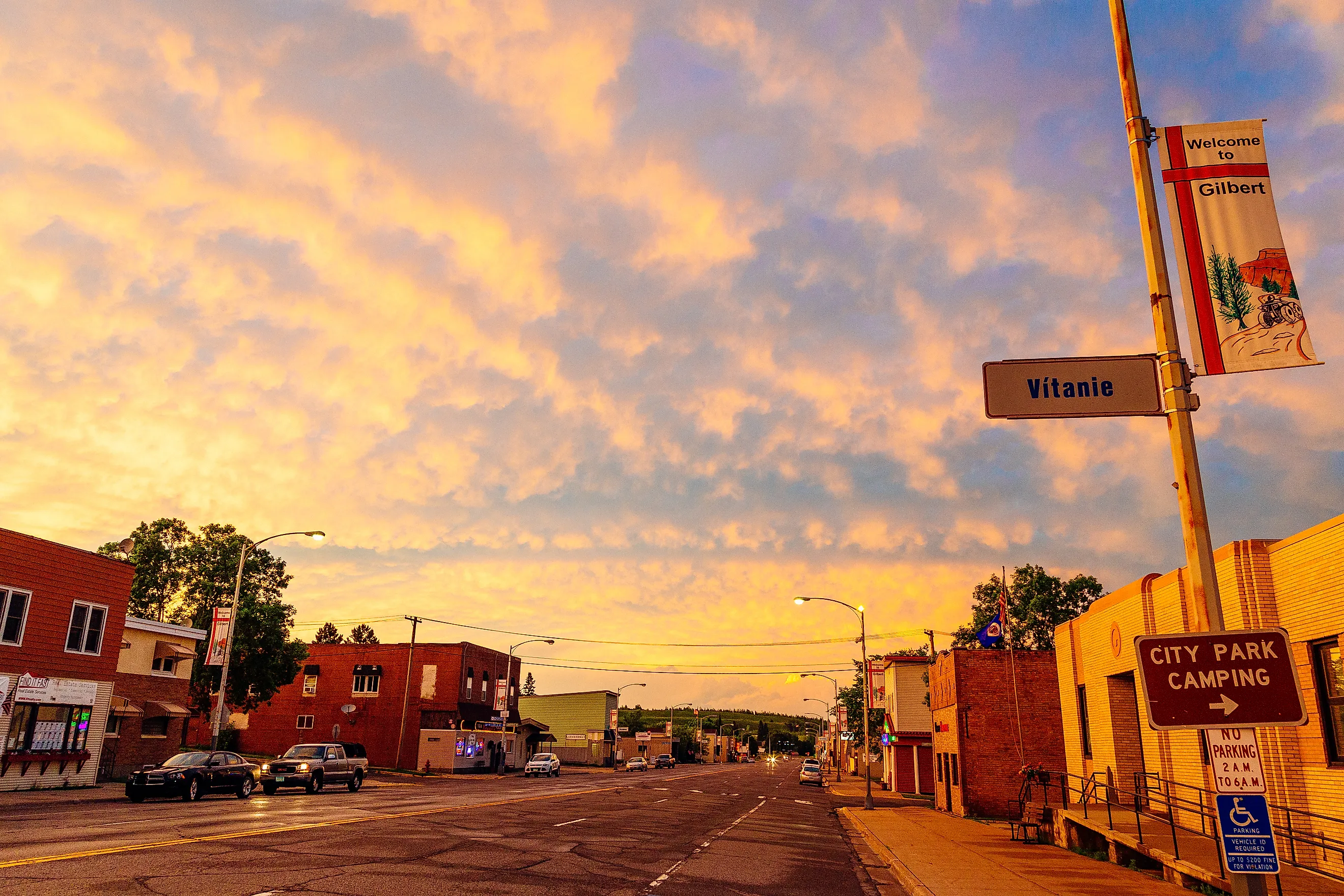
Gilbert is another town that was built and grew due to mining activities on the Mesabi Iron Range. Gilbert grew as quickly as it could attract miners and their families. These families settled nearby so workers could find employment in open-pit and underground mines. This town is one of the few that has remained small, while others have grown into larger cities. Gilbert stayed focused on local mining activity and the businesses that continued to serve miners. The town was named after the fee owner, Giles Gilbert, and when underground mining shifted to open-pit mining, the gorgeous Lake Ore-Be-Gone was created. This was the final Gilbert mining pit to be filled with water, and now it is a star attraction for visitors and tourists.
Lake Ore-Be-Gone’s waters are clear, so you can go scuba diving to see mining equipment abandoned hundreds of feet below. There is also a fishing pier, a dock, a picnic area, and a swimming beach for a fun day out. At the edge of town, you will find the Iron Range Off-Highway Vehicle Recreation Area, where you can go riding in an ATV or Jeep. And, since you'll want to stay a while, you can pitch a tent at the Sherwood Forest Campground, located next to the Mesabi Trail.
Looking Back To Appreciate What Is Here Today
If it were not for Minnesota’s small-town mining buzz, the stunning lakes and historical landscapes would not be here today. It is awe-inspiring to see how each town has carried its own history forward in the most practical ways. There are lakes and trails for locals and visitors to explore. Some industrial buildings have been transformed into landmarks or museums. And, even the smallest communities have found new purpose and reasons to stay long after mining jobs disappeared. When you visit these old-timey mining towns, you can trace how and when they adapted as soon as the main industry changed.