11 Tennessee Towns With Unforgettable Main Streets
Some of Tennessee's small-town Main Streets are tied to unusually specific histories. Jonesborough built a storytelling district around the International Storytelling Center. Dayton's courthouse square preserves the site of the 1925 Scopes Trial. In Rogersville, the Hale Springs Inn has been at the center of Main Street since 1824. Winchester runs a renovated 1950s theater on the courthouse square that still shows first-run films. The eleven Tennessee Main Streets ahead each carry their own anchor.
Jonesborough

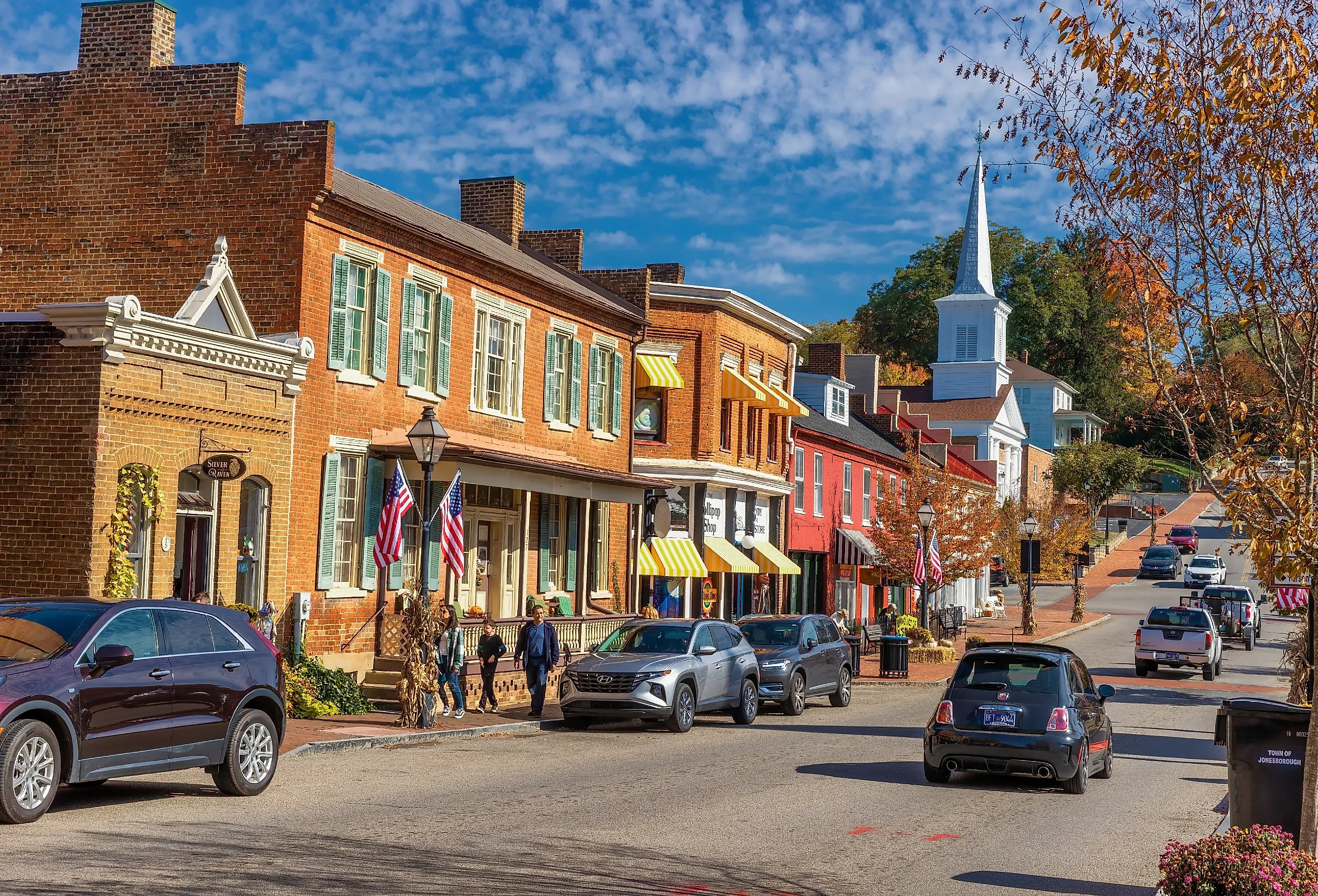
Jonesborough's Main Street has the advantage of being both deeply historic and still very much alive. Tennessee's oldest town leans into red-brick sidewalks, preserved storefronts, and a downtown that feels designed for wandering slowly. The International Storytelling Center is the town's defining stop, but it is not just a building with a good title. Its downtown campus includes the historic Chester Inn, Mary B. Martin Storytelling Hall, a gift shop, and Jimmy Neil Smith Storytelling Park.
The Chester Inn State Historic Site adds another layer to the street, as it sits at 116 West Main Street and preserves one of Jonesborough's most recognizable historic structures. The shops and cafes along Main Street keep the historic district active without pulling attention away from the older buildings. Jonesborough's Main Street has the rare quality of feeling both preserved and active, with the old buildings, brick sidewalks, shops, and storytelling tradition all reinforcing the same sense of place.
McMinnville

McMinnville's Main Street has an easy downtown rhythm, but the details keep it from feeling generic. The standout is The Park Theater, a restored Art Deco venue at 115 West Main Street that brings concerts, performances, and community events into the middle of downtown. It gives the street a natural evening stop and a reason to stay active after dinner.
Collins River BBQ & Cafe sits right on Main Street and describes itself as a locally owned barbecue spot in the heart of Warren County, with smoked meats, craft beer, and live music. Nearby downtown businesses, such as boutiques and local restaurants, give McMinnville enough to fill a low-key afternoon before a show. What makes this Main Street memorable is not one giant attraction. It is the pairing of a real downtown theater, local food, and storefronts that still feel connected to the town around them.
Bell Buckle

Bell Buckle proves that an unforgettable Main Street does not need to be large. The town's downtown clusters around Railroad Square, where antique shops, cafes, galleries, and old storefronts create a Main Street experience that feels almost impossibly preserved. Bell Buckle Cafe is the best-known stop, serving down-home food that helps anchor the downtown visit.
The town's Main Street also gets a personality boost from the RC Cola-MoonPie Festival held annually by the Bell Buckle Chamber of Commerce on the third Saturday in June. That event brings music, contests, food, and local tradition into the heart of downtown for one of Tennessee's more memorable small-town festivals. The Webb School adds another defining piece to Bell Buckle's identity, though downtown remains centered on Railroad Square, local shops, food, and festivals. Founded in 1870, the co-ed college-preparatory boarding and day school serves grades 6 through 12 and provides the town with a long-running educational institution tied to its history. Bell Buckle's Main Street is unforgettable because it turns a small downtown into a full expression of the town's history, traditions, and personality.
Rogersville

Rogersville's Main Street has the feel of an old East Tennessee crossroads, with older buildings and local landmarks still shaping the town's center. The town is one of Tennessee's oldest communities, and its downtown still carries that early sense of place. The best place to start is Hale Springs Inn, built in 1824 and located at 110 West Main Street in the heart of downtown Rogersville. The inn gives Main Street a centerpiece that feels lived-in rather than decorative.
Rogersville also benefits from having several walkable pieces close together. The Rogersville Historic District, Tennessee Newspaper and Printing Museum, and Crockett Spring Park & Arboretum are all near Hale Springs Inn, allowing visitors to move between architecture, local history, and green space without driving between each stop. That closeness is what makes the street work. Rogersville's Main Street feels like a preserved historic district that still understands the pleasure of a simple afternoon walk.
Greeneville

Greeneville's Main Street has a stronger civic feel than many small-town downtowns. Historic hotels, theaters, and presidential sites all sit within a few blocks, giving the district more weight than a simple storefront row. The General Morgan Inn is one of the street's most recognizable landmarks. Historic Hotels of America describes it as a Main Street property with dining, shops, and easy access to the Andrew Johnson sites.
The Capitol Theatre of Greeneville, located at 104 South Main Street, provides the district with an evening venue for movies, concerts, comedy, and community theater. Regular programming spanning movies, comedy, concerts, and Theatre Guild productions helps Main Street feel active beyond the usual daytime historic stops. The Andrew Johnson National Historic Site is close enough to shape the downtown experience, with the National Park Service preserving sites connected to the 17th president's life in Greeneville. Greeneville's Main Street is not just a row of storefronts. It has lodging, performance, national history, and a streetscape that still gives the town a strong, recognizable downtown core.
Dandridge

Dandridge's Main Street stands out for pairing a preserved historic downtown with a scenic East Tennessee setting near Douglas Lake. The town calls itself Tennessee's second-oldest town, and its downtown sits near Douglas Lake at the foothills of the Great Smoky Mountains. That combination gives Main Street a historic center with an unusually scenic backdrop.
The Jefferson County Courthouse is the defining downtown landmark, sitting on West Main Street and giving the town a traditional courthouse-square feel. Historic Downtown Dandridge is promoted as a walkable historic site with tours centered around Main Street. The Dandridge Visitors Center gives visitors background on the town before they explore the shops, historic buildings, and courthouse square. What makes Dandridge memorable is the scale. It feels compact, intact, and scenic all at once, with a Main Street that feels historic without feeling overly staged.
Sweetwater

Sweetwater's Main Street has a relaxed East Tennessee feel with a downtown that combines shops, local restaurants, historic walking-tour appeal, and easy access to nearby natural attractions. Main Street Sweetwater points visitors toward downtown shops and eateries, the Sweetwater Heritage Museum, a historic walking tour, and green spaces such as Duck Park. Sweetwater's downtown offers several easy ways to fill an afternoon, with shopping and local food alongside history and nearby outdoor stops.
The larger Sweetwater visit is strengthened by The Lost Sea, located just outside town and recognized as a National Natural Landmark, but the Main Street appeal still comes from its shops, food, museum, walking-tour stops, and relaxed downtown pace. While not on Main Street itself, it attracts many visitors who find themselves downtown afterward, taking advantage of all the places to eat, shop, or just slow down. Sweetwater offers a small downtown with local texture, while The Lost Sea gives the trip a memorable reason to begin nearby.
Paris

Paris has one of Tennessee's most recognizable downtown identities, with a historic courthouse square and a nearby Eiffel Tower replica that serves as an unmistakable landmark. Downtown Paris centers on a historic courthouse, with shops and lunch spots around it, while the nearby Eiffel Tower Park is home to a striking 60-foot steel Eiffel Tower, playgrounds, a splash pad, walking trails, sports fields, and picnic areas, so visitors can easily pair it with time around the downtown square.
Downtown Paris feels most like a classic small city. Its shops, lunch spots, and historic courthouse give the Main Street area a clear center before visitors head to nearby Eiffel Tower Park. That court-square setup gives the Main Street area a clear center, and events such as Tennessee River Jam, the Spring Open House, and the Downtown Paris Christmas Festival bring people back to the square throughout the year. Paris works because it has both playful attractions and a traditional downtown structure. The Eiffel Tower provides the photo op, but the square offers a place to go afterward.
Dayton

Dayton's Main Street is unforgettable because its courthouse square is home to one of the most famous courtroom stories in American history. The Rhea County Heritage and Scopes Trial Museum sits inside the historic courthouse where William Jennings Bryan and Clarence Darrow faced off during the 1925 Scopes Trial. That gives downtown Dayton a specific identity that is hard to confuse with anywhere else.
The courthouse is not just a marker to glance at. It remains the center of Dayton's downtown story through the museum, restored courtroom, and ongoing Scopes Trial Play & Festival. Downtown Dayton is memorable because the courthouse is not just a historic building. It is the place where the town's biggest story happened. Visitors can see the museum, step inside the restored courtroom, and then walk back out onto a Main Street that still functions as the center of town.
Lawrenceburg

Lawrenceburg's downtown square has a strong visual centerpiece: the David Crockett Statue, which stands as a local landmark. The statue was erected in 1922 and honors Crockett as a frontiersman, statesman, legislator, Alamo figure, and one of the town's most recognizable historic figures.
The downtown area around the square also includes the Crockett Theatre, the Mexican-American War Monument, and the Nicho of the South Mural on the west wall of the Society restaurant, giving downtown more than one landmark. Lawrenceburg's Main Street maintains a traditional county-seat feel, with the David Crockett Statue, theater, monuments, murals, and surrounding storefronts that give the square a clear local identity. The result is a Main Street that feels grounded in the town's history while still giving visitors specific places to pause, take a photo, catch a show, or keep walking around the square.
Winchester

Winchester's downtown square offers the kind of Main Street experience that preserves its historic scale. The Oldham Theater is the standout. It is a 1950s theater on the square where renovations have preserved the vintage look while still showing first-run movies. It provides downtown Winchester with a practical attraction, not just a nostalgic one. The theater adds character to the square while giving downtown Winchester a practical attraction rather than just a nostalgic one. The town's Main Street and square also benefit from Winchester's location near Tims Ford Lake, which brings visitors into the area before downtown offers places to eat, shop, or catch a movie. The square centers on the Franklin County Courthouse with broad sidewalks, local restaurants, specialty shops, and community events such as concerts and wine tastings, giving the downtown more than one reason to stay active. Winchester's Main Street stands out because its historic square still feels connected to daily life with the Oldham Theater, courthouse, local businesses, and nearby lake traffic all adding to the downtown's rhythm.
What Makes These Tennessee Main Streets Memorable
The best Main Streets in Tennessee are not memorable because they all look alike. Jonesborough leans into storytelling, McMinnville has a restored theater and local restaurants, and Bell Buckle turns a tiny downtown into a full personality. Farther east and west, places like Rogersville, Dandridge, Paris, Dayton, Lawrenceburg, and Winchester show how much a town can do with a courthouse, theater, museum, or historic inn placed in the right spot. These Main Streets work because they are not just photo backdrops. They still give people something specific to see, do, eat, remember, and come back for.