10 Under-The-Radar Retirement Towns In Texas
Increasingly, when it comes to retirement, older Americans are choosing river towns, pine forests, and Gulf islands that once sat far from any real estate brochure. Demographers now find that in many Texas counties, the 65-plus population is growing faster than any other age group, often in places that still rely on a single courthouse square or fishing harbor.
This guide looks at ten under-the-radar Texas towns like Kerrville, and Boerne, where retirement means waking up to river trails, working marinas, or dark-sky desert rather than gated cul-de-sacs. If you value walkable cores, cultural anchors, and everyday access to water or open land, this list is for you.
Kerrville

Kerrville sits quietly on the banks of the Guadalupe River, but it’s no sleepy Hill Country outpost. Known for hosting the longest-running folk music festival in North America, the Kerrville Folk Festival, it draws a national crowd of musicians and songwriters each spring. The town also boasts a large collection of outdoor sculptures, with bronze pieces tucked into parks and public spaces. With elevations around 1,600 feet, the area escapes the worst of the Texas heat, making it unusually pleasant year-round.
The Kerrville River Trail stretches over six miles, hugging the river and connecting residents to Louise Hays Park, a popular spot for walking and watching egrets skim the water. The Museum of Western Art houses a serious collection focused on cowboys, frontier women, and Native American life, and offers rotating exhibits worth revisiting. Pint & Plow Brewing Company anchors the small downtown with wood-fired pizza and live music nights. For those looking for serenity, the Riverside Nature Center offers quiet trails and native plant gardens just steps from the town center.
Boerne

Boerne was founded in 1852 by German freethinkers fleeing political unrest in Europe, and that contrarian spirit still marks the town. Set along Cibolo Creek, the town’s stone buildings and limestone bridges have been carefully preserved, giving Main Street a visual continuity rare in Hill Country. The city has kept large commercial development at arm’s length, allowing small businesses and local institutions to shape its pace. Its old library building is now a performing arts space; its old jail, a boutique shop.
The Hill Country Mile runs straight through downtown, with stores like The Dienger Trading Co. offering books, baked goods, and coffee in a restored 19th-century dry goods store. Cibolo Nature Center spans over 100 acres and includes trails through marshland, cypress forest, and native prairie. Just outside of town, Cave Without a Name offers limestone chambers and underground concerts in a natural acoustic hall. Cibolo Creek Brewing Co., just off the Hill Country Mile, now fills that role with house-brewed beers, a shaded patio, and a regular schedule of food trucks and live music.
Marble Falls

Marble Falls was built around water, not railroads or cattle. The Colorado River flows directly through the center of town, forming Lake Marble Falls and anchoring daily life with open views and constant motion. The original marble-like rock for which the town was named has long been submerged by the dam, but its identity remains tied to the lake and the bluffs above it. Unlike other Hill Country towns, Marble Falls developed as a hydro-powered industrial hub, giving it a different rhythm—less staged, more lived-in.
Blue Bonnet Café has been serving pie since 1929 and still pulls steady crowds seven days a week. Lakeside Park offers direct access to Lake Marble Falls, with a public beach, boat ramp, and long views across the water. Art and culture center around Harmony Park and the nearby Sculpture on Main, an open-air exhibit that threads large-scale installations through downtown. Flat Creek Estate Winery, northeast of Marble Falls, offers tastings of estate Texas wines, wood-fired pizzas at its bistro, and long views over its 80-acre Hill Country vineyard.
Granbury

Granbury’s limestone courthouse square is one of the most intact in Texas, anchored by an 1891 Second Empire-style courthouse and surrounded by buildings that haven’t drifted far from their original use. The town is named for Confederate General Hiram Granbury, but its main draw today is Lake Granbury, a long, narrow reservoir that cuts directly through the landscape. Retirees settle here for the walkable downtown, steady stream of cultural events, and lake access without the heavy tourism of larger waterfront towns.
The Granbury Opera House stages live theater in a restored 19th-century venue with original balcony seating and gaslight replicas. Down the street, Ketzler’s Schnitzel Haus offers German staples with outdoor seating facing the square. Granbury City Beach Park, directly off Pearl Street, provides lake swimming and shaded picnic areas within walking distance of downtown. For quieter afternoons, Shanley Park borders the creek and connects to the city’s hike-and-bike trail via footbridge.
Rockport

Rockport developed as a shipbuilding and fishing hub, but its modern reputation rests on two things: coastal birding and the state’s only certified Blue Wave Beach. Located on Aransas Bay, the town serves as a wintering ground for whooping cranes and a permanent home to pelicans, egrets, and herons that move along the shoreline year-round. Its historic homes and weathered piers remain central to its identity, even as galleries and seafood spots continue to multiply around Austin Street.
Rockport Beach, maintained by the city, includes a long arc of sand, covered cabanas, and a protected swimming area. The Fulton Mansion, built in the 1870s, offers tours of the restored Second Empire home, complete with gaslight fixtures and indoor plumbing installed before much of Texas had either. Latitude 28°02’ serves seafood and displays work from local artists, functioning as both restaurant and gallery. Rockport Center for the Arts, relocated in a new facility, hosts exhibitions, workshops, and a sculpture garden a few blocks from the harbor.
Port Aransas

Port Aransas sits at the northern tip of Mustang Island, bordered by dunes, surf, and ship channels that remain active with working vessels and recreational boats alike. Known as the “Fishing Capital of Texas,” the town maintains daily charters for deep sea, bay, and jetty fishing, with marinas that function as social hubs. Its year-round ferry, which connects the island to the mainland, underscores its separation—Port Aransas is accessible, but not incidental.
Port Aransas Beach runs uninterrupted along the Gulf, with beach access roads and parking directly on the sand. Virginia’s on the Bay, located in the marina district, overlooks shrimp boats and hosts nightly crowds drawn by blackened fish and oyster platters. Leonabelle Turnbull Birding Center includes a boardwalk that cuts through marshland, offering consistent views of roseate spoonbills and, during migration, species from across the continent. Farley Boat Works operates as a community boatbuilding center, preserving the tradition of the local tarpon skiffs that once defined commercial fishing here.
Wimberley

Wimberley sits at the confluence of Cypress Creek and the Blanco River, a layout that has shaped its scale and identity. Known for its artesian springs and limestone swimming holes, the town is also a magnet for visual artists and musicians, many of whom relocated here in the 1970s and stayed. Public art—boots, benches, installations—fills the town square, while the surrounding hills hold studios, sculpture gardens, and low-profile retreats. Despite its size, Wimberley sustains a year-round arts economy and preserves its physical limits with few large-scale developments.
Blue Hole Regional Park, fed by spring water and shaded by bald cypress, operates with timed swim slots and limits on capacity, keeping its creek-fed pool quiet even in summer. On Market Days weekends, Lions Field turns into a maze of stalls for antique tools, plants, local honey, and quilts. Leaning Pear, perched on a bluff off River Road, serves seasonal Hill Country dishes in a glass-walled dining room with views of the creek. Old Baldy, a 218-step limestone hill on the edge of town, offers clear views of the Wimberley Valley and serves as a quick climb for early risers.
Alpine

Alpine sits at 4,475 feet in the high desert, surrounded by the Davis Mountains and the Chihuahuan grasslands. It is one of the few towns in Texas with a functioning Amtrak stop, a four-year university, and no big-box retail. The town’s mural program covers dozens of buildings with hand-painted history and desert iconography. Its remote location keeps the skies dark—McDonald Observatory, an hour away, depends on Alpine’s minimal light pollution for research-grade visibility. The town’s altitude brings cooler summers and colder winters than most of the state.
Hancock Hill rises directly behind Sul Ross State University, with a steep, unpaved trail that leads to a student-placed desk overlooking downtown. The Museum of the Big Bend sits on campus and houses regional exhibits on ranching, border culture, and geology. Cedar Coffee & Supply, a specialty coffee bar on North 4th Street, now handles most of the daily espresso traffic a few blocks from the courthouse square. Reata Restaurant offers green chile mashed potatoes and local beef, with rooftop seating that looks out over the basin.
Bastrop

Bastrop sits in a stretch of loblolly pine known as the Lost Pines, a forest pocket separated by over a hundred miles from East Texas timberlands. Its downtown runs along the Colorado River and contains over 130 historic buildings, including the Bastrop Opera House and the 1889 county courthouse. While nearby Austin continues to expand, Bastrop holds its scale through zoning limits and historic preservation, resulting in a town that’s increasingly connected but still self-defining.
Neighbor’s Kitchen & Yard, built into a 19th-century feed store, overlooks the river and hosts live music on its lawn most weekends. Bastrop State Park offers hiking through post-fire regrowth and fishing in Lake Mina, with CCC-era stone shelters still in use. The 602 Brewing Company, set in the former First National Bank, serves local beer under pressed-tin ceilings and maintains a regular schedule of jazz and blues nights. The Bastrop Museum and Visitor Center anchors the town’s commercial core, with exhibits on regional timber, rail, and flood history. A riverside boardwalk links downtown to Fisherman’s Park and serves as a quiet corridor for walkers, runners, and herons.
Fredericksburg
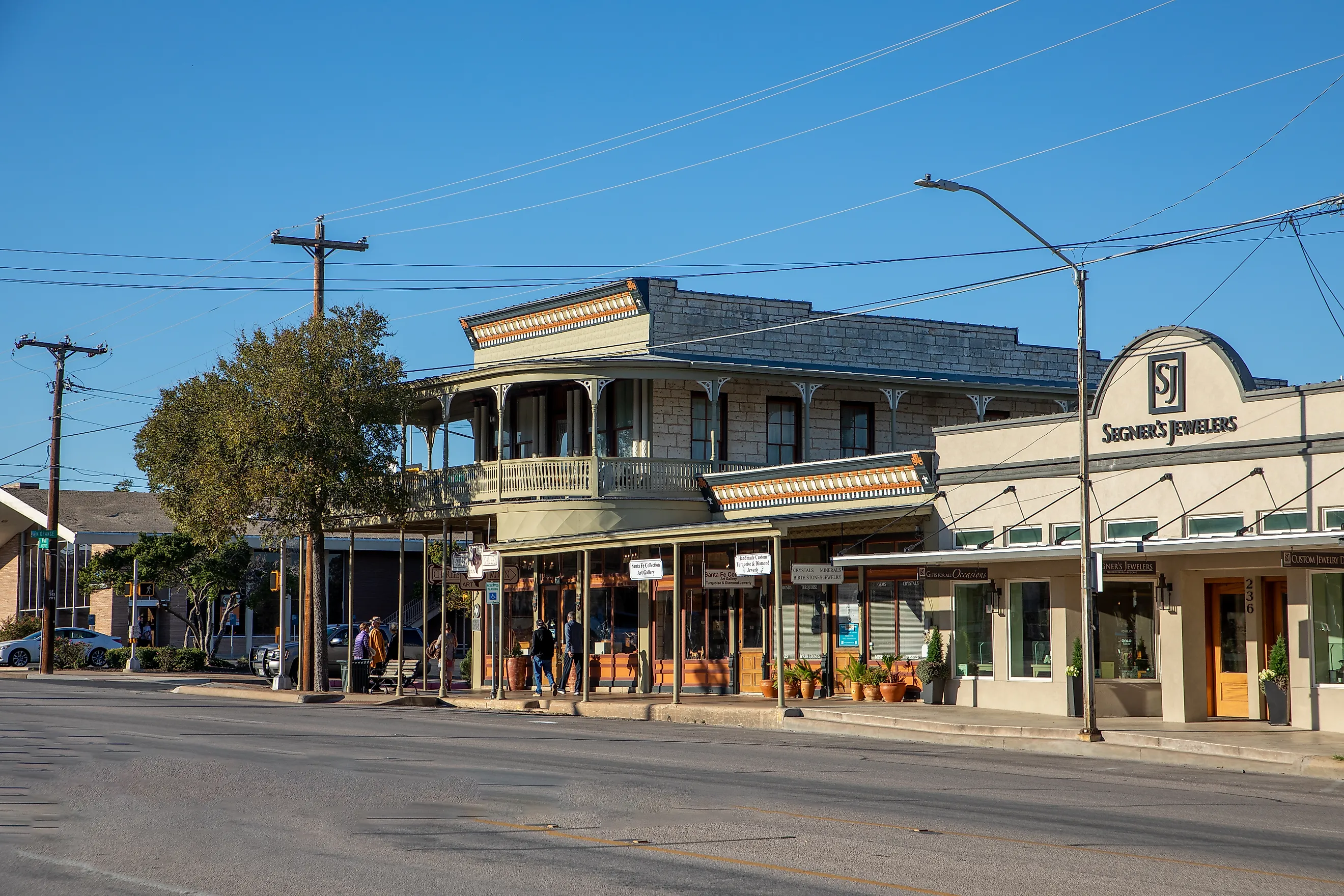
Fredericksburg was founded in 1846 by German immigrants who signed a peace treaty with the Comanche that remains unbroken. The town’s cultural footprint is anchored not just in its architecture, but in its calendar—Oktoberfest, Weihnachtszeit, and the annual Vereins Kirche lighting all maintain direct links to its origin. Unlike many Hill Country towns, Fredericksburg still has a strong German cultural footprint, with the Fredericksburg Standard-Radio Post covering local life and the school district maintaining German language instruction alongside standard coursework. Its Main Street spans nearly a mile, with the historic core dominated by independent restaurants and bars even though national chains appear farther east along the same corridor.
The National Museum of the Pacific War, housed in the former Nimitz Hotel, includes indoor and outdoor exhibits covering the Asian theater of WWII with archival footage, aircraft, and oral histories. Otto’s, located behind the museum, serves a rotating menu of Central European dishes like duck schnitzel and flammkuchen. Grape Creek Vineyards operates a full tasting room on Main Street, while its larger property on Highway 290 includes a tram tour through the vines. Enchanted Rock, a granite dome 17 miles north, offers marked trails and designated dark-sky viewing zones.
For retirees who measure quality of life in morning walks, familiar shopfronts, and recurring festivals, places like these towns turn the idea of “slowing down” into something active, rooted, and durable.