10 Stunning Small Towns In North Carolina
North Carolina is one of the few US states with both high mountains and barrier islands, giving many of its towns undeniable charm. Along the Eno River in North Carolina’s Piedmont, Hillsborough preserves an old street grid and landmarks like Ayr Mount and the Old Orange County Courthouse. And in far southwestern North Carolina at more than 4,000 feet elevation, Highlands brings together Dry Falls and a compact center anchored by spots like The Bascom and Kilwins. To explore North Carolina at its most scenic, these 10 towns below offer the best views in the state.
Blowing Rock

Just off the Blue Ridge Parkway, Blowing Rock sits high in North Carolina’s Blue Ridge Mountains above steep wooded ridges. That mountain setting carries straight into Moses H. Cone Memorial Park, where a preserved estate, carriage roads, and the walk around Bass Lake add a strong historic layer close to town. From there, the focus naturally shifts to The Blowing Rock itself, the cliffside landmark most closely tied to the town’s identity and the old legend behind its name. Back in the center, the Blowing Rock Art & History Museum gives the area a solid indoor stop through regional art and Appalachian history. Main Street then finishes the picture with places like Kilwins and The Spice & Tea Exchange rather than a blur of shops.
Bryson City

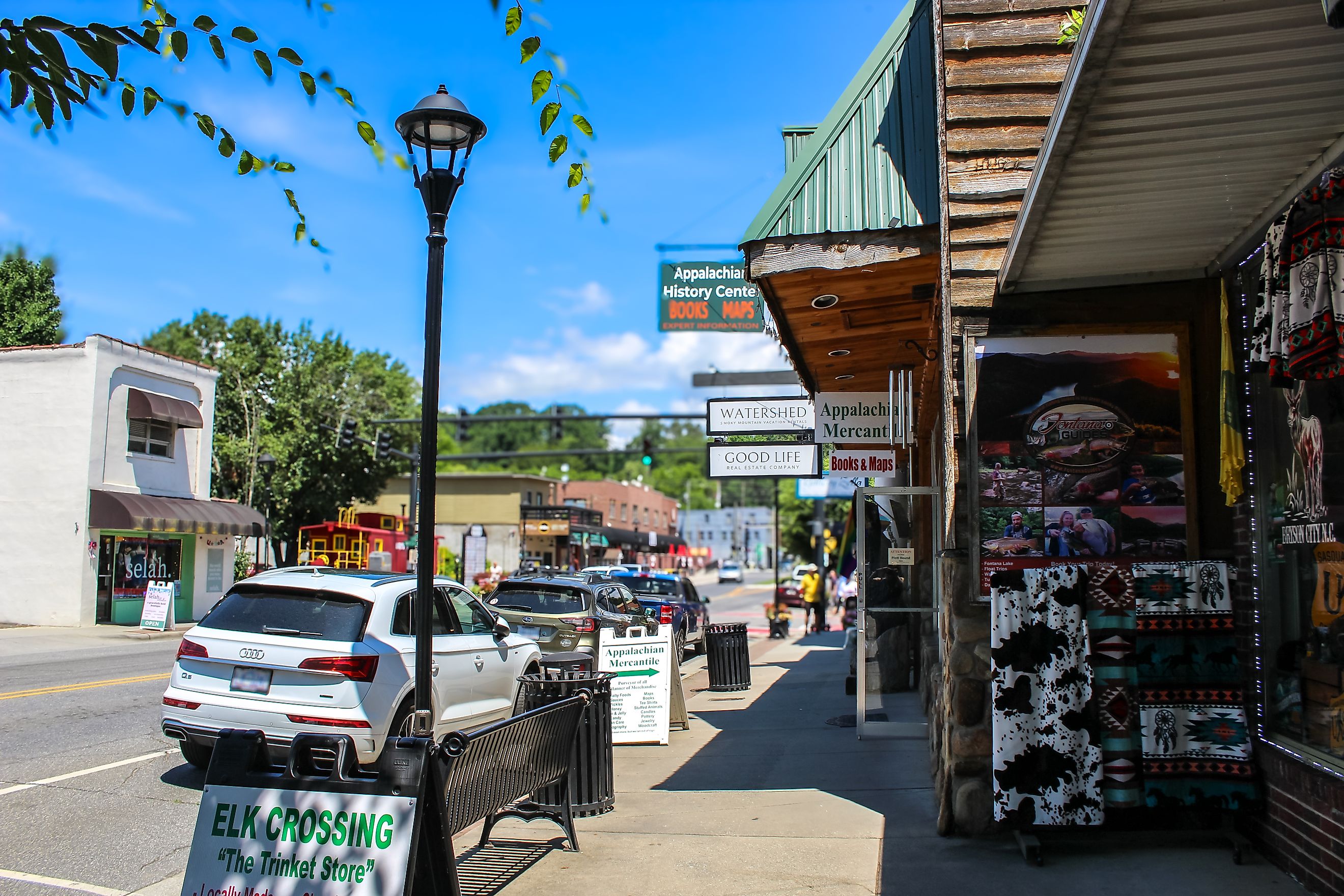
Along the Tuckasegee River beside Great Smoky Mountains National Park, Bryson City developed in a narrow mountain setting shaped by rail lines and wooded slopes. That railroad history still defines the place, which is why the Great Smoky Mountains Railroad remains the town’s best-known attraction, sending excursion trains out from the historic depot through tunnels, river valleys, and mountain scenery. The same local story continues at the Swain County Heritage Museum, where the old courthouse houses exhibits on Cherokee history, logging, and rail development in the region. After those stops, Deep Creek shifts the emphasis outdoors with waterfalls, streamside trails, and a tubing route just outside town. Back on Everett Street, Mountain Layers Brewing Company gives the center a stop with rooftop seating and mountain views.
Beaufort

On Taylor’s Creek along North Carolina’s Crystal Coast, Beaufort still follows an old seaport layout shaped by its long waterfront and harbor traffic. That working-waterfront setting is easiest to take in along Front Street, where Beaufort Grocery Co. is one of the places anchoring the stretch near the water. Just across the channel, the Rachel Carson Reserve adds a striking natural counterpoint with marshes, birdlife, and the wild horses that have become one of Beaufort’s most recognized sights. Back in town, the North Carolina Maritime Museum explains the coast more fully through exhibits on Blackbeard’s Queen Anne’s Revenge and local boatbuilding traditions. The Beaufort Historic Site then ties everything together by preserving the buildings that show how the port developed over time.
Edenton

Set on Albemarle Sound in North Carolina’s Inner Banks, Edenton is defined by its waterfront green and one of the state’s most intact colonial-era centers. The shoreline remains central to the town’s appeal, which is why Waterman’s Grill stands out with tables beside the marina and direct views over the water. From there, it is easy to move into Edenton’s earlier history at the Penelope Barker House, which connects the town to the Tea Party protest and also holds one of the best positions on Edenton Bay. The 1758 Cupola House adds another major landmark through its Georgian architecture and restored gardens. Near the green, the 1767 Chowan County Courthouse brings the whole scene into focus as the building most closely associated with Edenton and one of the oldest courthouses still in use in the country.
Brevard

Near the entrance to Pisgah National Forest in Transylvania County, Brevard sits close to some of western North Carolina’s best-known trails and waterfalls. That access is most obvious at Looking Glass Falls, which drops beside U.S. 276 in a setting that delivers one of the area’s clearest scenic payoffs without much hiking. The broader landscape continues into Pisgah National Forest itself, where trailheads, overlooks, and additional cascades explain why the region has long been associated with waterfalls. Closer to town, the Brevard Music Center adds a different dimension through its wooded campus and summer performance schedule. Downtown, the White Squirrel Shoppe brings the local character into sharper focus by leaning directly into the white squirrels that have become Brevard’s best-known emblem.
Highlands

At more than 4,000 feet in North Carolina’s far southwest, Highlands sits in steep mountain country surrounded by Nantahala National Forest. That terrain shapes the town’s best-known outdoor stop, Dry Falls, where the trail passes behind the waterfall instead of stopping at a distant overlook. For an even wider view of the landscape, Whiteside Mountain adds sheer cliffs and one of the region’s strongest short hikes. Back near town, The Bascom: A Center for the Visual Arts introduces a more formal cultural stop through galleries and studios on a campus just outside the busiest blocks. On Main Street, Kilwins keeps things grounded, drawing people in for fudge and ice cream rather than relying on a vague shopping scene.
Manteo

Facing Shallowbag Bay on Roanoke Island, Manteo occupies a harborfront position between the Outer Banks and the mainland. That waterfront setting is immediately visible at the Roanoke Marshes Lighthouse, which stands at the end of its boardwalk as one of the town’s most recognizable views. A short distance away, Poor Richard’s Sandwich Shop keeps the harbor in sight with an upstairs dining room overlooking the water. The historical side of Manteo comes through most clearly at Roanoke Island Festival Park, where exhibits on the first English settlement attempt are anchored by the full-scale Elizabeth II ship. Nearby, the Elizabethan Gardens extends that colonial thread through formal plantings and sculpture tied to the island’s early English story.
Southport

Where the Cape Fear River opens toward the coast, Southport spreads out along a waterfront grid of old houses, docks, and broad views across the channel. The town’s long relationship with the river comes through first at Waterfront Park, where benches and live oaks line the shore facing passing vessels. That maritime setting continues at Provision Company, a stop beside the marina known for shrimp burgers and seafood served close to the water. Southport’s deeper history then comes into view at Fort Johnston-Southport Museum & Visitors’ Center, tied to one of the oldest military sites on the lower Cape Fear. The North Carolina Maritime Museum at Southport builds on that context with exhibits about storms, fishing, and daily life along this stretch of coast.
Hillsborough

Along the Eno River in the North Carolina Piedmont, Hillsborough combines an old street grid with riverbank paths and a compact historic core. The river remains part of the town’s appeal through the Riverwalk, which follows the Eno past stonework, wooded stretches, and remnants of earlier industry near downtown. From there, the center shifts back toward town life at Weaver Street Market, a local anchor that functions as grocery, café, and gathering place all at once. The architectural focus sharpens on King Street at the Old Orange County Courthouse, still the building that most clearly defines the historic core. A short distance away, Poor Richard’s Sandwich Shop adds a reliable waterfront stop on Queen Elizabeth Avenue, with dining right along the Manteo boardwalk.
New Bern

At the confluence of the Neuse and Trent rivers, New Bern occupies a two-waterfront site on North Carolina’s coastal plain. That setting is easiest to grasp at Union Point Park, where the city opens directly onto the water at the edge of downtown. From there, the historic center leads naturally to Tryon Palace, whose reconstructed government buildings and formal gardens recall New Bern’s years as the colonial capital. A different piece of the city’s past appears at Cedar Grove Cemetery, where old family plots and carved markers preserve some of the earliest surviving inscriptions in town. The side becomes clear at the Birthplace of Pepsi, which marks the original drugstore site and still serves the drink in a period-style setting.
From mountain towns like Blowing Rock, Bryson City, and Highlands to coastal favorites like Beaufort, Manteo, and Southport, North Carolina delivers remarkable variety in a relatively short distance. These small towns combine riverfront streets, historic sites, waterfall trails, harbor views, and memorable local landmarks without losing their individual character. Whether you head for the Blue Ridge or the coast, each one offers a different way to see why North Carolina is such a beautiful state.