US Cities With the Most Skyscrapers
Skyscrapers do more than scrape the sky; they reveal how a nation chooses to grow.
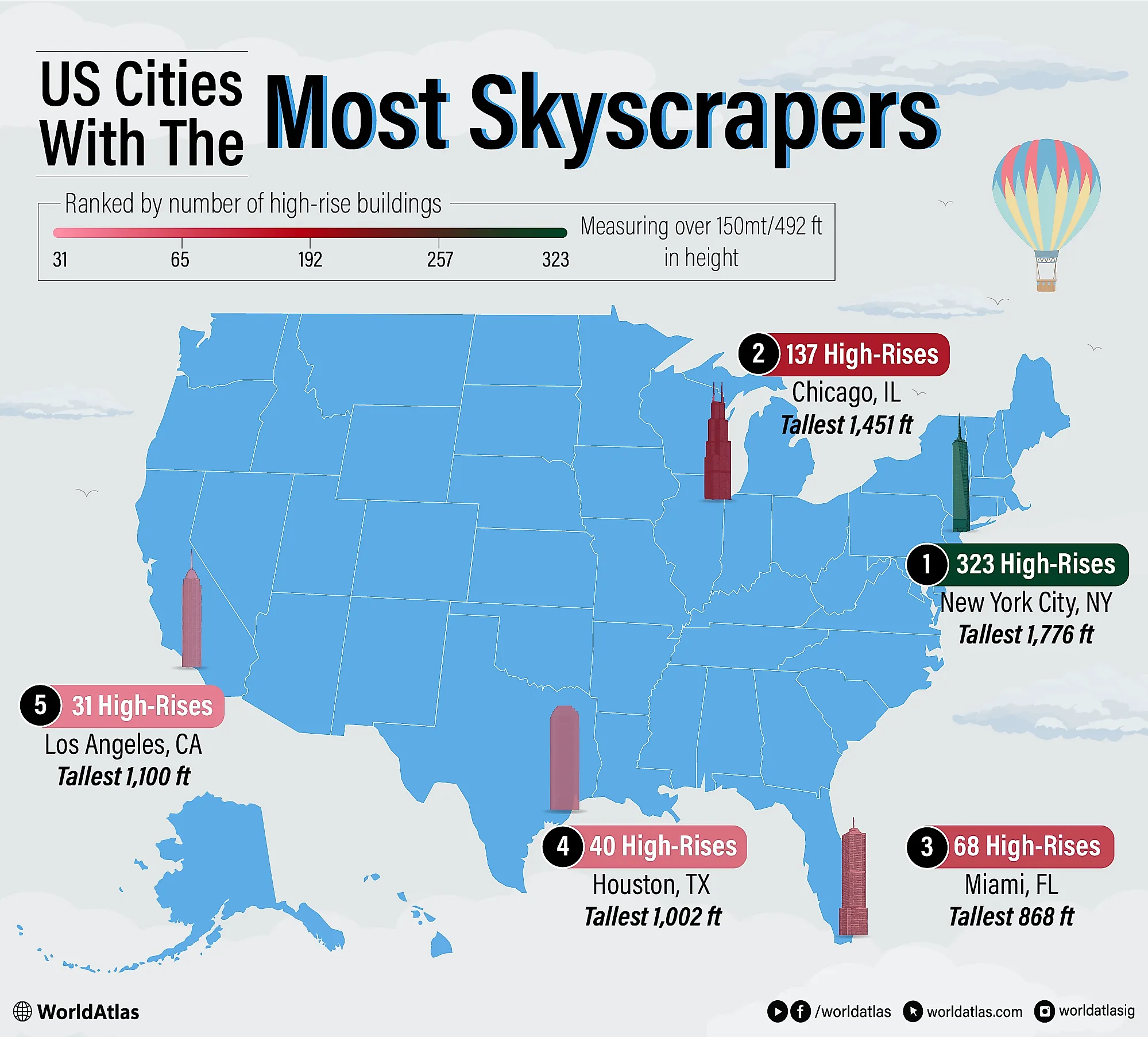
This ranking of U.S. cities with the most tall towers highlights five very different models of urban ambition: New York City, Chicago, Miami, Houston, and Los Angeles. Each skyline is shaped by a distinct mix of history, economics, regulation, and geography, from New York’s finance-fueled supertalls to Miami’s height-limited residential boom.
Why does density concentrate in some cores while others spill into multiple business districts or coastal corridors?
| Rank | City | State | N# of Skyscrapers |
|---|---|---|---|
| 1 | New York City | NY | 323 |
| 2 | Chicago | IL | 137 |
| 3 | Miami | FL | 68 |
| 4 | Houston | TX | 40 |
| 5 | Los Angeles | CA | 31 |
1. New York City, New York - 323

New York dominates U.S. skyscraper rankings, anchored by New York City, the nation’s largest skyline. As of 2025, the city counts 879 buildings over 100 m, including 323 (plus six topped out) above 150 m, 101 (+5) above 200 m, 18 (+1) above 300 m, and six above 400 m.
One World Trade Center (1,776 ft) is the state and country’s tallest. Skyscrapers concentrate in Midtown and Lower Manhattan, with major 21st-century growth from the World Trade Center redevelopment, Billionaires’ Row supertalls (Central Park Tower, 111 West 57th), and the Hudson Yards/Manhattan West megaprojects. Historic peaks include the 1930-31 Chrysler and Empire State Buildings; the Twin Towers (1970s) later redefined the skyline. Super-tall construction has spread beyond Manhattan: Brooklyn’s 1,066-ft Brooklyn Tower and Queens’ emerging Long Island City cluster lead outer-borough growth. With more than 7,000 high-rises and the world’s third-largest concentration of supertalls, New York remains firmly America’s skyscraper capital.
2. Chicago, Illinois - 137

Illinois’ skyscraper story is defined by Chicago, the birthplace of the form. The 1885 Home Insurance Building pioneered the steel frame, launching waves of construction that made Chicago’s skyline the nation’s second largest after New York. 110-story Willis Tower (1,451 ft, 1974) remains the city’s peak; Chicago claims five of the 15 tallest U.S. buildings. As of 2025, it has 353 buildings over 100 m, 137 over 150 m, 38 over 200 m, seven over 300 m, and two over 400 m. Booms in the 1880s-1930s, 1960s-1990s, and since the 2000s produced icons including Aon Center, 875 North Michigan Avenue, Trump International Hotel & Tower, and St. Regis Chicago, the world’s tallest woman-designed tower. Growth has spread from the Loop into Streeterville, River North, the South Loop, and the West Loop. Current headline project: 400 Lake Shore Drive (due 2027), with Tribune East Tower approved, underscoring Illinois’s enduring leadership in tall-building innovation.
3. Miami, Florida - 68

Florida’s skyscraper story is overwhelmingly a Miami one. The metro (6.4 million) hosts the nation’s third-largest skyline after New York and Chicago, with 400+ high-rises and 68 buildings at least 150 m (492 ft), plus more topping out.
Miami’s tallest is the 85-story Panorama Tower, 826 ft, completed in 2017 in Brickell. The city’s early skyline began with Burdine’s (1912) and the Freedom Tower (1925), but the profile stayed modest until a mid-1990s residential boom that stretched the skyline from Downtown into Brickell and Edgewater, paused in the Great Recession, then reignited in the mid-2010s and in the 2020s. Height in Miami is constrained by FAA limits tied to Miami International Airport, capping buildings at 1,049 ft above sea level; the under-construction Waldorf Astoria Miami will meet that limit. Miami’s skyline is dominated by residential and mixed-use towers and hotels, with additional clusters in Coconut Grove, including Sunny Isles Beach.
4. Houston, Texas - 40

Houston anchors Texas’s skyscraper story with a sprawling, multi-core skyline. Downtown’s high-rise surge began with the 1970s energy boom and culminated in the 75-story, 1,002-ft JPMorgan Chase Tower, the tallest building in Texas, followed by the 71-story, 992-ft Wells Fargo Plaza. A seven-mile tunnel and skywalk network stitches much of Downtown together.
Unlike most U.S. cities, Houston developed several business districts beyond Downtown, Uptown, the Texas Medical Center, Greenway Plaza, Westchase, the Energy Corridor, Midtown, and Greenspoint, creating multiple skylines. Uptown’s landmark is the 64-story, 901-ft Williams Tower, long cited as the tallest U.S. skyscraper outside a central business district. Since 2000, the city has added more than 30 new skyscrapers and dozens of mid- and high-rise residences, with 72 high-rises in total noted in local counts. In 2015, Houston ranked fifth in North America for skyline height. The result is a diversified vertical profile that mirrors the city’s energy, medical, and aerospace economy.
5. Los Angeles, California - 31

California’s skyscraper story is anchored by Los Angeles, California’s largest city, and notably the West Coast’s biggest skyline. LA counts 800+ high-rises, including 107 exceeding 300 ft and 88 topping 100 m, with 32 at 150 m+ (placing the city fifth nationally).
Two supertalls crown the skyline: Wilshire Grand Center (1,100 ft, 2017), California’s tallest, and U.S. Bank Tower (1,018 ft, 1989). The city’s high-rise era began with the 13-story Braly (1903), but a 1904 height cap of 150 ft, except for 1928’s City Hall, kept buildings low until the limit was lifted in 1957. A major boom from the 1960s to the 1990s produced many downtown landmarks, followed by a residential-heavy surge from the mid-2010s that pushed the core south. Today, tall clusters span Downtown, Century City, Wilshire’s Koreatown/Miracle Mile corridor, Westwood, LAX’s Century Boulevard, Hollywood, and the San Fernando Valley, with additional hubs in Greater LA cities such as Long Beach, Glendale, and Irvine.