The State Parks With The Longest Entrance Lines
On the Fourth of July in 2024, the line to get into Greenbrier State Park stretched 3.1 miles back along U.S. Route 40, and Maryland staff went out and measured it. At Slide Rock in Arizona, the wait to park once got so bad that rangers couldn't reach their own gate to open it. On summer mornings at Sand Harbor, people show up before dawn to claim a stall on the Lake Tahoe shore. No agency tracks these waits nationwide, so no one can say for certain which park has the worst of them. But at each of the parks below, someone counted the cars, clocked the delay, or shut the gate by lunchtime, and wrote it down.
Greenbrier State Park, Maryland

Greenbrier State Park has the strongest measured traffic backup in this group. Maryland Department of Natural Resources staff recorded a 3.1-mile queue on U.S. Route 40 on July 4, 2024. Hundreds of vehicles were waiting for entry, and the backup affected highway traffic and nearby homeowners. Maryland had also been recording more than 150 capacity closures annually across its park system, with Greenbrier among the locations facing serious overflow problems.
Greenbrier moved to advance day-use reservations during peak weekends and holidays in 2025. Maryland reported that its first reservation season nearly eliminated traffic backups at participating parks. None experienced an unexpected capacity closure that summer. The system remains in use at Greenbrier in 2026, and Maryland expects busy dates to sell out regularly. Once inside, visitors have a 42-acre freshwater lake and sandy swimming beach waiting beyond the gate.
McArthur-Burney Falls Memorial State Park, California

McArthur-Burney Falls Memorial State Park has produced some extraordinary documented waits. California State Parks says campers sometimes needed up to two hours to re-enter on crowded days. Weekend parking frequently reached capacity, and the park could close for several hours. Traffic also backed up along State Route 89.
Most day visitors head toward 129-foot Burney Falls, where spring-fed water pours over volcanic rock into a forested basin. Park facilities largely date to the 1960s. California says that infrastructure was never designed for today's visitation levels. Heavy summer use also led to illegal roadside parking and unsafe conditions along SR 89.
California introduced a reservation pilot for peak weekends and holidays in 2026. Timed vehicle passes are issued in limited quantities, and same-day reservations are unavailable. Campers with overnight reservations do not need another day-use booking. The state launched the program after documenting crowded entrances, repeated parking shortages, and highway safety problems.
Slide Rock State Park, Arizona

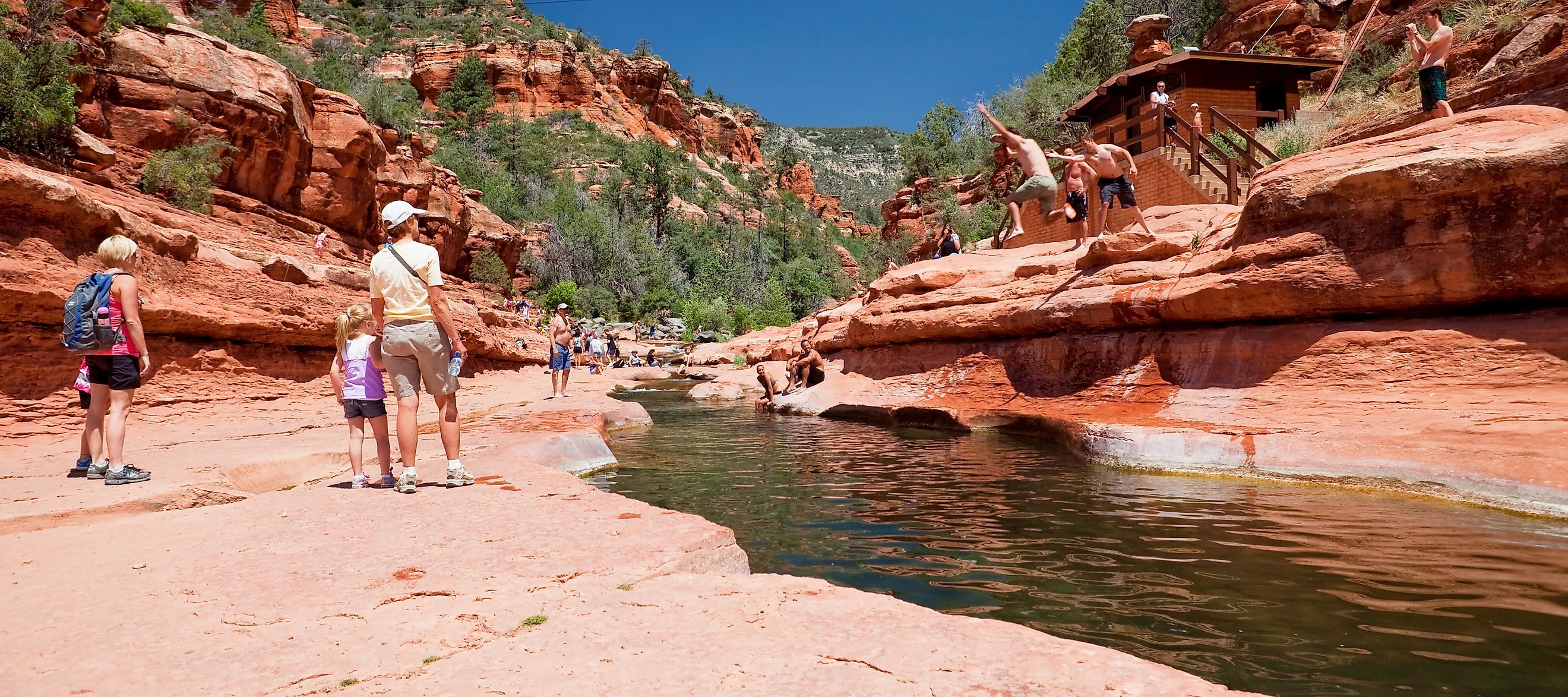
Slide Rock State Park became so crowded in summer that Arizona changed the rules for waiting outside its entrance. Visitors had often queued on State Route 89A through Oak Creek Canyon while parking spaces opened. Arizona State Parks and Trails said waits could reach an hour or more. The stopped vehicles clogged a major route through the Sedona area. Officials also reported occasions when congestion prevented rangers from reaching the property to open it. Beginning May 1, 2026, vehicles were prohibited from lining up along SR 89A for parking. Drivers must continue past the entrance when the lot is full. Oak Creek runs across smooth red sandstone inside the park, forming the natural water slide that gives Slide Rock its name. Hot summer days can send parking demand soaring early.
Sand Harbor, Lake Tahoe Nevada State Park, Nevada

At Sand Harbor, summer visitors once arrived during very early morning hours simply hoping to secure parking. Nevada State Parks says that pattern contributed to congestion along Highway 28, where roadside parking is prohibited. The park later adopted required day-use vehicle reservations during its main warm-season period.
Reservations guarantee a parking space until 10:30 a.m. Nevada specifically identifies highway congestion and beach overcrowding among the reasons for the system. Capacity controls continue after the morning rush. Rangers close the gates once Sand Harbor reaches its safe visitor limit, with another group generally admitted later in the day. Demand centers on a compact Lake Tahoe shoreline with clear water, sandy swimming areas, and distinctive granite formations close to shore.
Blue Spring State Park, Florida

Blue Spring State Park directly warns visitors about a history of long entrance lines. Florida State Parks says the property frequently reached capacity and temporarily closed during periods of heavy visitation. Some closures lasted several hours. Walkers and cyclists could also be denied admission until space became available again.
Winter brings crowds to see manatees gathering around the spring's roughly 72-degree water. Swimming season creates another busy period once water recreation resumes. The spring run connects with the St. Johns River, giving this compact park plenty of reasons to fill during different parts of the year.
Mandatory day-use reservations began July 15, 2026. Blue Spring's park manager said years of long traffic lines and capacity closures helped drive the change. All day-use visitors now need reservations, including annual passholders. The booking guarantees admission and gives park staff a way to control vehicle numbers before they reach local roads.
Wekiwa Springs State Park, Florida

Wekiwa Springs State Park had an entrance queue that extended beyond park property and into surrounding traffic. Florida State Parks cites those backups, significant road disruption, and long visitor waits as reasons for requiring day-use reservations. The rule took effect in September 2025 and covers annual passholders along with other day visitors. Wekiwa sits a short drive outside Orlando, placing its 72-degree spring within easy reach of a large metropolitan population. The spring feeds the Wekiva River, and thousands of acres of central Florida habitat surround the water. The park opens at 8 a.m., with reservations required before day-use entry. Florida also collects the admission charge during booking, removing that payment step at the entrance.
Henderson Beach State Park, Florida

Henderson Beach State Park sits directly beside U.S. Highway 98 in Destin. Florida State Parks says vehicles waiting for admission had stretched into surrounding traffic and caused long delays. Mandatory day-use vehicle reservations began May 15, 2026, with reducing those entrance queues named as a reason for the change.
Beyond the entrance lies more than a mile of Gulf shoreline bordered by white sand dunes reaching about 30 feet. The park occupies a small piece of the heavily visited Destin coast, and its campground brings overnight guests onto the same property. Annual state park passholders and Destin resident passholders still need vehicle reservations. Pedestrians and bicyclists are exempt. Admission is handled during the reservation process before motorists reach the gate.
Devil's Lake State Park, Wisconsin

Devil's Lake State Park receives more than 2.5 million visitors annually, according to the Wisconsin Department of Natural Resources. It is Wisconsin's most-visited state park. DNR specifically tells summer and fall weekend visitors to expect long entrance lines and long waits.
Parking pressure develops early in the day. Lots often fill before 9 a.m. on busy weekends and holidays between May and October. Access can then be temporarily restricted until congestion decreases. DNR also asks motorists to keep moving when a parking area is full and prohibits waiting along roadways.
The busiest territory includes the lake's north and south shores and the quartzite bluff trails above the water. Wisconsin recommends purchasing vehicle admission before arriving to shorten waits at entrance stations. Parking has faced additional pressure in 2026 because construction has reduced availability around sections of the North Shore area.
Kohler-Andrae State Park, Wisconsin

Kohler-Andrae State Park draws more than 600,000 visitors, and Wisconsin DNR openly warns about its busiest arrival periods. Weekends, holidays, and hot summer days can bring long entrance lines and crowded parking areas. Lots often fill before 11 a.m. during the busy season between May and October. Access may then be temporarily restricted until congestion eases. Lake Michigan provides the big summer pull, with a broad beach backed by an extensive dune landscape. The Dunes Cordwalk crosses those dunes on a raised walkway and ranks among the park's busiest areas. Heavy use also concentrates around the north and south beaches. Wisconsin advises purchasing vehicle admission before arriving because advance payment can shorten entrance-station waits. Drivers cannot wait along park roads once parking areas are full.
Cape Henlopen State Park, Delaware

Cape Henlopen State Park's crowding can be measured through repeated closures. A Delaware State Parks report counted 34 capacity closures between Memorial Day and Labor Day in 2024. Sixteen occurred at the main day-use entrance. Gordons Pond recorded nine, and Deauville Beach recorded another nine.
Delaware's entire coastal park region recorded 103 capacity closures during the same summer period. Cape Henlopen occupies the coast where Delaware Bay meets the Atlantic, with several popular access areas served by the park road network. Its 34 closures record repeated moments when available vehicle capacity had been exhausted during prime beach season. The figures provide unusually concrete evidence for a subject that most state park systems describe only through general crowd warnings.