The Oldest Hospitals In The United States
For most of American history, getting sick meant staying home and hoping for the best. Hospitals were scarce, clustered in a few cities, and they began less as centers of cutting-edge medicine than as shelters for the poor, the sick, and the otherwise out of options. A handful opened back in the 1700s and, remarkably, are still names you would recognize across the United States today. Here are the oldest hospitals in the country still in operation, in roughly the order they opened, with the occasional reminder that early American medicine ran on goodwill, daylight, and the odd donated farm animal.
Bellevue Hospital, New York - 1736

Bellevue, on First Avenue in Manhattan, is the oldest public hospital in the country and, nearly three centuries on, still very much open for business. It started in 1736 as a six-bed infirmary on the second floor of the city's almshouse, a building reportedly put up for the tidy sum of 80 pounds and 50 gallons of rum. Those modest beginnings produced an improbable run of firsts: the first maternity ward in the US (1799), the first ambulance service (1869), and, in 1889, the first report that tuberculosis was a preventable disease. Today it handles hundreds of thousands of patient visits a year, many of them New Yorkers with nowhere else to turn, and it still houses FDNY EMS Station 08.
Pennsylvania Hospital, Philadelphia - 1751
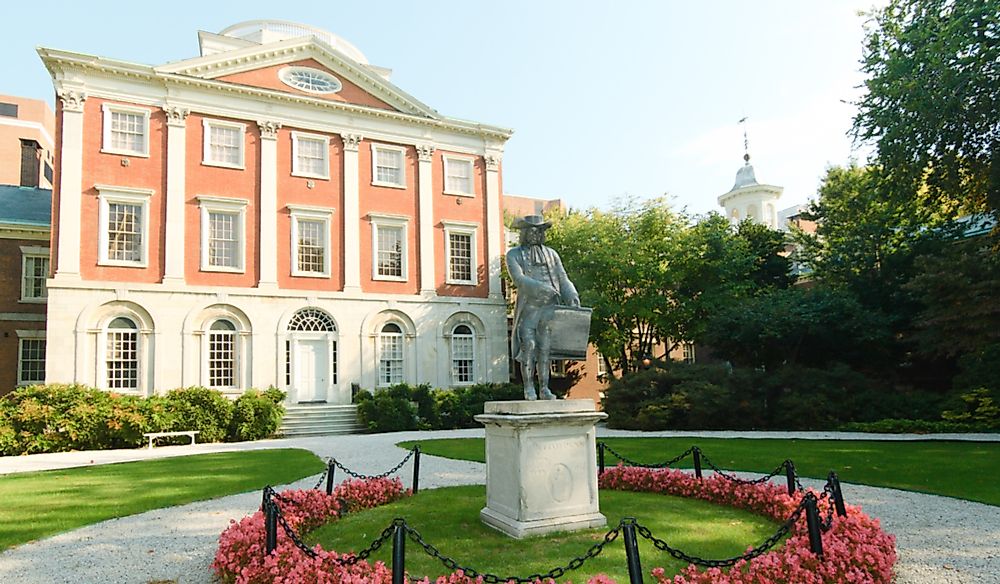
Here is where the bragging rights get complicated. Pennsylvania Hospital, chartered on May 11, 1751, by Benjamin Franklin and Dr. Thomas Bond, is widely called the nation's first hospital. It has a fair claim, as long as you specify the first founded purely as a hospital, rather than one that grew out of an almshouse like Bellevue, which beat it by 15 years. Franklin got it funded with a maneuver he clearly relished, talking the colonial assembly into matching whatever private donations he could raise, knowing full well he could raise plenty; he later called it one of the most satisfying political tricks of his career. The hospital's seal still shows the Good Samaritan and the faintly menacing promise, "Take Care of Him and I will Repay Thee." Its 1756 building is a National Historic Landmark, and its top floor holds the first surgical amphitheater in the US, in operation between 1804 and 1868. It was a literal theater, with tiered seats for spectators, and operations were booked between 11 a.m. and 2 p.m. for the simple reason that electricity did not exist yet and the surgeons needed the daylight.
New York Hospital, New York - 1771

New York's second hospital had a rough start. It was chartered in 1771 under a royal grant from King George III, but the building burned in 1775, the Revolution intervened, and it did not actually admit patients until 1791, twenty years after the paperwork went through. Once open, it grew into a leading teaching hospital and a fixture of Manhattan medicine. It survives today, many mergers later, as part of NewYork-Presbyterian, one of the largest hospital systems in the country.
Boston Dispensary, Boston - 1796

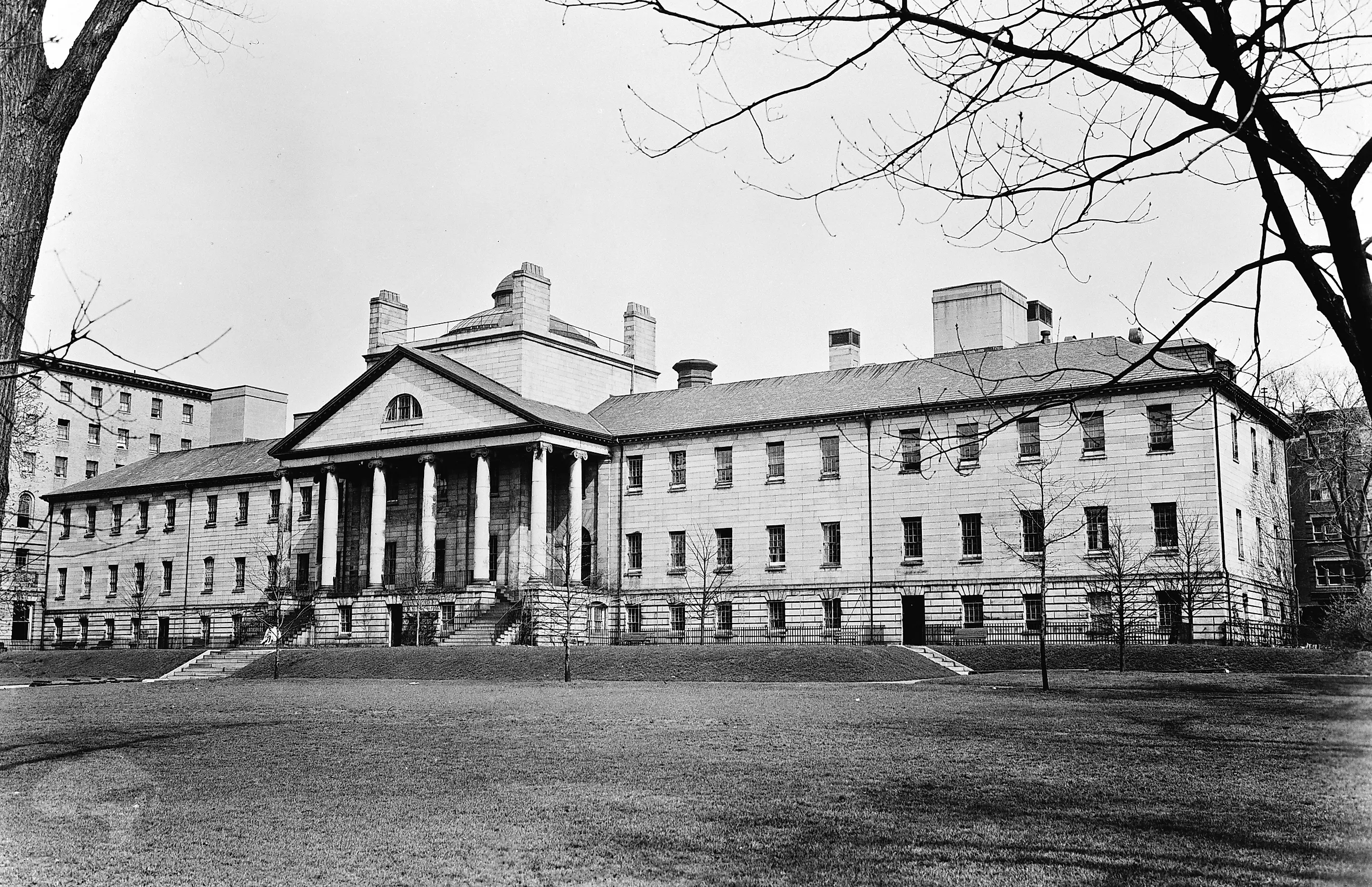
Boston Medical Dispensary, corner Ash St. and Bennett St., Boston, Massachusetts, 1859
The Boston Dispensary, founded in 1796, took a different tack: rather than house the sick, it treated the poor in their own homes, on the sensible theory that a patient recovers better in his own bed and at less expense to the public. It was the first institution of its kind in New England and one of the earliest anywhere in the country. It never closed; it folded into Tufts Medical Center, where the same line of work carries on today.
Candler Hospital, Savannah - 1804

Down in Savannah, Candler Hospital opened in 1804 to serve sick sailors and the local poor, two groups a busy port produced in steady supply. It is the oldest hospital in Georgia, and it has stayed open through yellow fever epidemics and the Civil War, when it treated soldiers from both sides. Today it anchors the St. Joseph's/Candler system, still running more than two centuries on.
Massachusetts General Hospital, Boston - 1811

Massachusetts General was chartered in 1811 and opened its doors in 1821, built on a fundraising campaign that took whatever it could get; the donations came in every size, famously including a single 273-pound sow. The patience paid off. In 1846, a Boston dentist publicly demonstrated ether anesthesia in the hospital's surgical amphitheater, and surgery stopped being something patients had to stay awake for. Mass General is now Harvard Medical School's largest teaching hospital and one of the most prominent research hospitals in the world.
McLean Hospital, Belmont - 1811

McLean shares Mass General's 1811 charter; it began as the asylum half of the same corporation and opened in 1818. It was built on the then-radical idea of "moral treatment," that mentally ill patients should be housed in calm, humane surroundings rather than chained, which was roughly the opposite of how such patients were handled almost everywhere else at the time. Renamed in 1826 for a major benefactor, McLean is the oldest psychiatric hospital in the country and remains one of the most respected, affiliated with Harvard.
Friends Hospital, Philadelphia - 1813

Two years later, Philadelphia Quakers founded Friends Hospital on the same humane premise, modeled on a Quaker retreat in England that had thrown out the era's standard reliance on restraint. It opened in 1817 as a place of quiet, gardens, and routine rather than confinement. It is the oldest private psychiatric hospital in the country and, true to its founding idea, still treats patients on its grounds today.
University Hospital, Augusta - 1818
Augusta built its City Hospital in 1818, a small place for the town's sick poor that soon doubled as a classroom; the Medical College of Georgia held its first medical classes inside it. The hospital grew, moved, and was renamed University Hospital, and during the Civil War the whole city became a hospital town for the wounded. It is still going after more than two centuries, though under a new name yet again since 2022, when it became Piedmont Augusta.
Honorable Mention: Charity Hospital, New Orleans
Charity Hospital earns a place in any history of American medicine, even if it no longer belongs on a list of the country's oldest working hospitals. New Orleans founded it on May 10, 1736, only about six weeks after Bellevue, with a bequest from Jean Louis, a French sailor and shipbuilder who left his estate to build a hospital for the city's poor. Originally the Hospital of Saint John, it moved and rebuilt repeatedly across two centuries, outlasting fire and hurricanes. Its sixth and final home, a hulking Art Deco tower finished in 1939, opened as the second-largest hospital in the country, with 2,680 beds. That building closed in 2005 after Hurricane Katrina flooded it, and it never reopened. Charity's role passed to the new University Medical Center New Orleans, which opened in 2015, while the old tower still stands downtown, empty, as the city debates what to do with it.
Still Standing
The pattern across nearly three centuries is consistent: almost every one of these hospitals began as a shelter for people with nowhere else to go, the poor, the sick, the sailors off the ships, and then grew into something far larger. Most are still treating patients on the same ground they started on, a few under names their founders would not recognize. For institutions built on almshouse charity and donated rum, that is a remarkable run.