The Largest Art Museums in the United States
When people call a museum one of the largest in the country, they usually mean its exhibition space, the gallery floor where the art actually hangs, rather than the size of its collection or the footprint of its building. By that measure, the United States is home to some of the biggest art museums in the world, led by a single institution in New York that more than doubles its nearest rival. The list below ranks American art museums by approximate gallery space, a useful gauge of how much a museum can show at once, though not a measure of how important or well-loved its collection is. The field also keeps shifting, as major expansions in cities like Houston and Los Angeles have rewritten the rankings in recent years.
1. Metropolitan Museum of Art

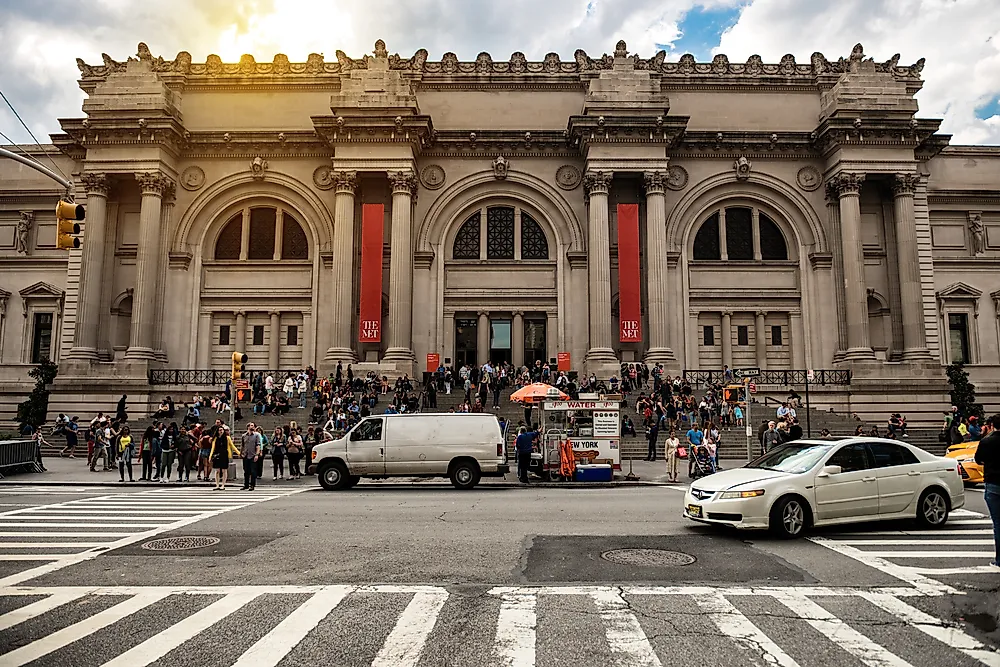
The Metropolitan Museum of Art is the largest art museum in the United States by a wide margin, with roughly 633,000 square feet of gallery space inside a Fifth Avenue building that covers some two million square feet in all. Founded in 1870 to bring art and art education to the American people, "the Met" now holds more than 1.5 million works spanning over 5,000 years, organized across 17 curatorial departments. Its best-known holdings include the ancient Egyptian Temple of Dendur, the European painting galleries, the American Wing, and one of the world's great collections of arms and armor. The museum also operates The Cloisters in northern Manhattan, a separate branch devoted to medieval European art.
2. Art Institute of Chicago

The Art Institute of Chicago is the country's second-largest art museum, with about 280,000 square feet of gallery space, much of it added by the Renzo Piano-designed Modern Wing that opened in 2009. Founded in 1879, it is one of the oldest art museums in the United States and among the most visited. Its great strength is European painting, including one of the finest collections of Impressionist and Post-Impressionist work outside France, anchored by Georges Seurat's "A Sunday on La Grande Jatte." The American galleries hold national touchstones such as Grant Wood's "American Gothic" and Edward Hopper's "Nighthawks."
3. National Gallery of Art

The National Gallery of Art has about 271,000 square feet of gallery space, making it the largest art museum in Washington, D.C., the nation's capital and a federal district rather than a state. Congress established the gallery in 1937 around a founding gift from the financier Andrew W. Mellon, who donated both his art collection and the money for the original building; it opened in 1941 and has always been free to enter. Its neoclassical West Building, designed by John Russell Pope, stands beside the angular East Building that I. M. Pei completed in 1978 for modern art. Among its treasures is Leonardo da Vinci's "Ginevra de' Benci," the only painting by the artist on public view anywhere in the Americas.
4. MASS MoCA

The Massachusetts Museum of Contemporary Art, known as MASS MoCA, fills about 250,000 square feet of a converted factory complex in the small city of North Adams, Massachusetts. The buildings once housed Arnold Print Works and later the Sprague Electric Company before the museum opened there in 1999. The scale of the old mill lets MASS MoCA show enormous, room-filling installations that few conventional galleries could hold, including long-term presentations of wall drawings by Sol LeWitt and light works by James Turrell. It ranks among the largest contemporary art venues in the country.
5. Museum of Fine Arts, Boston

The Museum of Fine Arts in Boston rounds out the top five, with roughly 221,000 square feet of gallery space. Founded in 1870, the same year as the Met, it moved into its current Huntington Avenue home in 1909. Its collection runs especially deep in ancient Egyptian art, the arts of Asia, and French Impressionism, with one of the largest groups of Monet paintings held anywhere outside France, alongside a major collection of American art.
Beyond The Top Five

Several more museums sit just behind the leaders, and some are climbing fast. The Los Angeles County Museum of Art, the largest art museum in the western United States, reopened in April 2026 with the David Geffen Galleries, a single-floor concrete building by Peter Zumthor that spans Wilshire Boulevard and brings its total gallery space to around 220,000 square feet. The Museum of Fine Arts, Houston, roughly doubled its exhibition space when the Kinder Building for modern and contemporary art opened in 2020. The San Francisco Museum of Modern Art reached about 170,000 square feet after a 2016 expansion, while long-established institutions such as the Philadelphia Museum of Art, the Detroit Institute of Arts, and the Cleveland Museum of Art remain among the country's largest. Because "size" here means gallery floor area, the order can shift whenever one of these museums adds a wing.
The Largest Art Museums In The United States By Gallery Space
The figures below are approximate exhibition space drawn from published gallery-area data. Several museums have expanded since these counts were compiled, most notably the Museum of Fine Arts, Houston, and the Los Angeles County Museum of Art, so the lower ranks are best read as a close approximation rather than an exact order.
| Rank | Museum Name | Location | Size (Square Feet) |
|---|---|---|---|
| 1 | Metropolitan Museum of Art | New York, New York | 633,100 |
| 2 | Art Institute of Chicago | Chicago, Illinois | 280,000 |
| 3 | National Gallery of Art | Washington, D.C. | 271,000 |
| 4 | MASS MoCA | North Adams, Massachusetts | 249,990 |
| 5 | Museum of Fine Arts, Boston | Boston, Massachusetts | 221,000 |
| 6 | Los Angeles County Museum of Art | Los Angeles, California | 220,000 |
| 7 | Minneapolis Institute of Art | Minneapolis, Minnesota | 188,000 |
| 8 | San Francisco Museum of Modern Art | San Francisco, California | 170,000 |
| 9 | Denver Art Museum | Denver, Colorado | 160,000 |
| 10 | Philadelphia Museum of Art | Philadelphia, Pennsylvania | 160,000 |
| 11 | Dia:Beacon | Beacon, New York | 160,000 |
| 12 | Dallas Museum of Art | Dallas, Texas | 159,000 |
| 13 | Detroit Institute of Arts | Detroit, Michigan | 150,000 |
| 14 | Indianapolis Museum of Art at Newfields | Indianapolis, Indiana | 143,000 |
| 15 | Brooklyn Museum | New York, New York | 140,000 |
| 16 | Virginia Museum of Fine Arts | Richmond, Virginia | 135,000 |
| 17 | Cleveland Museum of Art | Cleveland, Ohio | 133,000 |
| 18 | Museum of Fine Arts, Houston | Houston, Texas | 130,000 |
| 19 | Milwaukee Art Museum | Milwaukee, Wisconsin | 128,000 |
| 20 | Museum of Modern Art | New York, New York | 125,000 |
| 21 | Portland Art Museum | Portland, Oregon | 112,000 |
| 22 | Carnegie Museum of Art | Pittsburgh, Pennsylvania | 110,000 |
| 23 | Saint Louis Art Museum | St. Louis, Missouri | 110,000 |
| 24 | Smithsonian American Art Museum | Washington, D.C. | 95,000 |
| 25 | Toledo Museum of Art | Toledo, Ohio | 86,000 |
| 26 | de Young | San Francisco, California | 85,000 |
| 27 | Nelson-Atkins Museum of Art | Kansas City, Missouri | 85,000 |
Size Versus Significance
Floor space tells only part of the story. The Met happens to lead on both size and the depth of its collection, but square footage and artistic importance do not always line up. Some of the most treasured art museums in the country are small: the Frick Collection and the Isabella Stewart Gardner Museum would not crack this list, yet both are renowned for the quality of what hangs on their walls. Gallery area is a good measure of a museum's ambition and reach, but it says little about the art itself.