Oldest Aquariums in the United States
The public aquarium is a 19th-century invention, and most of America's first attempts did not survive it. P.T. Barnum's museum aquarium in New York burned in 1865. Boston's Aquarial Gardens, San Francisco's Woodward's Gardens, and the original National Aquarium in Washington all opened to crowds and later closed for good. A handful of institutions from that era, though, are still filling tanks and unlocking their doors every morning, several of them well past their 120th birthday. These are the oldest aquariums in the United States that you can still visit, listed in the order they first opened to the public.
| Aquarium | Year Opened | Location | Operated By |
|---|---|---|---|
| Woods Hole Science Aquarium | 1885 | Woods Hole, MA | NOAA Fisheries |
| New York Aquarium | 1896 | Brooklyn, NY | Wildlife Conservation Society |
| Waikiki Aquarium | 1904 | Honolulu, HI | University of Hawaii at Manoa |
| Belle Isle Aquarium | 1904 | Detroit, MI | Belle Isle Conservancy |
| Birch Aquarium at Scripps | 1905 | La Jolla, CA | UC San Diego |
| Steinhart Aquarium | 1923 | San Francisco, CA | California Academy of Sciences |
| Shedd Aquarium | 1930 | Chicago, IL | Independent nonprofit |
1. Woods Hole Science Aquarium

The country's oldest public aquarium occupies a modest building on Water Street in Woods Hole, at the southwestern tip of Cape Cod. Its origins reach back to 1875, when Spencer Baird, the first U.S. Fish Commissioner, began inviting the public into his seasonal research station to see what scientists were pulling out of local waters. A permanent laboratory with a ground-floor public aquarium followed in 1885, the date the institution now treats as its founding. It is still run by the federal government, today through NOAA Fisheries, and admission remains free. The displays stay close to home, with roughly 140 species of New England fish and invertebrates, a pair of resident harbor seals, and touch tanks of local shore life. Several aquariums claim the title of oldest in the nation, but none holds a cleaner case than Woods Hole.
2. New York Aquarium

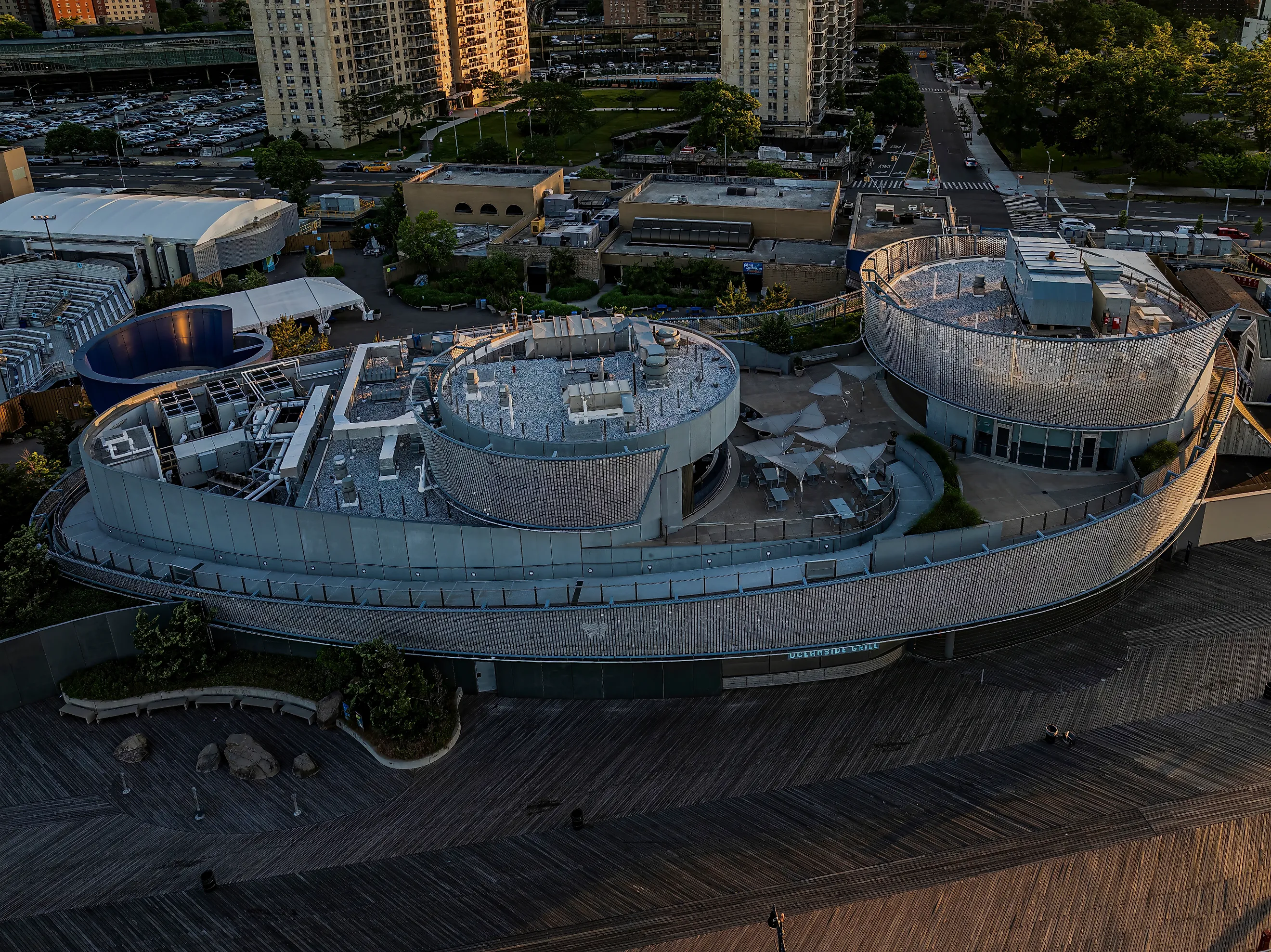
The New York Aquarium holds the distinction the Woods Hole site cannot quite claim: it is the oldest continually operating aquarium in the United States. It opened in 1896 inside Castle Garden, the former fort and immigration depot at the tip of Manhattan's Battery Park, and rapidly became one of the city's most popular attractions. Robert Moses forced its closure in the early 1940s, and in 1957 it reopened at its current home on the Riegelmann Boardwalk in Coney Island, Brooklyn. The Wildlife Conservation Society has operated it the entire time. Its 14-acre oceanfront campus now centers on Ocean Wonders: Sharks!, a building opened in 2018 whose tanks hold sand tiger sharks, rays, and sea turtles within sight of the Atlantic itself.
3. Waikiki Aquarium

Hawaii's oldest aquarium began as a marketing scheme. In 1904, the Honolulu Rapid Transit and Land Company opened the Honolulu Aquarium at the end of its new trolley line in Kapiolani Park, betting that the reefs of the Pacific would sell streetcar tickets. It worked. The biologist David Starr Jordan pronounced its collection the finest in the world, and visitors such as Jack London and William Jennings Bryan made the trip. The University of Hawaii at Manoa has run the renamed Waikiki Aquarium since 1919, keeping it both a public attraction and a working research lab. It was the first aquarium anywhere to breed the chambered nautilus in captivity, and it remains a stronghold for living Pacific corals, Hawaiian monk seals, and reef animals kept in few other tanks. By its own count it is the second-oldest still-operating aquarium in the country, though sources that tally the long-closed ones often rank it third.
4. Belle Isle Aquarium

Five months after Honolulu, Detroit opened an aquarium famous less for its tanks than for the room that holds them. The Belle Isle Aquarium debuted on August 18, 1904, in a building by Albert Kahn and George Mason, its single barrel-vaulted gallery lined with green glass tile meant to suggest the light of being underwater. For a century it was the oldest continually operating aquarium in North America, a run that ended when the city closed it on April 3, 2005, during budget cuts. Volunteers refused to let it stay shut. The Belle Isle Conservancy reopened the building on August 18, 2012, exactly 108 years after its first day, and operates it today on the island park in the Detroit River, with free admission supported by donations.
5. Birch Aquarium at Scripps

The public aquarium at Scripps is older than its sleek La Jolla building lets on. The Marine Biological Association of San Diego, the seed of what became the Scripps Institution of Oceanography, formed in 1903 with a public aquarium written into its founding purpose. The first one opened in 1905 in a tiny structure at La Jolla Cove known as the Little Green Lab. The aquarium changed buildings repeatedly as the institution grew, and the current hilltop facility, the Birch Aquarium at Scripps, opened in 1992 overlooking the Pacific it studies. Now the public face of oceanography at UC San Diego, it draws around half a million visitors a year and runs well-regarded seahorse and seadragon breeding programs.
6. Steinhart Aquarium

Steinhart Aquarium opened on September 29, 1923, when a crowd of 5,000 pushed into a new neoclassical hall in San Francisco's Golden Gate Park. Funded by the brothers Ignatz and Sigmund Steinhart and run by the California Academy of Sciences, it is the oldest continually operating municipal aquarium in the country. The original building was later demolished and rebuilt, and Steinhart reopened in 2008 inside the Academy's living-roofed home, carrying over its old entrance columns and a beloved seahorse railing. It now holds close to 60,000 animals, among them the Philippine Coral Reef, billed as the deepest living indoor reef in the world, and Methuselah, an Australian lungfish that arrived in 1938 and is the oldest aquarium fish alive anywhere.
7. Shedd Aquarium

When the John G. Shedd Aquarium opened on the Chicago lakefront on May 30, 1930, it solved a problem no inland aquarium had cracked: how to keep saltwater fish alive a thousand miles from the sea. Shedd, a former president of Marshall Field and Company, paid for railcars of seawater to be hauled up from the ocean, making this the first inland aquarium with a permanent saltwater collection. The marble Beaux-Arts building, a landmark on the Museum Campus beside Lake Michigan, is one of the oldest continually operating non-governmental aquariums in the United States. It houses about 32,000 animals across 1,500 species, including the Caribbean Reef tank that divers hand-feed each day and the belugas and sea otters of the Abbott Oceanarium.
Why These Aquariums Survived
The distance between these survivors and the aquariums that failed is partly money and luck, but it is mostly purpose. Barnum displayed belugas until they died and then ran newspaper obituaries while announcing their replacements; the institutions that lasted tied themselves instead to research, universities, and government science, which gave them a reason to exist beyond the turnstile. That difference still defines them. Woods Hole, Scripps, and Steinhart run active marine laboratories, while the New York Aquarium and Shedd fund field conservation and rehabilitate stranded animals. The practice of keeping marine life in tanks remains genuinely contested, and critics argue that no enclosure can replace the open ocean, especially for wide-ranging species such as whales and dolphins. The oldest American aquariums have spent the last century answering that charge by trading spectacle for science, and the clearest measure of their success is no longer how many visitors they draw, but how much of the ocean they help keep alive.