5 Wild Animal Hotspots in Nevada
Nevada’s remote wildlands hold some of the least visited and most dynamic wildlife habitat in the American West. Pronghorns cross empty highways at dawn. Canvasback ducks nest in unusually high numbers in spring-fed marshes ringed by red mountains. Desert bighorn sheep pick their way down canyon walls to drink from the Colorado River as the Mojave heats up around them.
Across the state’s contrasting landscapes, wetlands draw hundreds of thousands of migrating shorebirds and alpine zones push above 13,000 feet where pika colonies cling to boulder fields. Throughout the valleys and flatlands, vast sagebrush refuges protect species in recovery that came close to disappearing within a generation.
These wildlife hotspots stretch between the northeastern wetlands and the southern Mojave.
Ruby Lake National Wildlife Refuge

Ruby Lake National Wildlife Refuge is best known for hosting the largest canvasback duck nesting population west of the Mississippi River outside Alaska. In the shadow of the Ruby Mountains in northeastern Nevada, this refuge spans nearly 40,000 acres of wetlands, meadows, and upland habitats. Surrounded by desert landscapes, Ruby Lake is also an oasis for a range of wildlife.
Migratory birds are especially prevalent, with over 200 species passing through the refuge, including various waterfowl, shorebirds, and songbirds. Beyond its canvasback duck population, greater sandhill cranes and trumpeter swans use the marsh’s protected interior for nesting, while sage grouse inhabit the upland edges.
The refuge includes a 10-mile auto tour route that passes near the labyrinthine bulrush stands of the South Marsh. Canoe and kayak access is also available for those who want a more immersive experience of the waterways between island clusters.
Stillwater National Wildlife Refuge

Stillwater National Wildlife Refuge holds one of the most important shorebird staging areas in the Western Hemisphere. Sixty miles east of Reno near the community of Fallon, Stillwater sits at the terminal basin of the Carson River. It is the end of the line for water that drains much of western Nevada. The refuge’s 80,000-plus acres span fresh and brackish marshes, alkaline beaches, desert scrub, and sand dunes.
The Stillwater wetlands carry a designation of international importance from the Western Hemisphere Shorebird Reserve Network. That recognition reflects the hundreds of thousands of shorebirds that pass through during migration, including long-billed dowitchers, black-necked stilts, and American avocets. In fall, as many as 100,000 ducks can be present on the refuge at once, with gadwall, green-winged teal, and canvasback among the most common species. The Anaho Island unit of the refuge complex supports one of the largest American white pelican colonies in the western US. The list of animals present extends well beyond birds. Beaver, mink, mule deer, and kit fox all travel and forage throughout the wetland marshes.
A vehicle tour loop around Stillwater Point Reservoir gives visitors a solid overview. For hikers, the Tule Trail leads observers on foot along the marsh edges where the shorebird concentrations are thickest.
Sheldon National Wildlife Refuge

Sheldon National Wildlife Refuge represents one of the most important areas for the West’s recovering pronghorn population. In the far northwest corner of Nevada, Sheldon protects 573,000 acres of high desert. The landscape shifts from high basalt tablelands and deep canyons to vast sagebrush valleys. Each zone supports its own wildlife communities. Pronghorn, greater sage grouse, bighorn sheep, and golden eagles are among the most prominent residents.
The pronghorn is the primary reason the refuge was founded. By the early 20th century, overhunting and habitat loss had reduced pronghorn populations from an estimated 35 million across pre-settlement North America to roughly 13,000 animals. Thanks to conservation work and the establishment of refuges like Sheldon, there are now approximately one million pronghorn roaming the West. Around 3,500 live within Sheldon’s boundaries.
Visitor services are limited here, and cell coverage across the refuge is typically sparse to non-existent. A full tank of gas, a paper map, and a high-clearance vehicle are strongly recommended for exploring. What that isolation preserves is a fragile high desert ecosystem where wildlife move freely with minimal disturbance.
Great Basin National Park

Near the Utah border in eastern Nevada, Great Basin National Park is home to an extraordinary range of life across over 77,000 acres. The park extends from the sage-covered valley floor all the way to the 13,063-foot summit of Wheeler Peak, with each elevation band hosting unique ecosystems.
The park supports over 60 species of mammals, 238 species of birds, 18 species of reptiles, and 8 species of fish. At the lower elevations, pronghorn, coyotes, and jackrabbits live throughout the sagebrush flats. Higher up, mule deer and Rocky Mountain bighorn sheep navigate the talus and cliff faces, while yellow-bellied marmots sun themselves above the treeline.
The alpine zone around Wheeler Peak is one of the most visually striking. At these altitudes, bighorn sheep, rosy finches, and American pipits are especially prevalent, although sightings remain relatively rare in this year-round snowy climate. At higher elevations, American pika inhabit cool talus slopes, including areas near Wheeler Peak. Small, round relatives of the rabbit, pikas require cold temperatures to thrive. The Wheeler Peak talus slopes are one of the more accessible places in Nevada to still see this species, which is struggling under increasing pressure from warming temperatures.
Viewing this range of wildlife is possible both on foot and via scenic drives. The Wheeler Peak Scenic Drive reaches 10,000 feet, making the upper wildlife zones reachable even for those not attempting the summit trail.
Lake Mead National Recreation Area

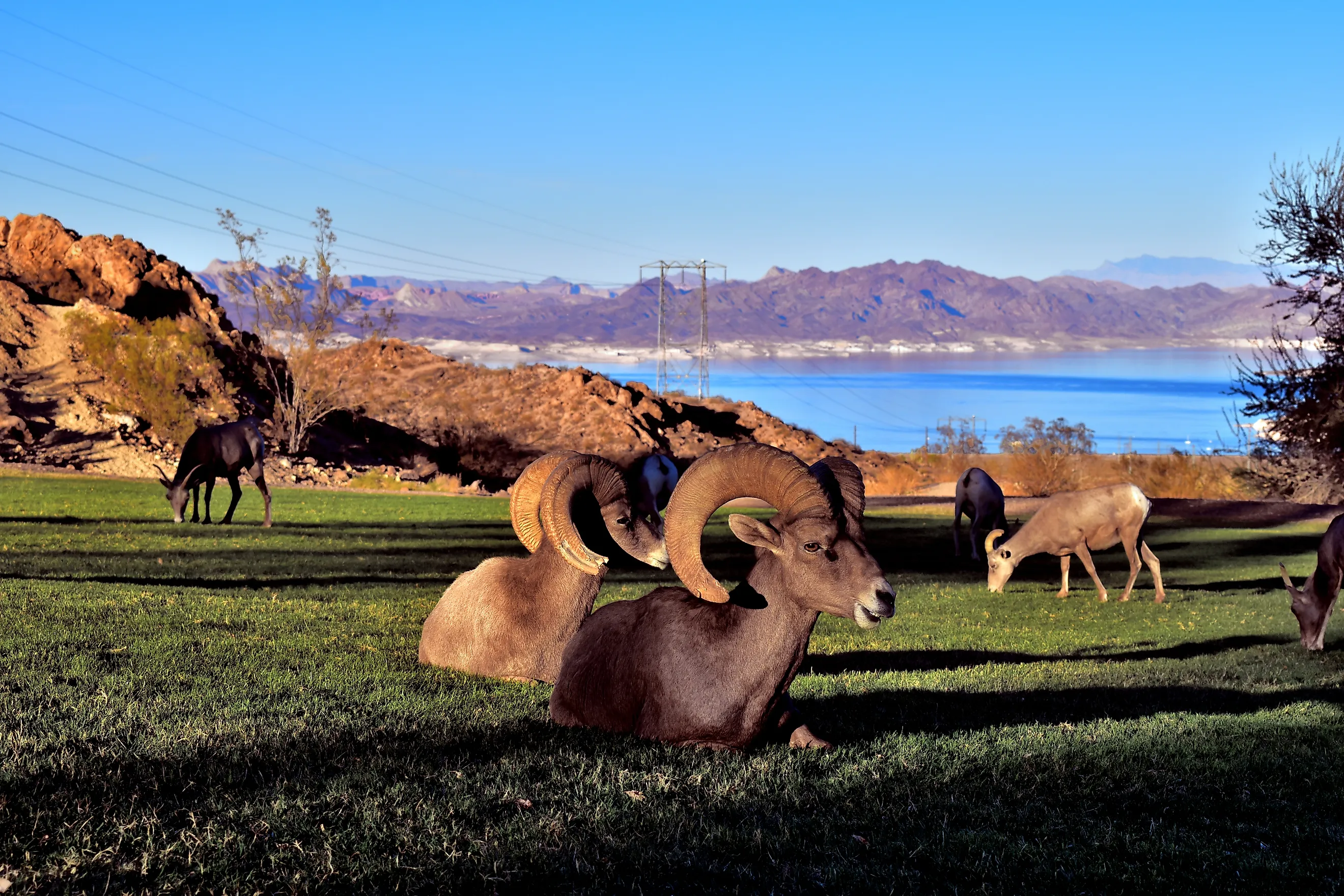
Lake Mead National Recreation Area is one of the few places in the country where three of America’s four desert ecosystems meet, with the Mojave, Great Basin, and Sonoran Deserts all converging within its boundaries. The overlap creates a unique mix of plant and animal communities. Where the Colorado River meets the Mojave Desert south of Las Vegas, Lake Mead National Recreation Area spans 1.5 million acres.
The desert bighorn sheep is Lake Mead’s most emblematic resident and Nevada’s official state animal. Once feared to be approaching extinction, the desert bighorn’s population is making a tentative comeback across the Southwest through a comprehensive reintroduction effort by the National Park Service.
The park is also home to mule deer, coyotes, bobcats, ringtail cats, and desert tortoise. Recovering species, including the peregrine falcon, share the landscape with ancient Colorado River fish species found nowhere else. The sheer size of the area creates distinct ecological regions. The Overton Arm section in the north, for instance, draws wading birds and waterfowl that gather in an aquatic landscape sharply contrasting with the backdrop of red rock canyons and desert scrub.
Where Nevada Runs Wild
These areas show Nevada’s wild range, from terminal wetland basins and sagebrush refuges to alpine talus slopes and Mojave canyon country. Together, they protect canvasback nesting habitat, pronghorn range, shorebird migration stops, pika habitat, and desert bighorn country. Their wildlife is not always easy to see, but each place reflects decades of conservation work in some of the state’s most important habitats.