National Parks in Newfoundland and Labrador
Newfoundland and Labrador’s national parks protect landscapes that range from the exposed cliffs and fjords of Gros Morne on the island’s west coast to the vast tundra and boreal forests of the Mealy Mountains in Labrador. Along the province’s shoreline, Terra Nova preserves sheltered bays and rocky headlands on Bonavista Bay, while the Torngat Mountains rise sharply from the Labrador Sea as some of the most remote terrain in Canada. Together, the province’s existing and proposed national parks showcase Atlantic coastlines, interior forests, and Arctic-influenced mountains found nowhere else in eastern Canada.
Dungeon Provincial Park

While Dungeon Provincial Park is not part of Canada’s national park system, it is often mentioned alongside Newfoundland and Labrador’s national parks because of its dramatic coastal landscape. Located near Bonavista on the island’s east coast, the park overlooks the open Atlantic, where steep cliffs and a rugged shoreline define the scenery. A short coastal trail traces the cliff edge, revealing wave-shaped rock formations and wide ocean views.
A working sheep pasture borders the park, adding to its distinctly rural character. Nearby, the Cape Bonavista Lighthouse, a designated provincial historic site, stands on a prominent headland and marks one of the region’s most recognizable coastal viewpoints. Despite its small size, the park captures the raw, exposed coastline that defines much of eastern Newfoundland.ize.
Torngat Mountains National Park

Torngat Mountains National Park protects one of the most dramatic and remote landscapes in Canada, covering a vast stretch of northern Labrador from Cape Chidley to Saglek Fjord. The park is defined by steep, jagged mountains rising directly from the sea, deep fjords, and broad glacial valleys carved by ice and time. Its name comes from an Inuktitut word associated with powerful spirits, reflecting the cultural and spiritual importance of the region to Inuit communities.
Established in 2008 as Labrador’s first national park, the area spans roughly 9,700 square kilometers of Arctic wilderness. Polar bears, caribou, peregrine falcons, and golden eagles inhabit the park’s mountains and coastal edges. Visitors who reach this remote region experience a landscape shaped by glaciers, exposed rock, and cold northern waters, with opportunities for guided hiking, scrambling, and sea travel through the fjords.
Terra Nova National Park

Terra Nova National Park lies along Newfoundland’s northeast coast on Bonavista Bay, where narrow rocky headlands extend into sheltered inlets and coves. The park’s coastline alternates between exposed cliffs, calm bays, and protected harbors, creating one of the province’s most varied coastal landscapes. These sheltered waters contrast with the open Atlantic and give the park its distinctive mix of rugged shoreline and navigable inlets.
Inland, the terrain shifts to rolling forested hills, bogs, ponds, and exposed rock faces shaped by glacial activity. Black spruce and balsam fir forests dominate the interior, while the park supports wildlife such as moose, black bears, Newfoundland martens, lynx, snowshoe hares, and a wide range of birdlife. Offshore, whales, dolphins, and seals are commonly found in the surrounding waters, reinforcing Terra Nova’s strong connection between land and sea.
Gros Morne National Park

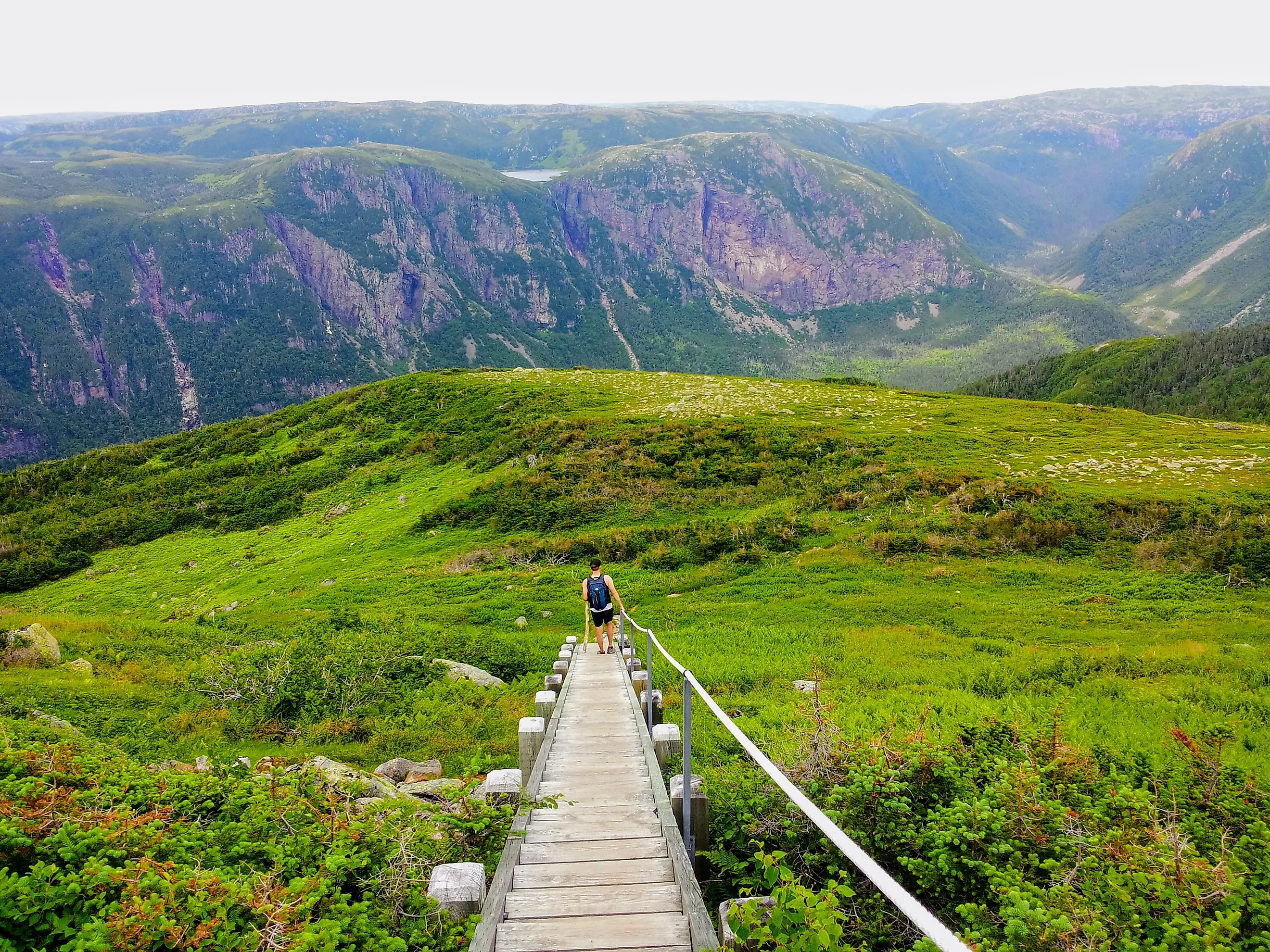
Gros Morne National Park, a UNESCO World Heritage Site, lies along Newfoundland’s west coast and protects one of the most striking landscapes in Atlantic Canada. Spanning roughly 1,805 square kilometers, the park is defined by towering cliffs, deep fjords, coastal lowlands, and exposed rock formed by ancient tectonic forces. Gros Morne Mountain, the second highest peak on the island of Newfoundland, rises above the park’s interior and gives the area its name.
The park supports a large moose population, along with black bears, red foxes, snowshoe hares, river otters, and beavers. Offshore and along the coast, harbor seals and whales are common sights. A network of hiking trails crosses coastal plains, alpine terrain, and dramatic escarpments, offering direct access to the park’s rugged scenery and geological features.
Mealy Mountains National Park Reserve

Akami-Uapishkᵘ-KakKasuak-Mealy Mountains National Park Reserve protects a vast stretch of wilderness in central Labrador. Established in 2015, the park reserve spans approximately 10,700 square kilometers, making it the largest national park reserve in eastern Canada. Its landscape includes rolling boreal forest, tundra-covered plateaus, and more than 50 kilometers of shoreline along the Labrador Sea and Lake Melville.
The Mealy Mountains rise gently above the surrounding lowlands, creating one of the least disturbed ecosystems in the region. The park supports a wide range of wildlife, including the threatened Mealy Mountains woodland caribou herd, as well as migratory birds and fish species such as Atlantic salmon. The scale and continuity of intact habitat make this park reserve a key protected area in eastern North America.