The 4 Most Beautiful Gothic Churches In New Mexico
While New Mexico is far better known for its Spanish Colonial, Pueblo, and adobe religious architecture, the state also contains a small but noteworthy group of Gothic Revival churches, along with vernacular buildings that incorporate Gothic-influenced elements. These structures are comparatively rare and often reflect the tastes of immigrant communities, missionary work, or brief 19th-century architectural trends that reached the Southwest. Their pointed arches, steep roofs, and vertical emphasis contrast sharply with New Mexico’s primarily earthen and horizontal architectural forms, making these buildings stand out within the state’s broader religious landscape.
St. Joseph Apache Mission Church

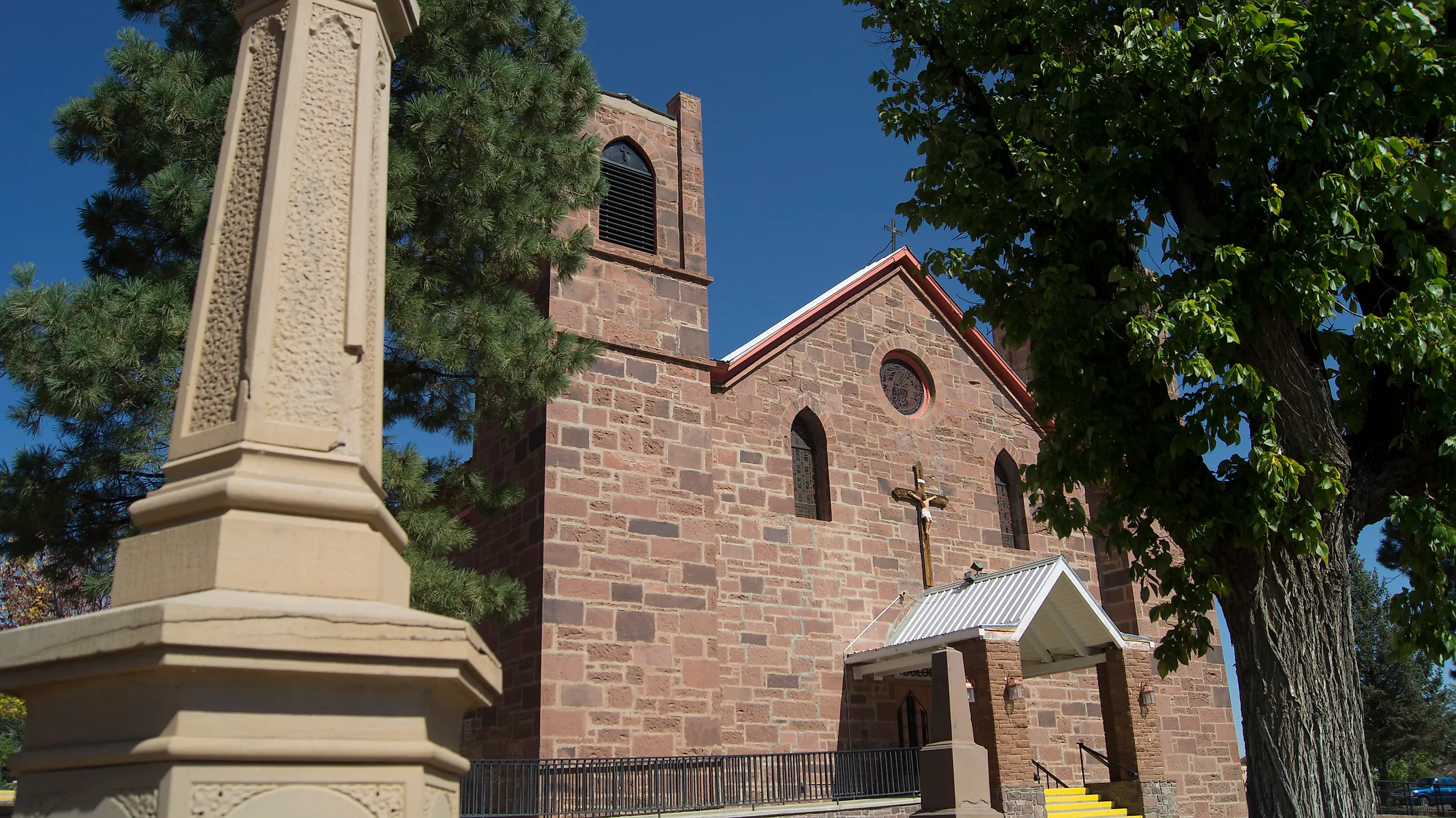
Architect William C. Stanton designed the St. Joseph Apache Mission Church in Mescalero during a period when Gothic Revival structures were uncommon in the region. Built between 1920 and 1939 using local stone and the combined labor of Franciscan friars and members of the Mescalero Apache community, the church reflects the dedication of those involved in its construction. The National Register of Historic Places recognized the building in 2005 for its architectural significance. Today, the church remains one of New Mexico's most prominent Gothic-influenced structures, serving the Mescalero Apache parish while blending Gothic Revival design with tribal heritage.
The Cathedral Church of St. John

The Cathedral Church of St. John in Albuquerque traces its roots to an 1882 Gothic-influenced church built on the same site. When the Episcopal congregation expanded in the mid-20th century, the earlier building was removed in 1951 to make way for a new Gothic Revival cathedral constructed in 1951 and 1952. The design incorporated brick, reclaimed stone, stained glass, and additional elements preserved from the original church. Listed on the National Register of Historic Places in 2018, the cathedral continues to serve as the seat of the Episcopal Diocese of the Rio Grande and remains one of New Mexico’s most significant ecclesiastical landmarks.
First United Methodist Church

First United Methodist Church in Albuquerque occupies a site with layered architectural history. The 1904 sanctuary, designed by Charles Frederick Whittlesey in a Gothic Revival mode, introduced pointed arches and stained glass to a rapidly growing railroad town. By the mid-20th century, the congregation required more space and built a new sanctuary in 1954 and 1955 in a Spanish Colonial Revival style, while earlier Gothic Revival buildings remained part of the campus. Listed on state and national registers, the complex illustrates how both Gothic Revival and Spanish Colonial Revival design shaped Protestant church architecture in New Mexico’s developing urban centers.
Our Lady of Sorrows Church

Built mostly between 1852 and the 1880s and then restored, Our Lady of Sorrows Church in Las Vegas, New Mexico, a town east of Santa Fe, is one of the most prominent examples of Gothic Revival influence on an initially adobe Catholic parish in the state. Gothicizing features, like the tall central bell tower, lancet windows, buttress-like projections, and noticeable verticality, were added to the church's façade during its 1885-1888 rebuilding.
The structure is listed on the National Register of Historic Places and continues to be an important architectural and cultural landmark in Las Vegas' historic district. As seen by its extensive history of renovations and significance, the church is a perfect example of how Gothic Revival aesthetics were purposefully employed to codify and elevate traditional New Mexican parish churches.
A Gothic Thread in New Mexico’s Architectural Landscape
Although limited in number, New Mexico’s Gothic Revival buildings form a revealing architectural thread. From the mountain reservation setting of St. Joseph Apache Mission to the stone nave of Holy Faith in Santa Fe, from the adobe vernacular Gothic church in Ensenada to mid-20th-century Albuquerque examples, these structures show how Gothic design was transplanted, adapted, and reshaped in a region better known for earthen materials and Indigenous, Spanish, and territorial influences.