7 Strange Discoveries About Chernobyl’s Abandoned City
Chernobyl's abandoned city of Pripyat, Ukraine, was once a thriving Soviet city. On April 26, 1986, after the Chernobyl nuclear power plant disaster, it became one of the world's most infamous ghost towns. Founded in 1970, Pripyat was built specifically to house workers and families of the Chernobyl nuclear power plant. It was a model Soviet city at the time, with more than 50,000 residents, schools, hospitals, parks, apartment blocks, and an amusement park was set to open on May 1,1986. By Soviet standards, Pripyat was a comfortable city in which to live, especially for those who worked at the nuclear power plant.
On April 26, 1986, Reactor Number 4 at the Chernobyl plant exploded due to a flawed reactor design operated by employees who were not properly trained. This caused uncontrolled fires, releasing massive amounts of radioactive material into the air.
Residents of Pripyat were not immediately informed of the disaster, and the government did not order the evacuation of Pripyat until 36 hours had passed. They were told that the evacuation would be temporary, lasting just a few days, so many people just took the essentials with them, leaving possessions behind. Within days, however, a 30-kilometer Exclusion Zone was established around the reactor, and Pripyat and its surrounding villages were emptied.

Chernobyl was the worst nuclear disaster in history. Two plant workers died that night, and 28 more people died within the first three months due to acute radiation syndrome. The World Health Organization estimates that 4,000 people eventually died from exposure to radiation in the years after.
Today, the abandoned city of Pripyat sits empty, frozen in time as a ghost town, slowly decaying. This deserted city symbolizes the dangers of nuclear power, the human race's vulnerability to technological disasters, and the deadly secrecy of the Soviet government. Many mysteries have arisen surrounding the Chernobyl disaster and the abandoned city of Pripyat. It is still not fully understood why some of these strange discoveries are occurring.
"Radiation Eating" Fungi Growing Inside the Nuclear Reactor

The black fungus known as Cladosporium sphaerospernmum grows inside the walls of the Number 4 reactor (the one that initially exploded on April 16, 1986). This fungus is flourishing due to high levels of radiation. This strange phenomenon was first discovered in May 1997 by a scientist, Nelli Zhdanova, visiting the site. Zhdanova called the phenomenon "radiotropism," saying that the fungi used ionizing radiation as their energy source. The fungi are, in fact, eating the radiation left behind. It can never eliminate all of the nuclear contamination at Chernobyl, as the fungi don't change the radioactive materials themselves.
Zhdanova also hypothesized that the melanin inside the black fungi shields it against ionizing radiation, protecting it as it eats the radiation, gaining energy from the radiation. This finding has shown potential for the creation of a radiation shield for astronauts on long-duration space missions. This could be one "benefit" from the fallout of the nuclear accident.
Stray Dogs Evolving in a Nuclear Wasteland

Thousands of feral dogs were left behind when humans evacuated Pripyat, and they have had to fend for themselves. Scientists studied 302 dogs representing three feral dog colonies living both within the Chernobyl power plant and up to 45 kilometers from the site. They found that the dogs living near the reactor have unique, different DNA mutations from dogs living farther from the site. This suggests that these stray dogs living in the area nearest to the reactor are evolving rapidly, with their DNA changing to cope with the stress from radiation.
These dogs don't have superpowers from radiation, but rather, have evolved to survive an event that threatened their species. Studying this evolution, scientists say, can teach us more about how other species, including humans, adapt to intense environmental pressures to survive. It's worth noting that, although some of these dogs have been observed to have blue fur, this is not believed to be due to radiation mutations. It was recently proposed that these dogs had rolled in blue toilet chemicals that had spilled from tipped-over porta-potties, causing the blue-colored fur.
The Abandoned School Building with Desks and Books Left Behind

April 26, 1986, started as just another school day for children in the five schools in Pripyat. Teachers in these schools gave the children iodine tablets to protect against radiation, and closed school windows, but no classes were cancelled. While the schools did dismiss the children early, when they left, neither teachers nor students knew that they would never return to these school buildings.
The largest of these schools, Pripyat Secondary School No. 3, has been photographed often in the years since. It sits abandoned and empty, looking as if it is waiting for children to return. Soviet propaganda materials are still on the walls, and gas masks litter the floors. Desks, books, and student belongings are left behind, frozen in time. Papers are scattered across the floor. This eerie tableau serves as a reminder of what life was like before the nuclear accident, as well as its lasting impact.
The Deserted, Rotting Amusement Park

The Pripyat Amusement Park was supposed to open on May Day, May 1, 1986. That opening never occurred, as the Chernobyl accident made it impossible, and the park, along with everything else in Pripyat, was abandoned. Today, the park is empty, lonely, and ghostly. Bright yellow bumper cars sit rusting where they last stopped, and the 26-meter-high Ferris wheel with its yellow buckets sits fading. The Daisy carousel and large swing stand are unused and looking unloved. Paint on these rides has peeled and flaked off, and rust has covered everything that is left.
Unconfirmed reports say that, on April 27, the morning after the disaster, the park was opened for a few hours to keep residents busy and distracted. It is said that some of the rides were even operated before the order to evacuate came through. If true, this makes the empty, abandoned, rotting amusement park an even more poignant symbol of how fleeting humans' time on Earth is.
The Red Forest: The Most Radioactive Outdoor Environment on Earth

Pine trees and other greenery growing around the Chernobyl nuclear power plant were exposed to such massive amounts of radiation during the accident that they burned from the inside. This turned the trees red. Some call this forest the most radioactive, contaminated forest on Earth. It is certainly the most contaminated, radioactive forest in Pripyat.
After the accident, as the trees absorbed radiation, they started to die. Pine tree needles turned from orange to a ginger brown. This created the Chernobyl Red Forest, also called the "Rudyi Lis." While the original trees were bulldozed and buried, the soil absorbed the radiation. Thus, new trees that have grown since then are still somewhat red, soaking up radiation from the soil. Any animals living in the Red Forest at the time of the blast died immediately because of the high radiation levels. In recent years, however, some wildlife have experienced a resurgence. The area is still highly contaminated and off-limits to human visitors.
The Empty, Haunted Pripyat City Hospital

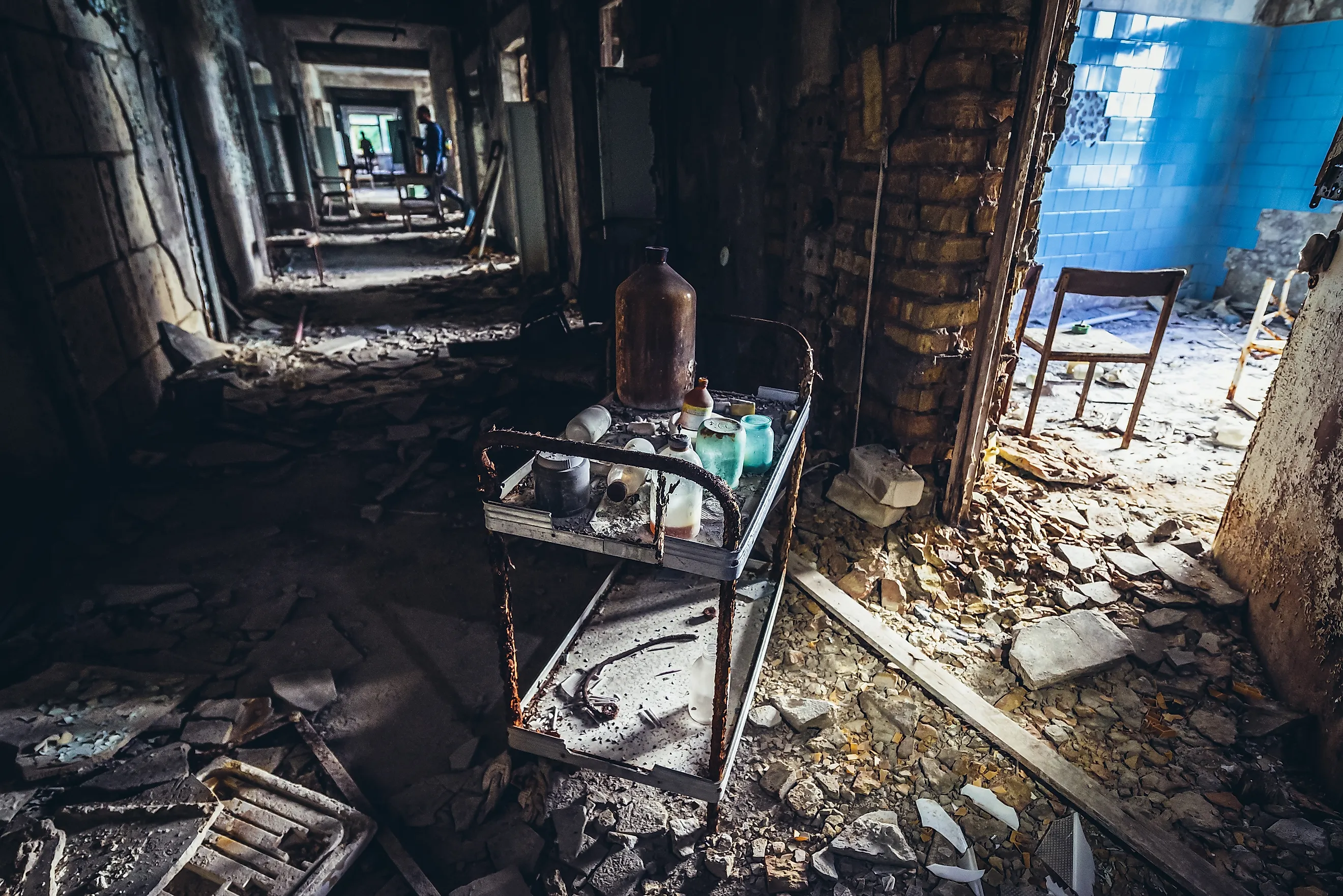
Pripyat City Hospital No. 126, on the outskirts of the city, was once a thriving hospital with 410 beds, a maternity ward, and a dental clinic. Immediately following the Chernobyl disaster, many workers and firefighters were treated here. Survivors were transferred to Moscow, and the hospital was abandoned when evacuation orders came through.
Today, tools, documents, and medical instruments that were left behind during the hurried evacuation are still in the hospital. Empty examination chairs, tables, and beds are present, waiting for patients who will never come back. Paint is peeling and flaking off the crumbling walls. The basement of the hospital is known as one of the most dangerous places in Pripyat, with the highest levels of radiation present.
Children Born Since Then Have Rare Defects and Cancer

Although the accident at Chernobyl occurred almost 40 years ago, babies born to some women who were exposed to its radiation have had severe birth defects. Doctors say some are born with limbs missing, and one baby was reportedly born with two heads.
Many of the children in the Gomel region, just outside of the Chernobyl exclusion zone, have developed thyroid cancer. Heart problems and learning disabilities are also seen in the offspring of those who lived near Chernobyl. Dr. Rachel Furley, who set up a charity to help these children, notes that children in this region have birth defects that aren't seen elsewhere in the world.
The story of the Chernobyl disaster and the abandonment of Pripyat stand as a powerful reminder of how quickly ordinary life can be upended by a single catastrophic event. What was once a thriving Soviet city filled with families, students, and workers became a silent time capsule almost overnight, frozen in the moment its residents were forced to leave. Today, Pripyat's empty schools, hospitals, and weather-worn amusement park speak to the scale of the tragedy and to the resilience of those who lived through it and the lessons the world continues to learn from it. As nature slowly reclaims the landscape, Pripyat remains both a warning and a memorial.