5 Most Beautiful Gothic Churches In Utah
Utah’s Gothic churches emerged in frontier-era towns at the same time the state was developing its more widely known Mormon architecture. During the late 19th and early 20th centuries, Catholic, Episcopal, and Protestant congregations established churches that reflected European training and ecclesiastical traditions brought west by architects and clergy. These churches adopted Gothic Revival forms, including pointed arches, buttresses, vertical massing, ribbed interiors, and stained glass, adapted to local sandstone, brick, and timber rather than imported materials. Pack your things and follow these five Gothic churches across Utah to see how architecture came to life in the West.
St. Joseph Catholic Church, Ogden

Before Ogden had a permanent stone parish, Catholic services were held in a modest wooden church that opened on Easter Sunday in 1877, reflecting the city’s early frontier conditions. That temporary structure was replaced by the present St. Joseph Catholic Church, dedicated in 1902 and designed by local architect Francis C. Woods in the English Gothic Revival style. Constructed of buff and salmon sandstone, the building introduces a vertical, masonry presence that marked a turning point in Ogden’s religious architecture. Pointed-arch openings and tall lancet windows establish its Gothic character, while a 137-foot bell tower rises above the surrounding streetscape. The tower underwent major structural reinforcement recently, ensuring its long-term stability. In 1971, the Utah Historical Society formally recognized the church as a state historical monument, underscoring its architectural and cultural importance.
The inside reflects the same level of ambition and craftsmanship. A long nave draws the eye toward an elaborately hand-carved altar, a centerpiece reportedly requiring 50 to 60 men to assemble, which speaks to the scale and complexity of its construction. The church is further defined by numerous stained-glass windows. Original materials and furnishings remain intact, preserving the church’s early 20th-century character. Its location within Ogden’s historic core also makes it a natural stop when visiting the town.
Cathedral of the Madeleine, Salt Lake City

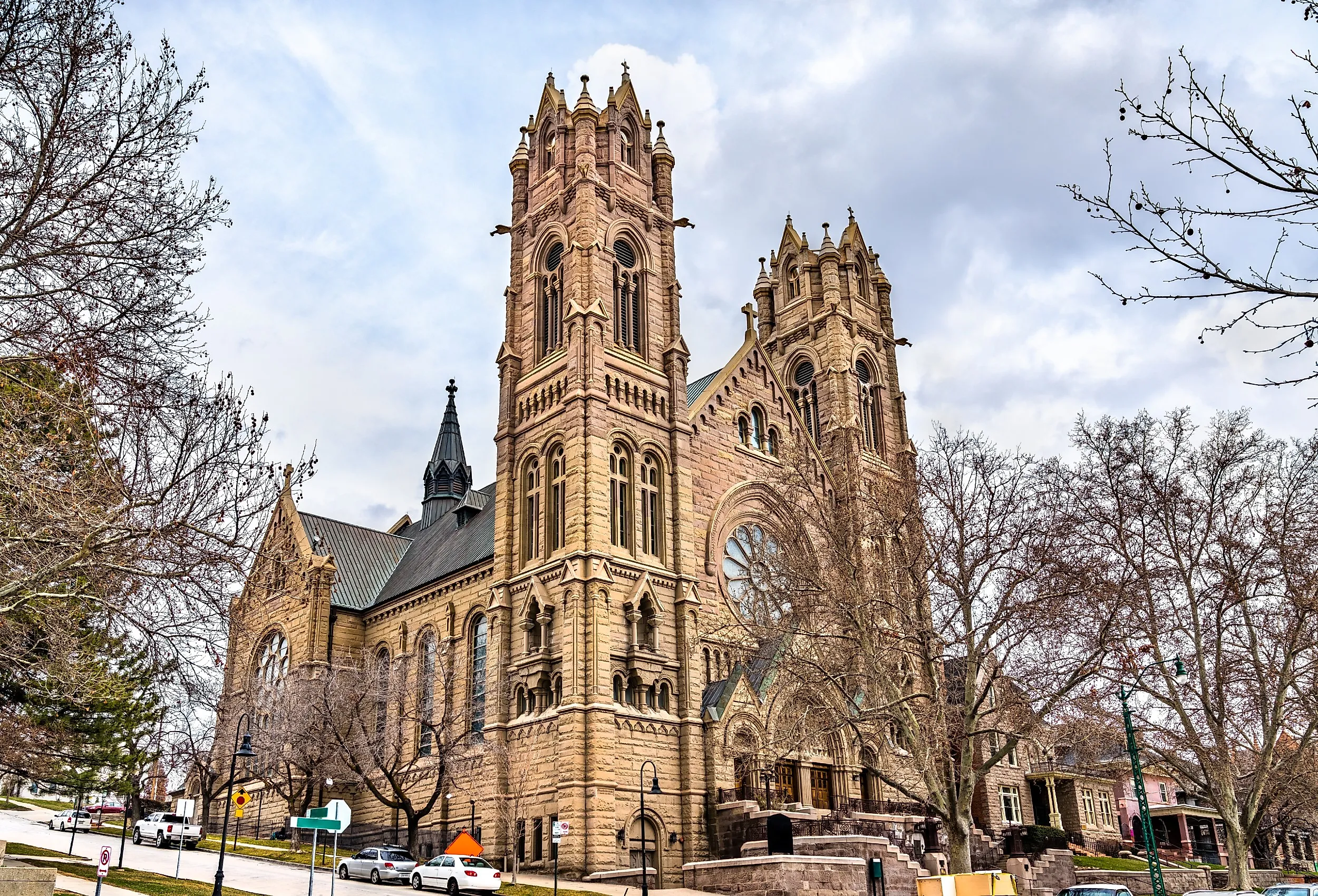
Although often identified as a Gothic landmark, the Cathedral of the Madeleine presents a more complex architectural story. The exterior expresses Romanesque design, while the interior is Gothic in both structure and ornament. Aside from the later addition of a sculpted tympanum above the main doors and a double flight of stone steps leading to the entrance, the exterior remains largely unchanged from its original appearance in 1909. This solid outer shell reflects the architectural preferences of the period and the desire for permanence in a growing city. Four bells remain (two of them original) in the cathedral’s towers. One of them, known as the Mary bell, bears a Latin inscription that reads in part, “I praise the true God, I call the people, I honor the feasts.”

Beginning in 1917, architect John Theodore Comes redesigned the space using Spanish Gothic influences drawn from the late Middle Ages. Ribbed vaulting, pointed arches, and a richly detailed sanctuary shifted the focus upward and inward, creating a Gothic atmosphere within the Romanesque structure. Visitors entering the cathedral experience this transition immediately, moving from the weight and solidity of the exterior into a space shaped by vertical rhythm and ornamental detail.
First Presbyterian Church of Salt Lake City

The congregation’s roots trace back to 1871, when Rev. Josiah Welch was assigned to organize a Presbyterian presence and establish a permanent house of worship in Salt Lake City. Membership continued to expand through territorial years, and following Utah’s statehood in 1896, plans began for a new and larger church. That vision culminated in April 1905, when nearly 1,000 people marched from the original church to the new building for its first service, marking a major moment in the city’s non-Mormon religious history.
Architect Walter E. Ware, one of Utah’s most prominent early architects, designed the church in an English-Scottish Gothic Revival style, drawing direct inspiration from Carlisle Cathedral in England. The exterior is defined by irregular massing, a low square crenellated tower, decorative finials, and tall lancet-shaped windows that establish a strong Gothic profile without excessive ornament. Construction relied on local red sandstone quarried from Red Butte Canyon, hauled to the site by horse-drawn wagon, with harder stone used for trim and structural accents.
Inside, the sanctuary is noted for its clear acoustics, which have made it a long-standing venue for concerts and recitals. Large stained-glass windows by R. T. Giles & Co. of Minneapolis depict scenes including Christ in the manger and the Resurrection. As one of the oldest surviving non-Mormon religious buildings in Utah, the church is listed on the National Register of Historic Places and remains a significant architectural and cultural landmark along South Temple Street.
St. Paul’s Episcopal Church, Vernal

This historic church building, built in 1901, represents a Late Gothic Revival interpretation adapted for eastern Utah’s developing towns. Constructed using locally quarried stone and finished with brick exterior walls, the structure is immediately identifiable by its steeply pitched gable roof and pointed-arch stained-glass windows. The foundation, window sills, and water tables are formed from coursed sandstone, providing visual contrast and long-term structural stability. A large central pointed-arch window dominates the front gable, filled with ornate stained glass set in wooden tracery. Decorative brick buttresses flank the façade, while functional buttresses along the side walls support the exposed roof trusses inside, reinforcing the vertical emphasis typical of Gothic Revival design.
The interior retains its original character through exposed roof trusses and evenly spaced lancet windows that distribute filtered light across the nave. Adjacent to the main church is the former St. Paul’s Lodge, constructed in 1909, which incorporates Craftsman-style elements, illustrating the architectural transition occurring during the early 20th century. Together, the church and parish house form a cohesive complex that was added to the National Register of Historic Places in 1985. The building remains an active parish, allowing visitors to enjoy Gothic Revival architecture.
St. Mark’s Cathedral, Salt Lake City

This Cathedral stands as Utah's oldest non-Mormon church in continuous use and a defining landmark of Gothic Revival architecture in the early American West. The building was designed by Richard Upjohn, a foundational figure in American church architecture and the first president of the American Institute of Architects. Upjohn’s approach here adapted English Gothic principles to frontier conditions, resulting in a structure that conveyed permanence with minimal ornament. Built primarily from locally sourced red sandstone, cut stone, and rubble masonry, the cathedral reflects what historians often describe as a “frontier Gothic” aesthetic. Pointed arches and a steep gabled roof establish its Gothic identity, while later transepts added in 1882 and 1902 expanded the original Latin-cross plan to serve a growing congregation. The cathedral is listed on the National Register of Historic Places.
St. Mark’s houses some of Utah’s most important stained glass, including four windows produced by Tiffany Studios in 1916, along with works by Charles Jay Connick and Franz Xaver Zettler, whose glass fills the sanctuary with controlled color rather than dramatic saturation. In 1935, a major fire gutted much of the interior and damaged several windows, yet the cathedral was carefully reconstructed using the original 1871 plans. During restoration, missing fragments in a Tiffany window famously resulted in a subtle change, replacing a brunette angel with a blonde one. The interior departs from heavy European vaulting in favor of an open, timber-framed nave supported by exposed roof trusses and walnut arches, creating a restrained, almost barn-like spatial clarity consistent with Upjohn’s philosophy.
Utah’s Gothic Legacy
Gothic architecture in Utah reflects how European ecclesiastical design was adapted to frontier conditions. The story opens in Salt Lake City with Cathedral of the Madeleine, where a Romanesque exterior gives way to a fully Gothic interior shaped by European precedent. From there, the tradition moves north to St. Joseph Catholic Church, where English Gothic principles appear in sandstone walls and monumental interior detailing. Back in the capital, First Presbyterian Church of Salt Lake City reflects how the Gothic Revival adapted to Protestant worship through red sandstone massing and restrained ornament. The same design reaches smaller towns at St. Paul’s Episcopal Church, showing how Gothic design extended beyond urban centers. The tour culminates with St. Mark’s Cathedral, Utah’s oldest non-Mormon church in continuous use, showcasing frontier Gothic architecture at a civic scale.