5 Most Beautiful Gothic Churches In Iowa
Iowa is no stranger to Gothic-style architecture, especially for art lovers, thanks to Grant Wood's 1930 oil painting, which depicts a single Gothic-style house with a pinnacle and a pointed arch window in the background. The painting titled American Gothic was created with the intention of being a reassuring sight prior to the country becoming entrenched in the Great Depression. However, the oil painting also highlights a significant period in history for architecture, known as the Gothic Revival period, which occurred during the late 18th and early 19th centuries.
The features of medieval period structures, such as turrets, parapets, and tracery around pointed arch windows, were making a comeback in structural designs during this time. It was a popular choice for houses in rural areas, such as the American Gothic House, but it was also a popular choice for churches. The style allowed churches to be bigger, taller, and more aesthetically pleasing, with beautiful colored lights shining through the ever-popular stained glass windows. Many of these churches can still be viewed today in Iowa, remaining authentic to the Gothic style they were constructed to portray.
Sacred Heart Roman Catholic Cathedral (formerly St Margaret’s)

Built in Davenport, the first edition of the Sacred Heart Roman Catholic Cathedral was built in 1856 and went by the name of St. Margaret's. Constructed on land donated by the original founder of the city, the name was intended to honor his wife, who was known as Marguerite. In the late 1800s, St. Margaret’s was chosen by the Archdiocese of Dubuque to be a spiritual hub, and it was decided that the Church would be rebuilt into a cathedral, renaming it the Sacred Heart. Although the building has endured even a fire caused by a lightning strike in 1928 and a renovation in the 1990s, it remains authentic to the Gothic Revival vision it was created to embody.
On the exterior of this beautiful church, rock-faced Bedford stone creates walls that rest on an Anamosa limestone foundation. The spire itself is impressive, as it was originally the highest structure in the city, with the cross atop sitting 160 feet above the ground. Inside the doors, the space is filled with stained glass windows, including a rose window over the entrance, and a large window overlooking the altar. A unique feature of the church is that the interior has no columns, instead opting for a more open floor plan, with a vaulted ceiling and hammer beams.
Trinity Episcopal Cathedral (formerly Grace Cathedral)

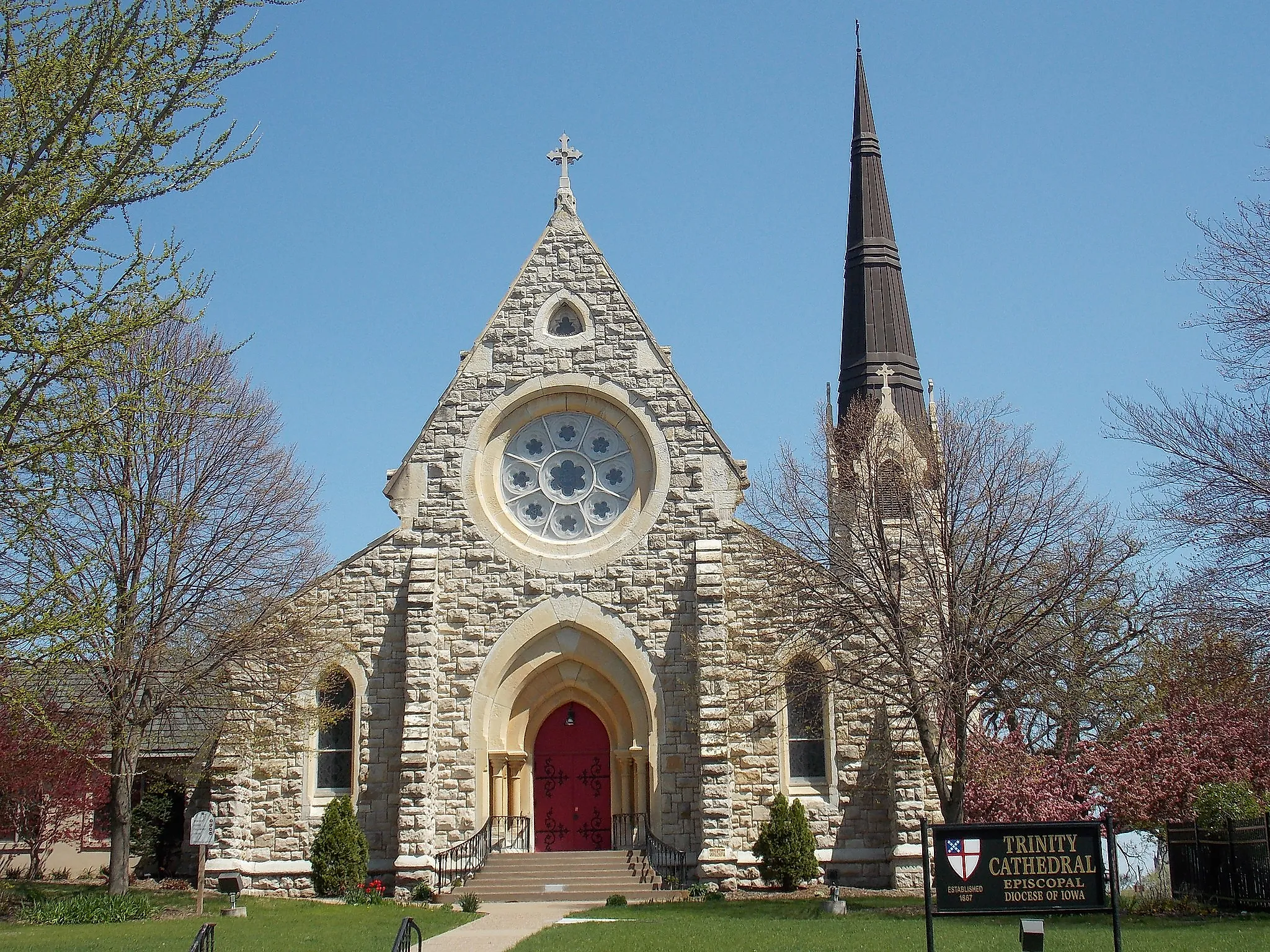
Also located in Davenport is the Trinity Episcopal Cathedral, recognized as one of the oldest Episcopal cathedrals in the United States. The cathedral seen today was the third attempt at constructing a place of worship for the local Episcopal community. The first version was a modest wooden building built in a nearby location, and the second was a far more intricate version built in 1852 in the Gothic style. When the second building succumbed to flames during a fire in 1874, it led to the construction of the church as seen today. Although it was originally named Grace Cathedral, it was renamed in 1908 after merging with the Trinity Parish.
The outside of the building is impressive, boasting a large rose window above the door, a 131-foot tower with a spire at the top, buttresses, and a pointed front entrance. The outside walls are built from Iowa limestone, featuring trim from limestone imported from Indiana. The interior is no less marvelous, featuring beams designed to resemble the popular timber roof style commonly used in medieval architecture, and gold-leaf stenciling painted over the top of the altar.
Basilica of St. Francis Xavier

Similar to the others on the list, the current version of the Basilica of St. Francis Xavier in Dyersville was not how the church began. The first version of the church was built in 1862, a short distance from the current location, but as the population of Roman Catholic congregation members grew, there were two separate occasions where it was clear more space would be required to house those practicing the faith. Once, in 1869, leading to the expansion of the original building, and then in the late 1880s, which led to the construction of the current building in 1887. It took two years to finish the construction, with the final touches completed by 1889. When first looking at the outside of the church, there are eye-catching twin towers on either side of the front doors, soaring at 212 feet high with 14-foot crosses resting on the top of each. Inside the church, there is decorative painting (including painted ceilings and on the south sanctuary wall), 64 large stained glass windows, including a rose window which sits over the entryway, and a curved wooden statue that dates back to the 1850s. The interior is a breathtaking scene, with an altar constructed from onyx and marble and a nave with a 70-foot high vaulted ceiling. With such detailed touches, the church is sure not to disappoint visitors seeking Gothic-style features.
St. Boniface Church

In the city of New Vienna, the need for a church began in the 1840s when a large number of German American families packed up from Ohio and moved, settling in the area. Originally, Maas was held inside a local family's home, which served the purpose for a couple of years. However, eventually it was clear that a building would be ideal for this purpose, and a church was constructed out of wooden logs in 1848. However, as the area continued to grow in population, the original church soon became far too small, prompting the construction of a second version between 1853 and 1855, built from solid stone. Eventually, though this was still not enough, and the final church, which can be seen today, was formed in 1887, a Gothic-style building 172-feet long by 62-feet wide. This was a huge step up from the predecessor church, which was 100 feet by 64 feet.
The church features many classic Gothic-style elements, including an expansive steeple that rises 200 feet into the sky, pointed arches, and numerous stained-glass windows. The walls on the interior are 35 feet high, with spacious vaulted ceilings. What is also beautiful about this church is that it features five altars, all carved from wood, which are well-preserved and still in use today. The organ found resting inside was created in 1891, and is still original, other than an electric blower, which was a more recent addition, to help maintain air supply to the pipes of the organ.
St. John’s Episcopal Church

The current church building for St John’s Episcopal Church took approximately three years to complete, built between 1875 and 1878. The church is described as High Victorian Gothic style, which includes some of the signature features, such as a turret with a conical roof and a steeply gabled roof, both displayed beautifully in the structure of St John’s. The outer walls are constructed of rough limestone and smooth stone trim. There is a big rose window which overlooks the front doors, also very traditional in the Gothic style. There is a low square tower, which in the original plans had a spire and upper tower portion, though this was never built, unfortunately. The church also boasts five glass windows from the craftsman and designer Louis Comfort Tiffany, a man who had a significant impact on the glassmaking and stained glass industry. With this list of features, St John’s is truly a sight to see, both inside and out.
Where History and Architecture Endure
Gothic style architecture has truly influenced onlookers for generations, whether it be simply through onlookers' awe, or even in the form of art such as oil paintings. These churches are not simply places of worship, but reminders of a time long ago when flying buttresses, soaring towers of impressive heights, turrets, and pointed arches were the norm. Even those who may not be religious can still appreciate the beauty of the architecture in these preserved buildings and the rich history that lies within.