4 Most Beautiful Gothic Churches In California
From Los Angeles to Mendocino, California’s churches reflect the state’s diverse architectural history. Originally developed in medieval Europe, the style was reinterpreted in the 19th and 20th centuries using stone, wood, and concrete. Characterized by pointed arches, steep gables, stained glass, and vertical lines, these buildings took on local character as the tradition spread across the state. Gothic Revival and Carpenter Gothic structures in California show how faith and design evolved alongside settlement and urban growth.
These four churches are among the most notable examples, each combining distinctive craftsmanship, materials, and regional settings, offering a clear view of how this architectural tradition was adapted for California communities.
Immanuel Presbyterian Church

Immanuel Presbyterian Church on Wilshire Boulevard in Los Angeles is celebrated for its dramatic Gothic Revival design and distinctive 205-foot corner tower. Designed by Los Angeles architect Chauncey Fitch Skilling and completed in 1929, the church was described by architectural critic Sam Hall Kaplan as “a splendid example of the soaring French Gothic Revival style.” Its façade features a striking stained-glass rose window above the main entrance, while the interior showcases beam trusses, arches, and columns, along with a carved wooden pulpit, chandeliers, and oak furnishings.
Located in Koreatown, the church is recognized as a Los Angeles Historic-Cultural Monument and remains a prominent landmark along Wilshire Boulevard. Beyond its active congregation, it regularly hosts cultural and musical events and has been featured in numerous films and music videos. Today, the sanctuary also serves as a concert venue for both sacred and contemporary performances.
First Congregational Church of Los Angeles

The First Congregational Church of Los Angeles, located on Commonwealth Avenue in the South Los Angeles neighborhood, was founded in 1867 and is the city’s oldest Protestant church in continuous service. The current cathedral-style building, the church’s fifth home, was completed in 1932. Designed by Los Angeles architects James E. and David C. Allison in the Gothic Revival style, it was constructed of reinforced concrete strengthened with over 500 tons of steel. The design includes bronze doors, elegant arches, stained-glass windows, and a hand-carved oak screen that frames and supports the altar.
The church houses one of the world’s largest pipe organs, with more than 20,000 pipes integrated into the structure. Its acoustics and scale make it a frequent venue for concerts and film productions. The complex, which includes Shatto Chapel and the Seaver Building, spans more than 150,000 square feet. Its centerpiece is a 157-foot tower, inspired by the tower of the University of Oxford's Magdalen College, giving the building a distinctly historic and scholarly presence in the urban landscape.
Mendocino Presbyterian Church - Mendocino

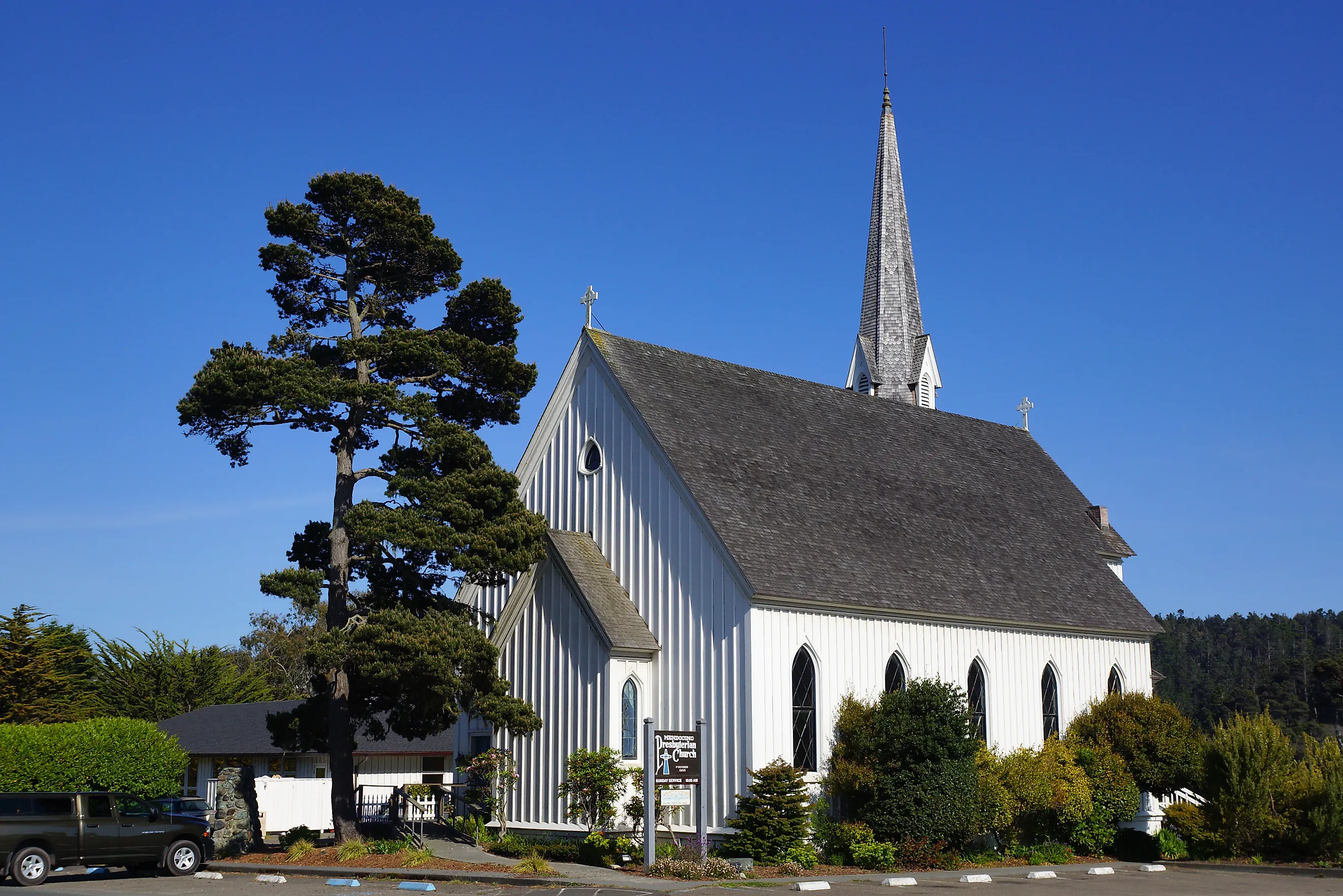
Built between 1867 and 1868, the Mendocino Presbyterian Church overlooks the Pacific Ocean from a bluff in Northern California. Designed by the San Francisco firm S.C. Bugbee & Son in the Carpenter Gothic style, it was constructed from locally milled coast redwood. The structure features board-and-batten siding, tall lancet windows, and a sharply pitched roofline, demonstrating how Gothic design principles were adapted to timber construction in small towns. Originally, the church faced the ocean along the Old Coast Road, the main route from the Big River crossing into town at the time, which is why it now appears oriented away from Main Street.
The interior preserves its original wooden pews, open-beam ceiling, and handcrafted furnishings, while the natural finish of the redwood adds warmth. Other notable features include memorial stained-glass windows, as well as a courtyard and memorial gardens. The church continues to hold services and is listed on the National Register of Historic Places.
St. James’ Episcopal Church - Sonora

St. James’ Episcopal Church, known locally as “The Red Church,” was built in 1859 and consecrated in 1870. Located off Snell Street in Sonora, it is one of California’s earliest surviving examples of Carpenter Gothic architecture. Constructed of redwood and painted deep red, the building features pointed-arch openings, a steep gabled roof, and decorative wooden trim, following Gothic Revival principles on a smaller scale.
Notable features include a bell that marks each service and signals local events such as the Mother Lode Round-up Rodeo and the Sonora Christmas Parade, a Flentrop pipe organ, and stained-glass windows depicting Biblical themes. The church has remained in continuous use since its founding, hosting services, weddings, and community events, and was designated a California Historical Landmark.
Discovering California's Most Stunning Gothic Churches
California’s Gothic churches display the variety and adaptability of the style across regions and materials. From the monumental concrete towers in Los Angeles to the redwood features in Mendocino and Sonora, each building preserves a record of its time and place. The Gothic forms, including arches, towers, steep gables, and stained-glass windows, remain consistent, but their interpretation shifts with climate, resources, and community.