9 North Carolina Towns Where Time Stands Still
As one of the 13 original states, North Carolina’s history is a key part of what makes it a state worth visiting. Going back to 1587 and the famed and mysterious Roanoke Island colony, the history of North Carolina is deep and rich. From its colonial past, its role in the American Revolution, its maritime history, the Civil War, and its African American history, there is a great deal to discover in North Carolina. There are many towns and smaller cities worth visiting for their history and timeless charms.
Beaufort

This coastal town of 4,464 residents has a fascinating colonial and early American history. Founded in 1709, its location on the sea and proximity to British Atlantic island colonies made Beaufort a hub for privateers and merchants. The area’s buildings were built in Bahamian and West Indies styles, of which many still stand today. The historical district, developed around the 1713 Plan of Beaufort Towne, contains many historic homes, and many Beaufort homes, more than 150, bear plaques identifying the original owners. Early names for the town include Hungry Town and Fish Towne.
The North Carolina Maritime Museum is a great way to take in the local history and its relationship with the ocean. Located on the water, the museum features the histories of maritime life, the seafood industry, and pirates, as well as artifacts from Blackbeard's Queen Anne's Revenge. The Beaufort Historic Site is the old town with its 18th- and 19th-century homes, plus the Old Jail, and the Old Burying Ground, a historic cemetery on the National Register of Historic Places. Fort Macon State Park is the site of a Civil War-era fort, right on the beach. Beaufort provides access to the barrier islands of the Outer Banks, including the wild Core Banks islands, North Core, South Core, and Shackleford Banks, home to wild horses.
Kill Devil Hills

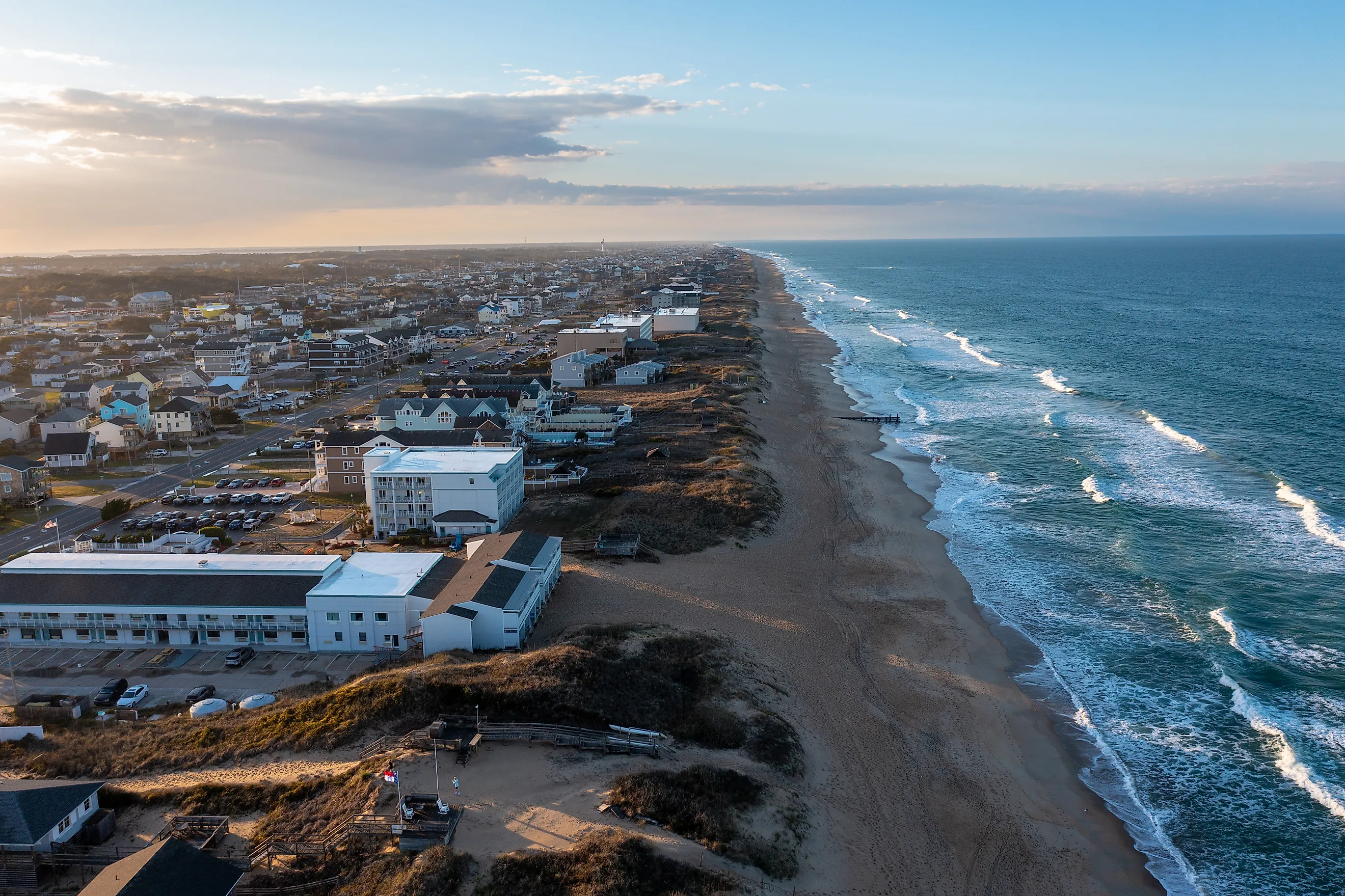
Kill Devil Hills is notable for at least two reasons: its unusual name, and as the place where humans first took flight. With a population of 7,700, Kill Devil Hills is a town at the center of North Carolina’s Outer Banks, right on the shores of the Atlantic Ocean. It was here that the Wright Brothers made the first controlled, sustained flight of an engine-powered, heavier-than-air aircraft. Kitty Hawk, North Carolina, just 4 miles north of Kill Devil Hills, gets the credit as the location of the first flight, but this has more to do with its position as the closest named settlement in the area. Kill Devil Hills would not exist as a named town for another 50 years. In the meantime, the town grew around the site of the Wright Brothers’ flight, which is commemorated by the Wright Brothers National Memorial, first opened in 1932.
With much of its identity wrapped up in the Wright Brothers’ flight, Kill Devil Hills nevertheless has other points of interest. The Avalon Fishing Pier is a popular fishing spot and also features a bar and snack bar featuring seafood. Nags Head Woods Preserve is a maritime forest, a woodland affected by the ocean, and one of the largest of such forests remaining on the Atlantic coast. The preserve features 8 trails, winding through wooded dunes and marshland. Sam’s Diner is a historical diner built in 1940 as a Streamline Moderne style building, and is listed on the National Register of Historic Places. The current occupant is the Kill Devil Grill. Colington Island is accessed through Kill Devil Hill and is an underexplored part of the Outer Banks, which has a few restaurants, campgrounds, and places for fishing and crabbing.
New Bern

Named for the Swiss city by immigrants, New Bern is a small city of 31,000. The city even shares the black bear emblem of Switzerland’s capital. Founded in 1710, New Bern functioned as the capital of North Carolina from 1770 to 1792 and is the second-oldest European settlement in the state, after Bath. In the 1890s, pharmacist Caleb Bradham developed the formula for what would later become Pepsi-Cola. The Birthplace of Pepsi historical site opened in 1998 in the original building. Built in the late 1700s, Tryon Palace was the seat of government for North Carolina as well as the residence of the colonial governor. This Georgian building was restored, where it sits in a neighbourhood of other historic homes. The North Carolina History Center is next to Tryon Palace, offering history exhibits from the colonial period onwards.
As a riverfront city near the Atlantic coast, the sea is a big part of New Bern’s culture. The Trent and Neuse rivers provide opportunities for fishing, camping, and biking, with many surrounding nature trails. Located on the coast, the Croatan National Forest has extensive trails and two remote lakes, Catfish Lake and Great Lake, that offer non-motorized boating, fishing, camping, and hunting in season. The Battle of New Bern was a Civil War battle, and 30 acres of the original battlefield are preserved, featuring a History Walk with interpretive panels telling the story of the battle and its role in New Bern history.
Edenton

A town of 4,397, Edenton was founded in 1712 as the “Towne on Queen Ann’s Creek”. Incorporated as Edenton in 1722, it was the colonial capital until 1743. For a time, the town had the second-largest port in North Carolina, and Edenton grew commercially as well as politically. Hundreds of its 18th-century buildings have been preserved. With its location on the sea with a crucial port, Edenton was also a key part of the Maritime Underground Railroad, with runaway slaves escaping to the North through the town’s port. Colonial Waterfront Park is part of the Underground Railroad Network to Freedom education program. Harriet Jacobs was a town resident who had escaped slavery in 1842 and wrote about her experiences in one of only a few first-person accounts of the maritime escape network.
Roanoke River Lighthouse is the last remaining screw-pile lighthouse in North Carolina. Built in 1886, it is a preserved landmark in Edenton Bay. Downtown Edenten is the commercial heart of the town, with restaurants, cafes, antique shops, and galleries. Located downtown, the 1767 Chowan County Courthouse is a landmark colonial-era public building that served as the county courthouse until the late 1970s. Bennett’s Millpond is a park featuring canoeing and kayaking, camping, a boardwalk, and a birding trail.
Ocracoke

Many coastal towns make claims to have had Blackbeard, the pirate, stay for a while in their midst. Ocracoke, an island on the Ocracoke Inlet, has more than a claim. In 1718, Edward Teach, better known as Blackbeard, was using the island as a base of operations. When it was discovered that Blackbeard was, in fact, on the island, Colonial Virginia’s governor sent Lieutenant Robert Maynard to hunt Blackbeard down, and Ocracoke was where the pirate met his end. The settlement at Ocracoke was established due to its location on the inlet, and it served as a strategic point in the Revolutionary War and later in the Civil War. History, whether maritime, colonial, Revolutionary War, or tales of pirates, is a big part of this small town of 709.
As an island, Ocracoke has plenty of beaches and waterfront activity available. Built in 1823, the Ocracoke Lighthouse is the oldest lighthouse in North Carolina and one of the oldest historic lighthouses still in operation in the U.S. Seafood is a big part of island life, and Ocracoke is part of the North Carolina oyster trail. Ocracoke Oyster Company is a great place to eat local catches. Salt Marsh Creeks are at Pamlico Sound, and visitors can kayak through the marsh-lined estuaries of the Cape Hatteras National Seashore. Springer’s Point was an undeveloped area of Ocracoke Island that was purchased by the Coastal Land Trust to prevent development. The original 31 acres were expanded to 132 acres of pristine wilderness.
Mount Airy

Mount Airy was first settled by Europeans in the 1740s. Over the years, this town of 10,583 became known as Granite City due to one of the world’s largest open-face granite quarries located nearby. Many homes in the town are built with local granite. Mount Airy is also known as the hometown of actor Andy Griffith, and served as the model for the fictional Mayberry on Griffith’s 1960s TV series, The Andy Griffith Show. Mount Airy is host to Mayberry Days, an annual event. The town was an important stagecoach stop as part of the road connecting Winston-Salem, North Carolina, and Galax, Virginia.
The downtown area contains many shops, restaurants, cafes, and antique shops, and is the location of the Mount Airy Museum of Regional History. Housed in a historical department store building, the museum focuses on the area’s past, Native American history, and settlers who developed the granite and tobacco industries. Built in 1938, the Earle Theatre is an Art Deco building that has been in continuous operation since the 1930s. Pilot Mountain State Park offers rock climbing, hiking trails, and wonderful views from Little Pinnacle Overlook.
Hillsborough

The area around what is now Hillsborough was an important hub on the Great Indian Trading Path, also known as the Occaneechi Path, a pre-colonial Native American trail that European settlers later utilized for the fur trade. Hillsborough, a town of 9,773, was founded in 1754, originally as Orange, and changed to Hillsborough in 1766 after the Earl of Hillsborough, the colonial secretary of state from 1768 to 1772. The Hillsborough Downtown Historic District is listed on the National Register of Historic Places, featuring over 100 homes and other structures dating back to the 18th and 19th centuries. The town has 16 museums exploring various aspects of Hillsborough history, including the Burwell School Historic Site that preserves the location of one of North Carolina’s earliest schools for girls, The Burwell Academy for Young Ladies.
Orange County Historical Museum focuses on local history from colonial times onward, while Ayr Mount is a Federal-era plantation house built in 1815 that is on the National Register of Historic Places. The town is an artistic community, with many galleries and studios in the downtown core and beyond. The Alliance for Historic Hillsborough organizes an annual event, the Revolutionary War Living History Day, and features live reenactments, historical tours, traditional dance performances, and special events in collaboration with local businesses. Although quite close to the town, Eno River State Park feels distinctly separate from town activity, with over 2,700 acres and 21 miles of hiking trails. The park is named for the Eno, who lived in the area before European settlement, along with the Shakori and Occoneechee tribes.
Tarboro

The Native Tuscarora people occupied the area that is now Tarboro, and it is their word, taw, meaning “river of health” that lent itself to the town’s original name, Tawboro, in 1733. The North Carolina General Assembly later Anglicized the name to Tarborough, which was eventually simplified to the present Tarboro. The town was a successful river port, and after the Civil War, 10,000 newly-freed African Americans settled across the Tar River, calling it Freedom Hill, later renamed Princeville. The Tarboro Historic District is on the National Register of Historic Places, with 45 blocks and over 300 18th and early 19th-century structures. The Tarboro Town Common, one of only two town commons left in the United States, is located in this area. The Historic Tarboro Walking Trail takes you around the historic district.
With a population of 10,954, Tarboro has a great deal to offer in addition to its history. The Historic District and adjacent neighborhoods now feature a thriving commercial section, with shopping, antiques, restaurants, and cafes. The Tar River provides plenty of opportunities for boating and fishing (both bass and crappie are in abundance), including the Tar River Paddle Trail. Riverfront Park provides access to the river for boating and also has walking trails and picnic areas. For kids, Indian Lake Park has TRACK trails for self-guided nature walks.
Bath

This small town of 250 has a deep history that is still very much evident today. The first European settlement of the area was near the Pamlico River in the 1690s. Bath was established in 1705 and has the distinction of being North Carolina’s first town and first port. An early contender for the colonial capital, the original town area forms the present-day Bath’s historical district. The Bath State Historic Site features three historic homes from the 18th and early 19th centuries: the Palmer-Marsh House, the Van Der Veer House, and the Bonner House. There’s an exhibit center for a closer look at local history, and walking tours cover the area as well. Local legend has it that English pirate Blackbeard called Bath home for a while.
Just outside the historic district sits St. Thomas Episcopal Church, built in 1734, and it is the oldest extant church in North Carolina. Bath’s location on the water and its status as North Carolina’s first port lend themselves to a rich maritime history. The Bath Harbor Marina is worth a short walk from the historic district to take in the views of the water. Bonner’s Point is a park on the water, and the location of Bonner House, built in 1830. Nearby Goose Creek State Park features old-growth oaks, swimming, hiking trails, and camping facilities. For some Southern home cooking, Old Town Country Kitchen is a diner serving all-day breakfast and other staples of Southern cuisine, such as country-fried steak and Southern fried seafood.
North Carolina's Most Remarkable Historical Towns
With a history spanning every epoch of the United States, from the Colonial era to the Revolutionary War, the growth and advancements of the 19th century, and the devastation of the Civil War, North Carolina has been at the center of it all. Many towns in the state date back to before the American Revolution, and individually, they possess rich histories. The history of North Carolina is deeply rooted in its communities along the Atlantic Coast and in the state's interior. What they have in common is what we can experience today, as we wander through these time capsules of American history.