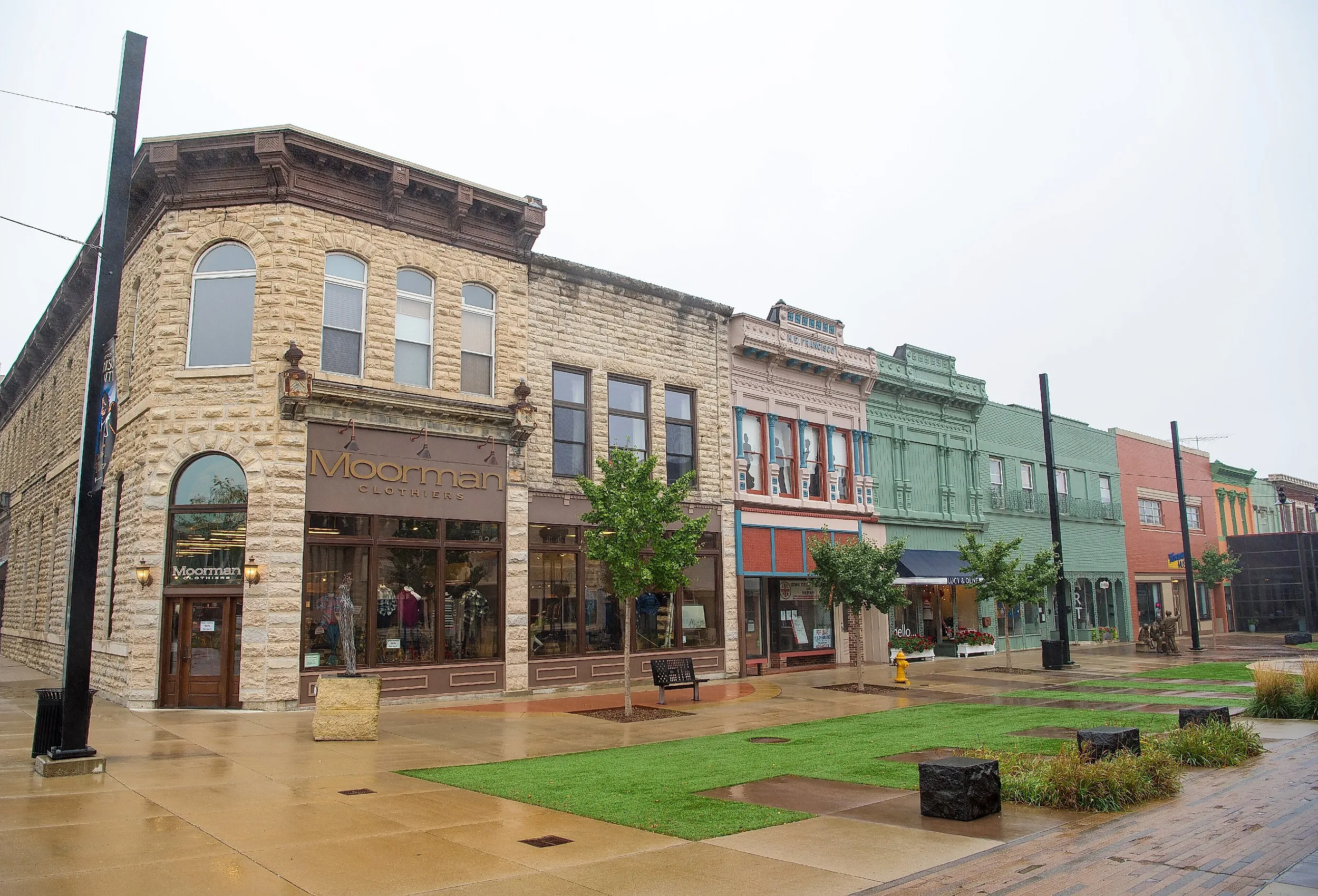
7 Most Walkable Town Centers In Iowa
These Iowa towns stand out because their downtowns were built on a scale that still works well for walking. In Burlington, the historic riverfront district climbs steeply from the Mississippi and includes Snake Alley, a famously tight and winding brick street that connects several downtown blocks. Mason City’s center was shaped by early twentieth-century planning and architecture, including a collection of Prairie School buildings that anchor a compact commercial core. Cedar Falls concentrates much of its activity along Main Street near the Cedar River, where shops, restaurants, and civic spaces sit close together. River towns like Muscatine and Clinton developed the same way, with downtown blocks built tightly along the Mississippi. Together with places like Ottumwa and Marshalltown, these communities retain dense historic centers where many of the town’s destinations remain within a short walk.
Ottumwa

Ottumwa may be the largest settlement in South Central Iowa and a regional employment and medical hub, but the town of about 25,000 still carries a classic small-town feel, boasting a fairly dense downtown area centered around Central Park and the historic Wapello County Courthouse. From Central Park, one of the town's better-known attractions, the century-old Canteen Lunch in the Alley diner is just two blocks to the southwest, while the Greater Ottumwa Convention & Visitors Bureau is just on the opposite side of the block. Moreover, the entire downtown area is within about 15 to 30 minutes on foot from various attractions on the opposite bank of the Des Moines River, including Bridge View Center, the Beach Ottumwa waterpark, Railroad Park, and War Memorial Park.
Mason City

As the name implies, this decent-sized town in North Central Iowa was historically a major hub for brick and tile manufacturing, although these days it's mainly known for its array of Frank Lloyd Wright-designed buildings and its status as the hometown of composer and playwright Meredith Wilson. Some of the town's most notable attractions are directly in the town square, such as the Wright-designed Park Inn Hotel and the Mason City Arena, with other attractions including Music Man Square and the Charles H. MacNider Art Museum clustered in an area about 10 minutes on foot from the town's Central Park.
Cedar Falls

Cedar Falls is the slightly smaller of two adjacent cities in Northeast Iowa, the other being Waterloo. While Waterloo earned its fame as the longtime home of the John Deere company, though, Cedar Falls is mostly known for being the home of the University of Northern Iowa, and like many college towns, it stands out for its comparative walkability. The town's main nexus is Overman Park across from City Hall, an attraction in and of itself with a replica pioneer cabin and a large bandshell, and many of the town's main attractions are within immediate walking distance; the Cedar Falls Historical Society is right across the street, Sturgis Park and the Ice House Museum are two blocks to the north, and the historic Oster Regent Theatre is a quick five-minute walk to the northeast.
Clinton

Clinton, the easternmost city in Iowa, is the first of three consecutive towns on the list to be situated along the Mississippi River, gaining prominence in the late 19th century as a transportation hub and a center of the lumber industry. Using DeWitt Park as a central reference point, there are many attractions located just a short walk away; the George M. Curtis Mansion is two blocks to the north, the Felix Adler Children's Discovery Center is just a block to the south, and Riverview Park and the adjoining Showboat Theatre are a 25-minute walk to the northeast along the Discovery Trail. Uniquely amongst towns of this size, however, Clinton is actually polycentric, with the area comprising the once-separate town of Lyons containing a walkable town center in its own right, complete with attractions such as the Lyons Farmers Market and the Sawmill Museum, essentially giving you two walkable town centers for the price of one!
Muscatine

Muscatine may be one of the smaller towns in the state in terms of population, but its size belies its historic importance as a trading post and industrial center along the Mississippi. Using the traffic circle at the intersection of Mulberry and 2nd as a reference point, most of Muscatine's main draws are within very quick walking distance; the Sino-US Friendship House and the directly adjacent The National Pearl Button Museum @ Muscatine History and Industry Center are a seven-minute walk down 2nd Street, and Riverside Park and its attractions such as the Riverview Center and the world's largest watermelon sculpture are another 7-minute walk to the southwest.
Burlington

Tucked away in the corner of Southeast Iowa, this historic railroad town has a great deal of character in proportion to its small population. Using City Hall on Washington Street as a center point, the town's most famous tourist draw, Snake Alley, the purported "crookedest street in the world," is just two blocks to the west, as is the Garrett-Phelps House Museum situated on Snake Alley itself. The Des Moines County Heritage Center Museum, housed in a former library, is just a block to the north of city hall, while the scenic views over the Mississippi River afforded from Mosquito Park are slightly farther afield, about six blocks and a 13-minute walk to the north.
Marshalltown

As it turns out, one of the most walkable towns in Iowa is practically right in the center of the state, not too terribly far from Des Moines. Marshalltown is a quiet and bucolic old railroad town on the Iowa River, complete with a classic town square centered around the Marshall County Courthouse; from the town square, the historic Tremont Inn is just a block to the east and the Glick-Sower Historical House is a five-minute walk to the northeast, while a brisk 15-minute walk to the south takes you to the Marshalltown Family Aquatic Center and another 5 minutes from there you will find the Marshalltown Arts and Civic Center.
Truth be told, a city doesn’t necessarily have to be a medieval hive of narrow alleyways and passageways in order to be considered at least decently walkable. American cities may not necessarily lend themselves to such a design, and a lack of adequate pedestrian infrastructure, such as sidewalks and crosswalks, is an issue endemic to many non-major settlements throughout the country, but it cannot be denied that a major aspect of the issue of walkability is psychological as well as physical. According to a study by the University of Tennesee Obesity Research Center, while the average European walks about 382 kilometers per year, Americans only average about 140, and another study by the CDC's Division of Nutrition, Physical Activity, and Obesity indicates that the average American balks at the idea of walking more than a mile, or even half a mile, in order to reach their nearest public transit stop.
The car may have largely built American society as we know it today, but what it provides in terms of convenience, it also robs us of the experience of being on the ground. If you can find the right places in Iowa, leaving your car behind and finally trusting yourself to navigate the world on your own two feet can make all the difference.

.jpg)
