5 Prettiest Downtown Strips In The Rockies
Mountain towns built on silver money put their wealth into their main streets, and the prettiest Rocky Mountain downtowns are the ones where the brick, sandstone, and clapboard from the 1880s and 1890s still face onto the same sidewalks. Aspen's red-brick Hotel Jerome has anchored the corner of Mill and Main since 1889. Ouray's Main Street threads a narrow box canyon walled in by 13,000-foot peaks. Silverton's entire downtown is a National Historic Landmark, with the colorful storefronts of Greene Street running unbroken between the river and the mountains. Manitou Springs runs along Manitou Avenue past eight natural mineral fountains at the foot of Pikes Peak. Five downtown strips, five different versions of the same story about silver, time, and the mountain settings they wear like a frame.
Estes Park, Colorado

Elkhorn Avenue runs four walkable blocks at the eastern gateway to Rocky Mountain National Park, with Long's Peak rising 14,259 feet in the southwest backdrop and the Big Thompson River tracing the south edge of the strip. The street holds more than 300 shops in those four blocks, from Patterson Glassworks at the gallery end to Hyk Mountain Lifestyle for trail gear at the other, with Trendz at the Park handling home goods in between.
The Big Horn Restaurant has been pouring coffee a block off the main strip since 1972, and Kind Coffee and Coffee on the Rocks split the morning rush. The visual anchor at the north end is the Stanley Hotel, a 1909 Colonial Revival landmark in white clapboard with a vivid red hipped roof and a long symmetrical facade that Stephen King turned into the Overlook Hotel in The Shining after a 1974 stay in room 217. The strip stays walkable all year and busy from late May through October.
Ouray, Colorado

Ouray calls itself the Switzerland of America, and Main Street earns the comparison: a six-block stretch of late-Victorian brick and stone storefronts running straight through a narrow box canyon in the San Juan Mountains, with 13,000-foot peaks rising on three sides of town. The Beaumont Hotel at the corner of Main and Fifth Avenue, built in 1886 and opened in July 1887, anchors the visual under a slate mansard roof and a corner tower in painted brick and stone.
The Ouray Hot Springs Pool at the north end has been a public pool since 1927, fed by geothermal water that ranges from 80 to 105 degrees across its different sections. The Ouray County Historical Museum on Sixth Avenue holds the silver-boom story, and the Ouray Alchemist Museum a block away is the largest pharmacy museum in Colorado with restored 19th-century fixtures and apothecary stock. Maggie's Burgers handles the lunch rush and the Outlaw Steakhouse handles the steak side of the local economy. Box Cañon Falls a short walk from downtown sends visitors home with the postcard shot.
Silverton, Colorado

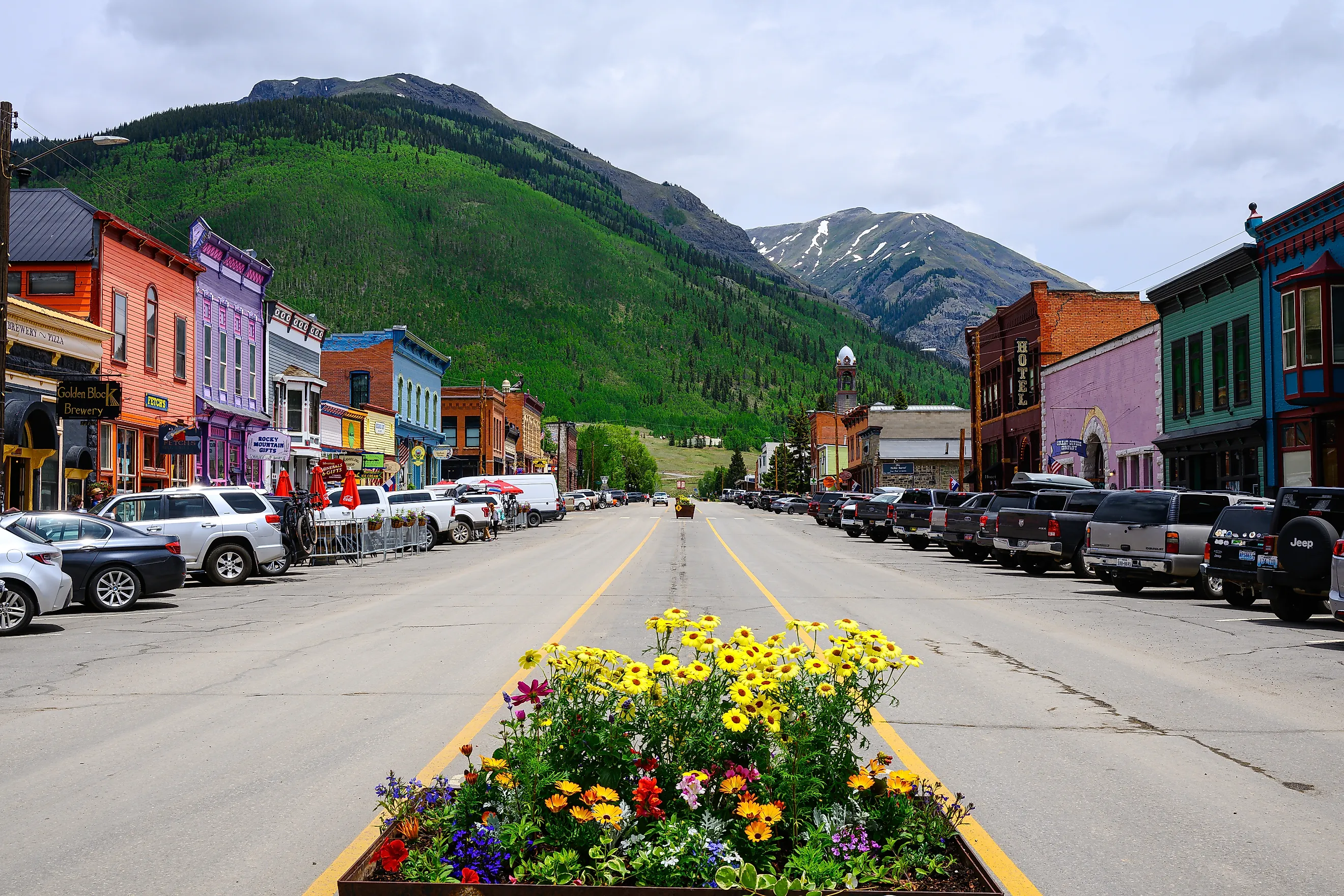
Silverton's entire downtown was designated a National Historic Landmark in 1961, and the visual proof runs up Greene Street: an unbroken row of brightly painted brick and false-front commercial buildings, most built between 1882 and 1910, at 9,318 feet of elevation with the San Juan Mountains rising on every side. Greene Street is the wide main thoroughfare; Blair Street one block east is the parallel back row that used to hold the saloons and brothels. The Durango & Silverton Narrow Gauge Railroad, running coal-fired steam locomotives since 1882, deposits day-trippers from Durango at the depot on the south end every summer morning.
The Grand Imperial Hotel at 12th and Greene, opened in 1883, holds the oldest continuously operating hotel in town under a three-story Italianate brick facade. The Bent Elbow on Blair Street, built in 1907, runs a small boutique hotel above its dining room and hosts an annual skijoring competition in the street out front each winter. Adelaide's Antiques and Timberline Trading hold most of the shopping along the four-block strip, and The Coffee Bear handles the caffeine. Animas Forks, a real ghost town a 12-mile high-clearance drive north on the San Juan Skyway, is the standard afternoon trip.
Aspen, Colorado

Aspen's downtown grid sits walkable and dense with Victorian-era brick and peachblow sandstone buildings raised on silver fortunes between 1879 and the Silver Crash of 1893. The four-story red-brick Hotel Jerome, opened Thanksgiving eve 1889 by Macy's co-owner Jerome B. Wheeler at the corner of Main and Mill, has hosted guests every season since and still anchors the north end of the downtown core. Two blocks south on Hyman, Wheeler's other 1889 commission, the Wheeler Opera House, rises three stories in rusticated peachblow sandstone with Romanesque Revival arches and Italianate details, the tallest building in town when it opened and still its most striking facade.
The Silver Queen Gondola lifts off the corner of Durant and Hunter at the south edge of downtown and runs straight up Aspen Mountain in 14 minutes from the same red-brick blocks visitors walked the night before. For high-end dinners, Aurum Food & Wine and Bosq sit a block apart on East Hopkins. The downtown reads at its prettiest on a sunny February day with snow on the eaves, the gondola turning above the sandstone of the Wheeler, and the cottonwoods on Wagner Park dusted white.
Manitou Springs, Colorado

Manitou Avenue runs at the foot of Pikes Peak with Fountain Creek tracing the south edge of the strip and stone-and-clapboard Victorian commercial buildings facing the avenue on both sides. The town gets its name from the eight natural mineral springs that bubble up along the avenue and through the side streets, each with its own public fountain in carved stone or cast iron. The free Mineral Springs Walking Tour map at the visitor center hits all eight in about an hour.
Iron Springs Chateau, on Ruxton Avenue at the base of the Manitou Incline, runs a melodrama dinner theater with audience boos and cheers built into the program. Miramont Castle on Capitol Hill, built in 1895 by a French priest in a layered mash of nine architectural styles (Romanesque, English Tudor, Byzantine, and Queen Anne among them), holds the Queen's Parlour Tea Room for a Victorian afternoon-tea service. Soda Springs Park along the creek runs free summer concerts most weekends. Manitou Springs earns the downtown crown for variety: nowhere else in the Rockies puts a 1,000-vertical-foot stair climb, a French priest's nine-styles castle, and eight natural mineral fountains on the same six-block strip.
Five Strips, Five Reasons to Stay
The five downtown strips above all run on the same root capital: silver fortunes that built the brick and sandstone, the railroads that came in to haul the ore, and the people who stayed after the boom ended. Pick the one that fits the weather and walk the main street first thing in the morning, before the day-trippers arrive, when the storefronts have the light to themselves.