5 Charming Old Railroad Towns In Pennsylvania
Despite being known as a center of industry, the railroad came relatively late to Pennsylvania, with the first rail lines set up in the 1830s. However, by the 1860s, Pennsylvania had surpassed all competitors in total railroad mileage. Although cars and trucks did a lot of damage to the industry, you can still find many charming railroad towns in Pennsylvania.
Within these towns, you can take scenic rides on steam locomotives, visit a museum filled with toy trains and cars, see an architectural marvel of a rail line within the Allegheny Mountains, and explore the Grand Canyon of Pennsylvania.
Here are five charming old railroad towns in Pennsylvania to visit.
Strasburg

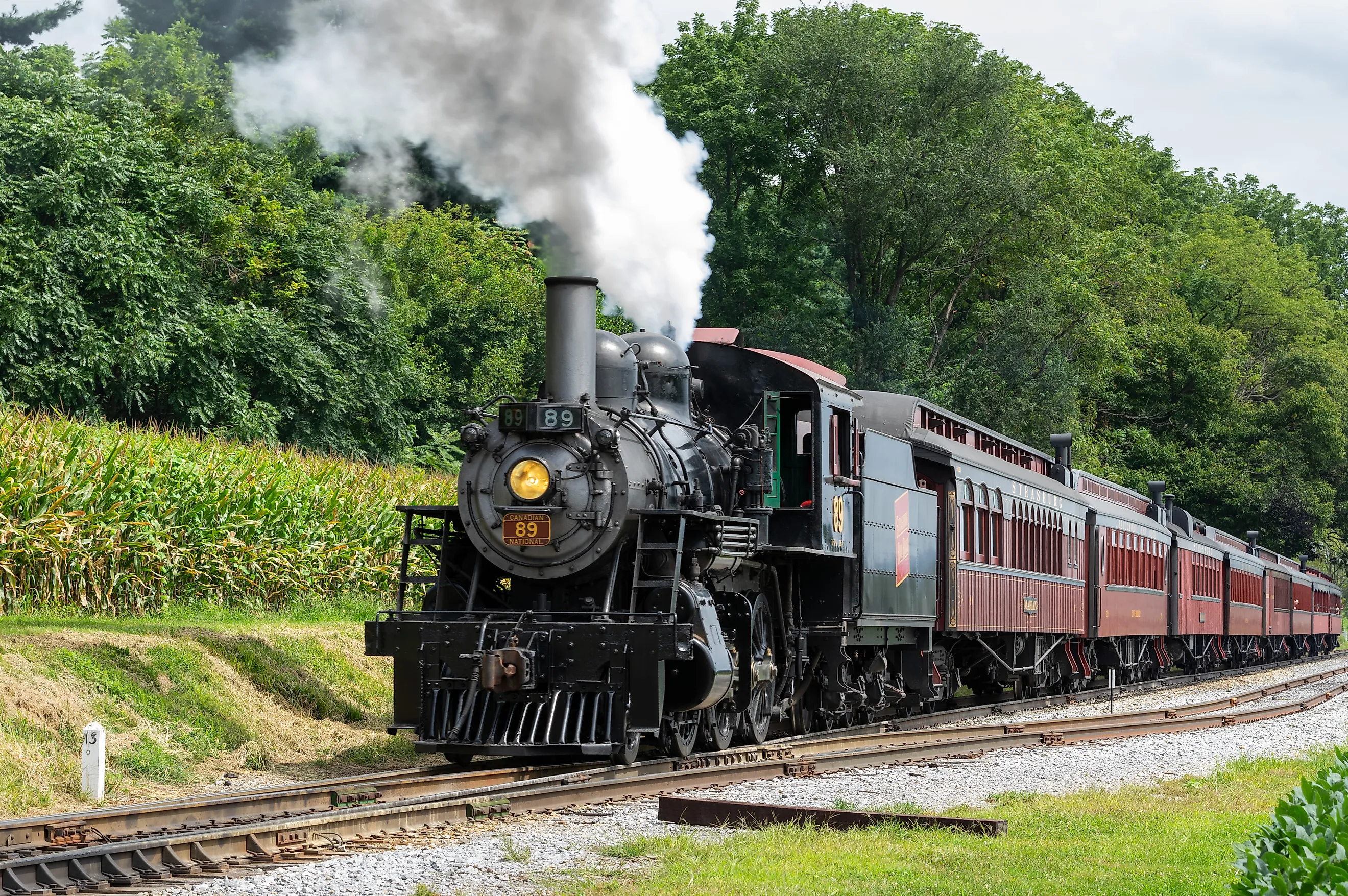
Named after the German city, Strasburg's history goes back to the early 1700s with the establishment of the Old Conestoga Road, a tavern, and some log houses. Its real legacy would begin in the 1830s, when the Strasburg Rail Road came to town. Today, the town has the oldest continuously operating railroad in North America and has been rightfully nicknamed Rail City. It's one of the few places in America where you can ride on a vintage steam train on the Strasburg Rail Road. The town overflows with railway attractions, with more than 100 locomotives and cars on display at the Railroad Museum of Pennsylvania and a massive collection of miniature and toy trains at the National Toy Train Museum. Children will love the Choo Choo Barn with its more than 150 hand-painted figures and vehicles, and 22 miniature trains dashing around its 1,700 square foot display. Due to the town's position in Lancaster County, it also has one of the largest Amish communities in the U.S. You can learn about their simple rural lifestyle at The Amish Village, with a farmhouse, blacksmith shop, and one-room school on site.
Altoona

Many towns grew due to the advent of the railroad. Others, like Altoona, were founded by a railroad company. The Pennsylvania Railroad established this town in the Allegheny Mountains in 1849. It remained a major hub until after WWII, as the demand for rail line services declined. Altoona today is one of the best places in the state to visit for those interested in railway history, as there are two railroad attractions to see. The first is the Railroaders Memorial Museum, which has a grand array of artifacts, cars, and equipment on display. The second is the engineering marvel: the Horseshoe Curve, a rail line that was carved out from the rugged landscape of the mountains with switchbacks and excavations. Other than the railroad, Altoona has a large arts scene. Catch a show at the Altoona Community Theatre, the Altoona Symphony Orchestra, or see fine art at the Southern Alleghenies Museum of Art. For hiking, Altoona is a good base for several state parks, including Canoe Creek State Park in Hollidaysburg, which features wetlands, fields, forests, trails, and a swimming lake.
Danville

The region around Danville was settled by a variety of Europeans. The Swedes came here briefly from the 1630s to 1650s, before their settlements were taken first by the Dutch and then the British. In 1792, a land acquirer named William Montgomery officially established Danville, which would go on to become a railroad hub of lines passing through the banks of the Susquehanna River. Danville was also an iron mill center and manufactured many of the rails used throughout the U.S. Every September, Danville hosts the Danville Heritage Festival, with a focus on its iron and rail heritage. Intriguingly, Danville may have the oldest rail line in the U.S., which today is a 3-mile trail called the J. Manley Robbins Trail. You can experience older history at the Montgomery House, built in 1792, which served as the home of the town's founder.
New Hope

Situated 30 miles to the north of Philadelphia is the delightful borough of New Hope. The rail line arrived a bit later in this region than others on this list, as the New Hope Branch of the North Pennsylvania Railroad was completed in 1891. Although much of the rail line service has halted, New Hope still maintains a scenic route on its 1925 steam locomotive via the New Hope Railroad. It offers a nine-mile narrated ride through the countryside. The ride begins at the cute 1891 New Hope Station, with its conical tower giving it a vintage feel. Another historic place in town is the Bucks County Playhouse, which has been around for 70 years and has been called "America's Most Famous Summer Theater" due to the sheer variety of performers to grace its stage, such as Grace Kelly. For outdoor activities, go out to the Delaware Canal State Park, which preserves an old canal and towpath as a series of trails along the Delaware River, and through 11 river islands.
Wellsboro

Wellsboro was founded by a group of settlers from nearby Delaware, Maryland, and Philadelphia in 1806, and was named after Mary Wells, one of the first Quaker residents. The rail line came to Wellsboro in 1871 as the Wellsboro & Lawrenceville Railroad built a route from Lawrenceville to the town. Wellsboro today is a major destination for hikers, as it sits within a canyon known as the Pennsylvanian Grand Canyon, or the Pine Creek Gorge. Hikers can explore the eastern side of this 1,000-foot-deep canyon within Leonard Harrison State Park. For other activities in town, there's the 1920s era Arcadia Theatre for a movie, or the Deane Center for the Performing Arts to enjoy live music. Downtown Wellsboro is worth strolling through as it is lit up by Victorian-era gas-powered lights.
Architectural Marvels
Even nearly 200 years later, it's easy to appreciate the ingenuity and tenacity of those railroad workers and companies who set up thousands of miles of lines all throughout the rugged landscape of Pennsylvania. That same ingenuity still remains in these charming towns, which celebrate their railroad heritage through well-maintained steam locomotives, museums, and rail lines turned hiking trails. By visiting these old railway towns, you'll also be immersed in nature and art, such as in the canyons of Wellsboro or the best summer theater in New Hope. These old railroad towns keep the past alive and provide delightful railroad experiences for visitors.