The Largest Universities In Canada By Enrollment
Canada is one of the world’s most popular destinations for education, with over 1.5 million students as of 2023. The country is home to some of the world’s most prestigious universities, including the University of Toronto, which is often ranked among the top global institutes. Among the many universities nationwide are several institutions that enroll exceptionally large student populations, including the University of Toronto, the University of British Columbia, Université de Montréal, York University, the University of Ottawa, Toronto Metropolitan University, the University of Alberta, Concordia University, and the University of Western Ontario.
This article details how many students each of the largest universities in Canada by enrollment has, with most numbers from the Fall 2024/25 academic year. It also examines what makes these universities stand out in terms of educational offerings, campus facilities, and their appeal to both domestic and international students.
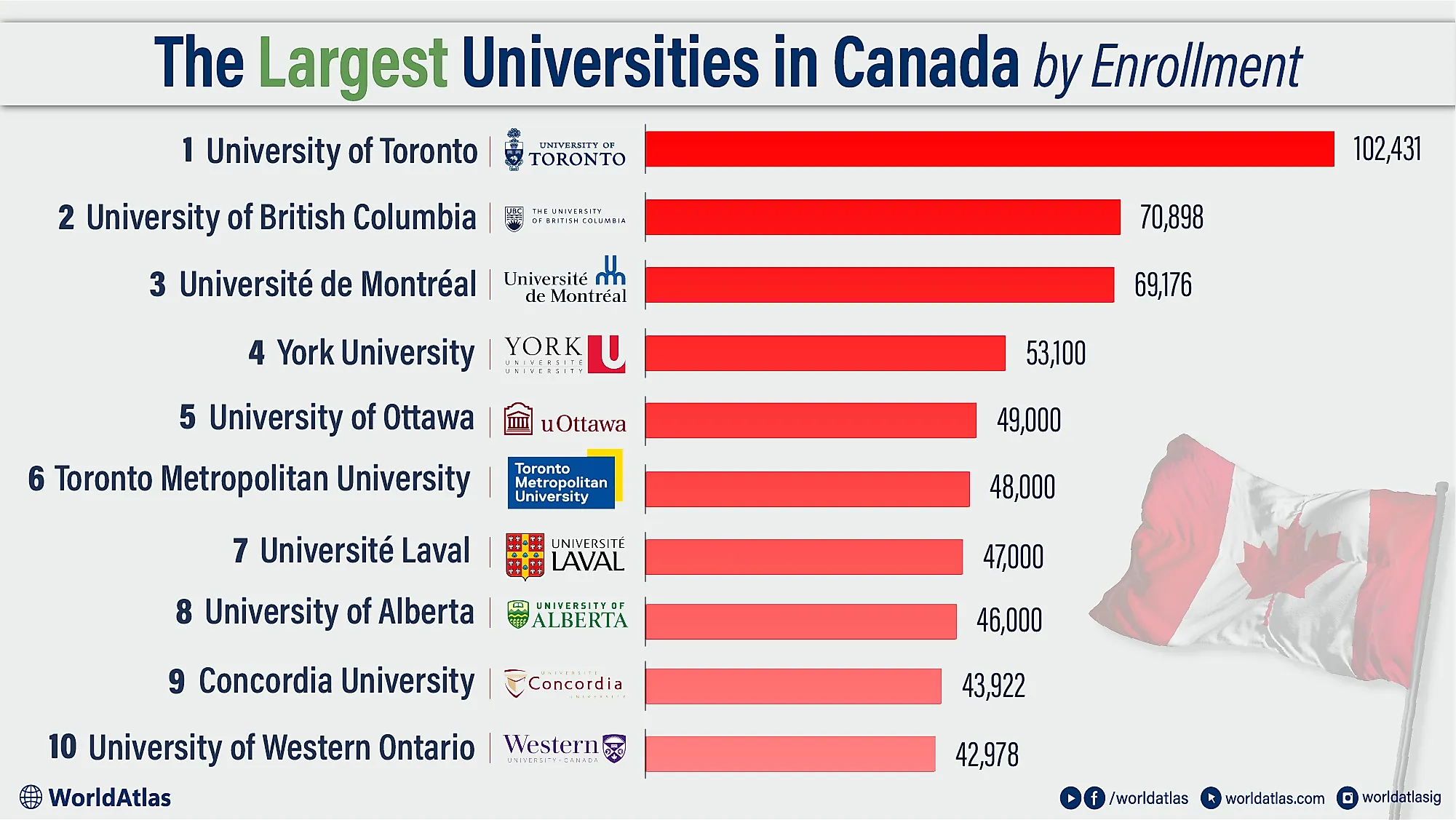
Largest Universities In Canada By Enrollment Of Both Undergraduate And Graduate Programs
| Rank | University | Enrollment | Location |
|---|---|---|---|
| 1 | University of Toronto | 102,431 | Toronto, Ontario |
| 2 | University of British Columbia | 70,898 | Vancouver & Kelowna, British Columbia |
| 3 | Université de Montréal | 69,176 | Montréal, Quebec |
| 4 | York University | 53,100 | Toronto, Ontario |
| 5 | University of Ottawa | 49,000 | Ottawa, Ontario |
| 6 | Toronto Metropolitan University | 48,000 | Toronto, Ontario |
| 7 | Université Laval | 47,000 | Québec City, Quebec |
| 8 | University of Alberta | 46,000 | Edmonton, Alberta |
| 9 | Concordia University | 43,922 | Montréal, Quebec |
| 10 | University of Western Ontario | 42,978 | London, Ontario |
1. University of Toronto (102,431)

The University of Toronto is Canada’s largest post-secondary institution and one of the world's top universities in terms of educational quality. Established in 1827 and divided among three campuses in Mississauga, St. George, and Scarborough, the university boasts a vast infrastructure framework that is well-suited to support thousands of students. To this end, it is also the largest university in Canada by enrollment, with 102,431 students as of the Fall 2024/25 batch. The majority of students are enrolled at the Downtown (St. George) campus, and nearly 30% are international students, representing 175 countries and territories.
Academically, the University of Toronto is known for its strength across a wide range of disciplines, including medicine, engineering, computer science, law, and the humanities. Its Doctor of Medicine (MD) program is among the most competitive in Canada, while the computer science and artificial intelligence programs are internationally recognized, particularly through research linked to the Vector Institute. The university is closely affiliated with major teaching hospitals, including Toronto General Hospital, Mount Sinai Hospital, and the Hospital for Sick Children, forming one of the largest academic health networks in North America. Moreover, its extensive library system, the third-largest in North America, supports over 40 libraries and millions of academic volumes, reinforcing its role as a national research leader.
2. University of British Columbia (70,898)

The University of British Columbia is Canada’s second-largest university and the largest outside of the Greater Toronto Area. This public research university has 70,898 students enrolled, split between the institute’s two campuses in Vancouver and Okanagan. Nearly 85% of students are located in the Vancouver campus, also known as the Point Grey campus lands. This area boasts multiple residential neighbourhoods, year-based housing residences, an internal campus street grid with TransLink connectivity, various gyms, and more spanning 990 acres.
Academically, the University of British Columbia is especially well known for programs in medicine, engineering, environmental science, forestry, and oceanography, fields closely tied to its coastal location. UBC’s Faculty of Medicine is one of the largest in Canada and is integrated with major teaching hospitals, including Vancouver General Hospital, St. Paul’s Hospital, and BC Children’s Hospital, supporting both clinical training and medical research across British Columbia. The university is also a global leader in sustainability and climate research, with specialized facilities such as the Bamfield Marine Sciences Centre and multiple on-campus research institutes focused on environmental and marine sciences.
3. Université de Montréal (69,176)

Ranked as one of the top universities in the province of Quebec and the second-largest in Canada by research volume, the Université de Montréal is one of the nation’s leading higher education institutions. Founded in 1878 as a branch of Université Laval, the institute has seen rapid growth. It now operates as a major French-language university with over a dozen faculties and sixty academic departments. It also includes two highly regarded affiliated schools: HEC Montréal, which focuses on business and management education, and Polytechnique Montréal, specializing in engineering and applied sciences.
In total, the three institutions under the Université de Montréal umbrella enroll 69,176 students, with 45,484 students attending Université de Montréal itself, 13,472 students enrolled at HEC Montréal, and 10,220 students studying at Polytechnique Montréal. The majority of these students study at the university’s main campus in Mount Royal, which is known for its scenic views and Art Deco-style tower. The primary campus spans 150 acres, featuring a range of facilities, including access to the metro. The university also has five regional facilities located in Terrebonne, Laval, Longueuil, Saint-Hyacinthe, and Mauricie. The university is also a major research hub, producing more than 15 percent of all university research output in Quebec and maintaining partnerships with leading hospitals, government agencies, and international institutions.
4. York University (53,100)

York University is one of Canada’s largest universities by enrollment, with approximately 53,100 students as of the Fall 2024/25 academic year. Located in northern Toronto, the university operates primarily from its Keele Campus, one of the largest university campuses in the country by land area, as well as the newer Markham Campus, which was opened to expand programs related to technology, business, and innovation. York’s size is closely tied to its broad academic scope, offering more than 200 undergraduate and graduate programs across 11 faculties.
The university is particularly well-known for its Osgoode Hall Law School, which consistently ranks among Canada’s top law schools, as well as the Schulich School of Business, whose MBA program has been ranked first in Canada by both the Financial Times and QS Global Rankings. York also performs strongly in the social sciences and arts, ranking within the top ten in Canada for subjects such as sociology, psychology, and performing arts according to QS subject rankings, reinforcing its reputation beyond professional programs alone. York has one of the most internationally diverse student populations in the country, with over 8,700 international students representing more than 160 countries. The university distributes over 125 million dollars annually in scholarships and bursaries, supporting access for students from a wide range of backgrounds.
5. University of Ottawa (49,000)

The University of Ottawa is a bilingual public research university in Canada’s capital city, Ottawa. It ranks among the nation’s top five universities for research intensity and has a substantial student population of 49,000 across undergraduate and postgraduate programs. U of O was established in 1848 and has since developed a strong alumni network with over 300,000 members. The main campus is situated in the Sandy Hill neighbourhood and spans nearly 100 acres, featuring around 30 main buildings and over 800 research laboratories. Moreover, the university’s library is one of the best in the nation, with approximately two million printed books, over 200,000 maps, and one million e-books, among other notable items.
Beyond its size, the University of Ottawa is distinctive as the largest bilingual (English-French) university in the world, allowing students to complete programs fully in either language or in a combination of both. This bilingual mandate has helped shape strong programs in public policy, law, political science, and international affairs, fields that benefit directly from the university’s proximity to Parliament Hill, federal ministries, and national institutions. The Faculty of Law is divided into Common Law and Civil Law sections, making it one of the few Canadian universities that offers both legal systems under one roof.
6. Toronto Metropolitan University (48,000)

Toronto Metropolitan University is another public research university in Canada, located in the Greater Toronto Area. With its campus located in the Garden District of downtown Toronto, the institute is situated in one of the world’s most bustling urban centers, offering great connectivity and numerous opportunities for students. To this end, the university has experienced strong enrollment in recent years, with 48,000 undergraduate and graduate students. Moreover, 3,000 of these students are pursuing master’s and PhDs, and over 245,000 have graduated and are part of a robust alumni network.
TMU also offers various additional benefits for students, including ideal student services, as indicated by its #1 ranking in student services in the 2026 Maclean’s University Rankings. Students can choose from over 400 courses in nine faculties, including The Creative School, which is renowned for its prominent journalism program. The college’s Public Health program is also the only CIPHI (Canadian Institute of Public Health Inspectors) accredited program in the province of Ontario. Students interested in research can also take advantage of over 35 research centers and institutes, which have around 300 research funding partnerships, providing optimal financial backing.
7. Université Laval (47,000)

The seventh-largest university in Canada by enrollment is Université Laval, a public research institute in Quebec City. Founded in 1852 and initially the parent university for the Université de Montréal, this institute is one of the premier places in North America for higher education in French. It also ranks among the top 10 Canadian universities in research funding and has a large 300-acre campus in the city. Here, students have access to over 30 buildings, sports fields, grasslands, and underground walkways for easy commuting. With its array of benefits, Université Laval attracts students from all disciplines and countries, bolstering a total student population of 47,000 as of the fall 2024 semester. Nearly 30% of students here are enrolled in graduate programs, while over 900 are medical residents, indicating a high level of education.
The university comprises 17 faculties and over 60 departments, offering approximately 600 programs across various fields of study. The institute is renowned for its business education, offering a distinguished Master of Business Administration course as well as numerous advanced IT programs. As for teachers, Université Laval is one of Quebec’s top employers, with over 10,000 employees, including 1,700 professors.
8. University of Alberta (46,000)

The University of Alberta is one of Canada’s largest and most research-intensive public universities, with approximately 46,000 students enrolled across undergraduate and graduate programs. Founded in 1908, the university is based primarily in Edmonton and operates five distinct campuses, including the North Campus, South Campus, Campus Saint-Jean, and the Augustana Campus in Camrose. The North Campus serves as the academic core, spanning more than 200 acres along the North Saskatchewan River valley, and provides extensive teaching, research, and residential facilities within a single, integrated setting.
Academically, the University of Alberta is especially well regarded for programs in engineering, energy and earth sciences, medicine, agriculture, and artificial intelligence. It is a founding member of the U15 Group of Canadian Research Universities and consistently ranks among the top five research institutions in the country by sponsored research income. The university maintains close ties with Alberta Health Services and major teaching hospitals, supporting a large faculty of medical and health sciences.
9. Concordia University (43,922)

Located in Montréal, Concordia University is one of Canada’s largest urban universities and a major hub for research, innovation, and creative studies. The institution operates from two distinct campuses: the Sir George Williams Campus in downtown Montréal and the Loyola Campus in the city’s west end. This split-campus structure allows Concordia to balance a dense, city-center academic environment with a more traditional, green campus setting. Its downtown location, in particular, places students within walking distance of transit lines, corporate offices, cultural venues, and research partners.
Concordia enrolls 43,922 students across undergraduate and graduate programs, making it one of the largest universities in Quebec by total student population. The Gina Cody School of Engineering and Computer Science, one of the largest engineering schools in Canada, is well known, as is the John Molson School of Business, which has strong enrollment in finance, management, and entrepreneurship. Concordia also has a long-standing reputation in fine arts, design, and film studies, and its student population includes learners from more than 150 countries.
10. University of Western Ontario (42,978)

Founded in 1878, the University of Western Ontario, commonly referred to as Western University, is a public research university located in London, Ontario. The institution enrolls 42,978 students across undergraduate, graduate, and professional programs, placing it among the ten largest universities in Canada by total enrollment. Western operates from one of the largest single-campus sites in the country, spanning more than 1,200 acres along the Thames River, with academic buildings, residences, research facilities, and athletic complexes concentrated in a single, cohesive setting.
Western is particularly well known for the Ivey Business School, which is internationally recognized for its case-based teaching model and highly selective MBA program. The university also maintains strong enrollment and academic standing in law, engineering, health sciences, social sciences, and medical education. Through the Schulich School of Medicine and Dentistry, Western is closely connected to regional teaching hospitals and research centers, supporting extensive clinical training and medical research in addition to its core academic programs.
The Largest Universities In Canada By Student Enrollment
Each home to over 40,000 students, these ten universities in Canada are the largest by student enrollment. They provide students with large campuses, ample facilities, and plenty of opportunities for research and education. These universities are not only full of Canadian students, but also attract international learners from hundreds of countries. They showcase the array of programs and the positive educational environment in Canada, featuring bilingual facilities, a strong focus on research, and ample scholarships.