Getting Lost In Romania’s Storied Capital
Find yourself a Balkan gal and your life will never be boring. For the last five years my girlfriend, Irina, and I have been making extended trips to Romania to visit her family and settle in as citizens.
Living in the capital city of Bucharest has been a dizzying experience, filled with culture shock, language barriers, and maze-like navigations through what has grown, chunk by chunk, into one of the biggest cities in the European Union.
Romania's was the last and by far the bloodiest of Eastern Europe's 1989 revolutions — Nicolae Ceaușescu and his wife Elena were executed by firing squad on Christmas Day, and the footage aired on national television within days. The commercial, cultural, and economic engine of Romania shows both its triumphs and its scars from various eras.
Here, neo-classical theaters and stolid statues intermingle with Brutalist government structures and graffitied tenements. Generational divides and disparate fashion trends litter the concrete streets. Crammed on the same tram are suspicious babushkas, alt-goth 90s kids, men in full Adidas track suits, teenagers arguing over a shared pair of wired earbuds, and long-nailed women dressed-to-impress with fixed, unimpressed expressions.
In short, there's a lot going on in Bucharest, and part of the fun is simply getting lost in this eclectic, storied city.

Despite the fact that I'm going to playfully dig into what has essentially become my home-away-from-home, I want fun to be the takeaway. If Bucharest was a person, it would be your alcoholic uncle at a wedding. This is not the type of city you come to for quiet introspection, nor has it embraced Western Europe's politically correct ways.
It is a raw, passionate, apathetic, strange, artsy, traumatized, chaotic, re-inventing, neighborly, enigmatic place all rolled into one.
The Adventure of Getting Around

Traffic in Bucharest is one of the most maddening things you could experience. Cars are a status symbol but the city planning, or rather the lack thereof, did not account for the more than two million people now trying to get in and out of the greater metropolitan area on a hourly basis, made worse by the perma-construction.
Sure, rush hour is a thing, but honestly, there doesn't seem to be a "good" time to get around by car either and judging by the plethora of double-parked, sidewalk-stacked cars, parking never comes easy either.
You can opt for a cab, but as a foreigner you'll for sure get overcharged. Rideshare platforms are available, but more often than not, your driver will speed and curse out other drivers while watching TikToks or video-calling his girlfriend the whole time.

On the plus side, Bucharest has an extensive, ever-improving subway system and, for whatever reason, most of my excursions tend to favor a combination of buses and above-ground trams. Because of this, I've become quite accustomed to The Grey Box.
Grey boxes are peppered all throughout the city. Functionally speaking, these are the only places to buy transit passes. Not a corner store, not an automated machine — the grey box. Inside these grey boxes is a lady who doesn't speak English and whose voice is muffled by the glass anyway. A simple "Zece călătorii, vă rog," and 25 Lei (about $5 USD), gets me a pass good for ten trips, scanable upon boarding — if I can reach the scanner and if it's even operational.
The donwside though is that at the end of the day, the buses and trams are so packed that you either have to surrender your humanity and shove your way on, in the direct line of every cough, sneeze and fart, or you can wait for multiple rides before securing a spot.
No matter the season, once you get on board, it will be sweltering. Either the air conditioning will be broken in the summer, or the winter heater will be blasting hot enough to strip paint.
Bucharest's Bottomless Art Scene

Bucharest may have some flaws but theres also a reason why this is Romania's great capital and how it is all connected to their arts. It's big enough, and European enough, to attract the best acts from the West and being the cool, underground place that it is, poetry open mics go down in some of the most inventive venues I've ever seen.
My first exposure to Bucharest's mainstream music scene came in the form of a concert from The 1975. Back in the summer of '23, I'd never actually heard of this British four-piece band, but my god, did they put on a show.
Discovering a new (for me) band is always rewarding, but what cemented the experience even further was the 1990s vibe of the youthful crowd. Black band shirts, altered jeans, and a marked lack of smart phones brought me back to a bygone era that I failed to appreciate at the time.

Skip ahead to the Bucharest International Poetry Festival, and I learned that this predominantly mono-lingual nation is still able to foster a global discussion. Hosted in historic venues, big and small, all over the downtown core, this celebration of the spoken word featured local poets, with English translations projected on the wall behind an accompanying choir, as well as creatives from Western Europe and North America.
Bucharest's lively opera and theater season runs from fall through spring and given the language barrier, I was hesitant to take on a three-hour performance, but then my mother-in-law suggested a ballet instead: Don Quixote.
Staged at the Bucharest National Opera, it got me a look at black-tie, silky dress Bucharest but of course, me being a Canadian manchild, the best I could do was button the top button on my plaid shirt.

Underneath Bucharest's formal festivals is a treasure trove of grassroots creative outlets. If you're a backpacker, then you'll likely find yourself staying at T5 Social. This hostel-creative space combo hosts social events every day of the week, but my go-to is the Open Stage on Tuesday nights.
In the summertime, international humans fill the spacious outdoor patio to drink Csíki Sör, smoke cigarettes, and bare their souls. When the cool sets in, the party moves into the intimate, creaky-floorboard chambers of the hostel.
The other amateur venue I've been drawn to as of late is Heavy Yard. I never felt cool enough to enter this peripheral Old Town space, but alas, I pushed through my imposter syndrome in the name of self expression.
Heavy Yard is the type of place you have to walk a few dimly lit streets to get to before you enter the beer garden. Then inside to a ground level bar. If you're feeling adventurous, take a walk up a flight of rickety wooden steps to what are clearly defunct living quarters.
After all that then you enter the nerve-racking, yet communal space in which three open mics take place: Open Mic Surgery, hosted by fellow Canadian ex-pats, Hai Să Ne Citim!, translated to Let's Read!, and Bloc de Baștină or Hometown Block.
Young Bucharestians speak enough English for me to be understood and warmly received, but I also appreciate the opportunity to pick out disparate Romanian words I recognize from other performers.
Even still, theres a certain magic that comes with being lost in translation.
Calea Victoriei

Moving on from logistics and underground quirks, let me show you some of Bucharest's classic show-stoppers. Calea Victoriei, or Victory Road, runs through Central Bucharest, from the Dâmbovița River all the way up to Piața Victoriei and a cluster of national museums.
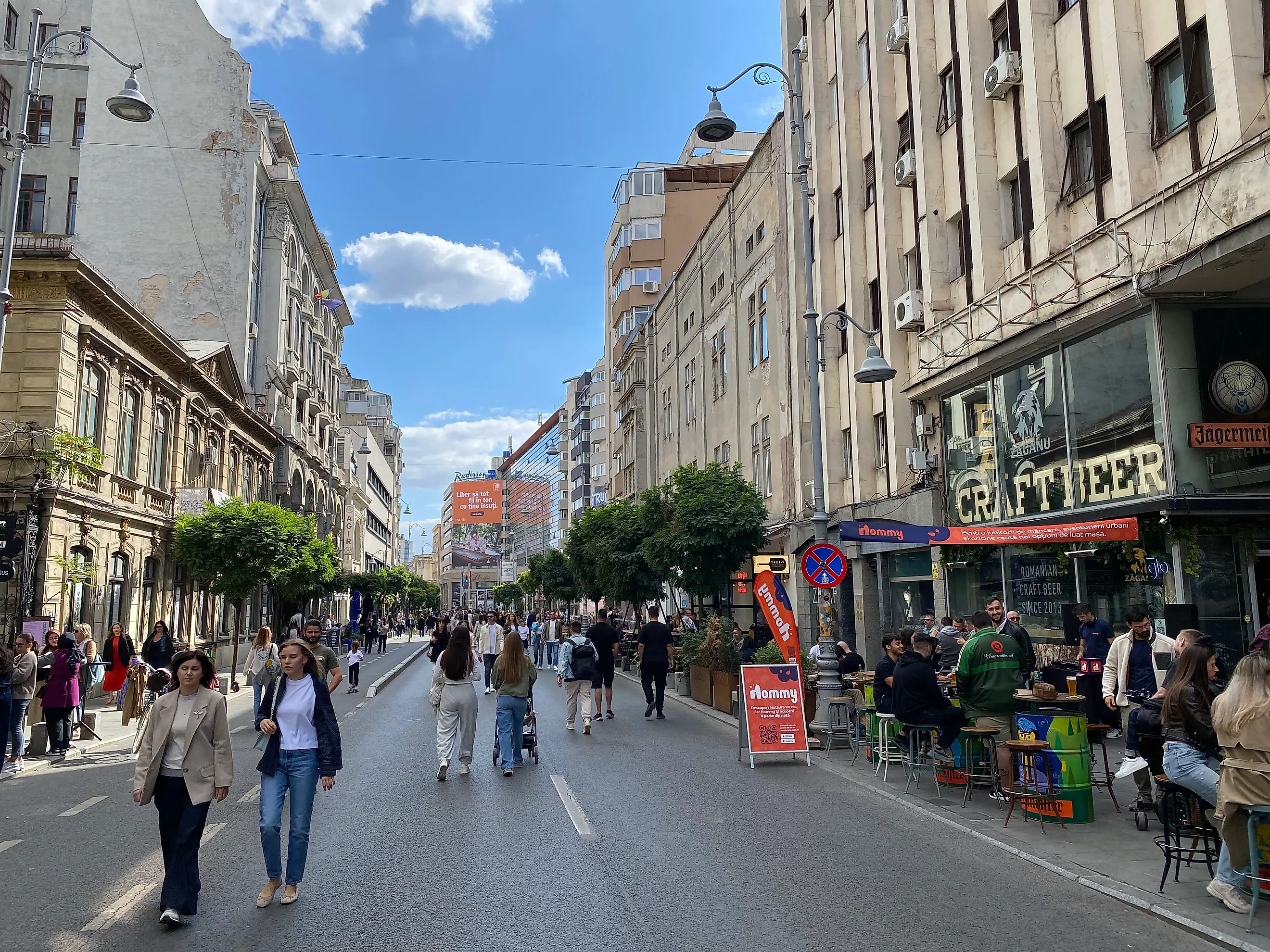
Weekends are when it really opens up, with stretches closed to cars for the city's Open Streets program. En route, this strip features the best of Bucharest's high-end shops, boutiques, and bougie cafes, plus historical structures covering at least six different architectural eras.
The Old Town

Bucharest's Historical Center, aka Old Town, is a mix of deterioration and re-invention. The term "grunge" feels appropriate. Flower stalls stand before graffitied walls, decommissioned ap

artments neighbor hip establishments, and picture-menu patios and pretzel shops intersplice Michelin-worthy restaurants.
As an avid reader, my Old Town happy place is Cărturești Carusel. Where getting lost in the sizable English section of this exceptional bookstore is what some would describe as heaven on Earth.
Parks & Recreation

Bucharest's slogans are "The city of running" and "The city of joy." Despite the omnipresent Slavic scowl, Bucharestians are incredibly neighborly once you get a proper introduction.
We live right next to Parcul Drumul Taberei, which sports a perimeter mondotrack running surface, inner paddleboat pond, outdoor gym, greenhouse botanical garden, playgrounds, an eye-catching pedestrian bridge, and ample natural spaces to sprawl out in.
Up the road is Lacul Morii — a popular spot for anglers and, thanks to its rubberized track, joggers, but the crown jewel public park is on the north end of the city: Parcul Herăstrău which was officially renamed King Michael I Park in 2017, though I've never heard a single person call it that.
Fixed between the namesake lake and the Arc de Triumf (you heard me), this park draws major weekend crowds, thanks not only to its open-air escapism, but also its array of restaurants, beer gardens, and snack vendors.

This past visit, I participated in both the Color Run Romania, aka the "Happiest 5k on the Planet," in which volunteers pelt you with colored powder at each of the five kilometer markers, as well as the thousands-strong Bucharest Marathon.
Trail races elsewhere in the country showed me that Romania has an advanced contingent of mountain runners, but I was impressed with the turn out of hobby joggers at the city's marquee race.
After three hours of running through the closed streets of Central Bucharest, I summoned a final sprint past Ceaușescu's Palace to the finish line.
As I caught my breath and my elevated heart rate pumped into my ears, I couldn't help but reflect on how far Romania's storied capital has come since the 1989 Revolution, which, coincidentally, was the same year I was born.
I'm not the person to speak to the political complexities, both past and present, but having dropped in as a tourist/pseudo-citizen in the 2020s, I can certainly vouch for the chaotic beauty that is modern-day Bucharest.
Pe curând! (See you soon!)