What Is The Biggest Time Difference Between Two Places On Earth?
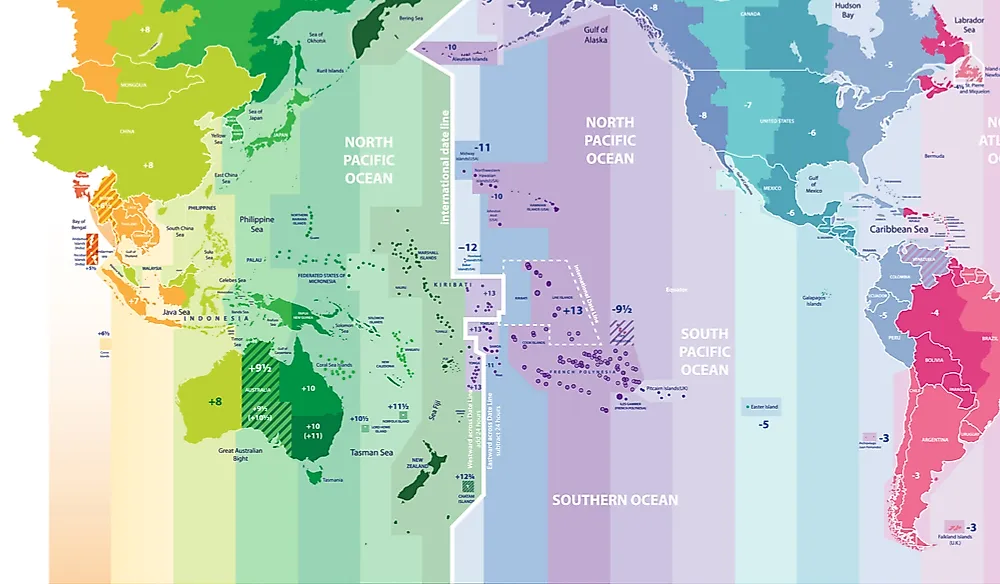
The largest possible time difference between two inhabited places on Earth is 26 hours, between Howland Island in the central Pacific (UTC-12) and the Line Islands of Kiribati (UTC+14). The figure exceeds the naive maximum of 24 hours because the world's time zones are not evenly distributed around the conceptual midline at UTC: some Pacific nations chose to set their clocks far ahead of UTC so that the calendar date matches their nearest trading partners rather than their geographic longitude, while uninhabited US territories on the opposite side of the date line use the historically defined UTC-12 zone. The result is a 26-hour spread between the two extremes, even though some of the places sitting at those extremes are less than 2,000 kilometers apart in physical distance.
How Time Zones Are Set
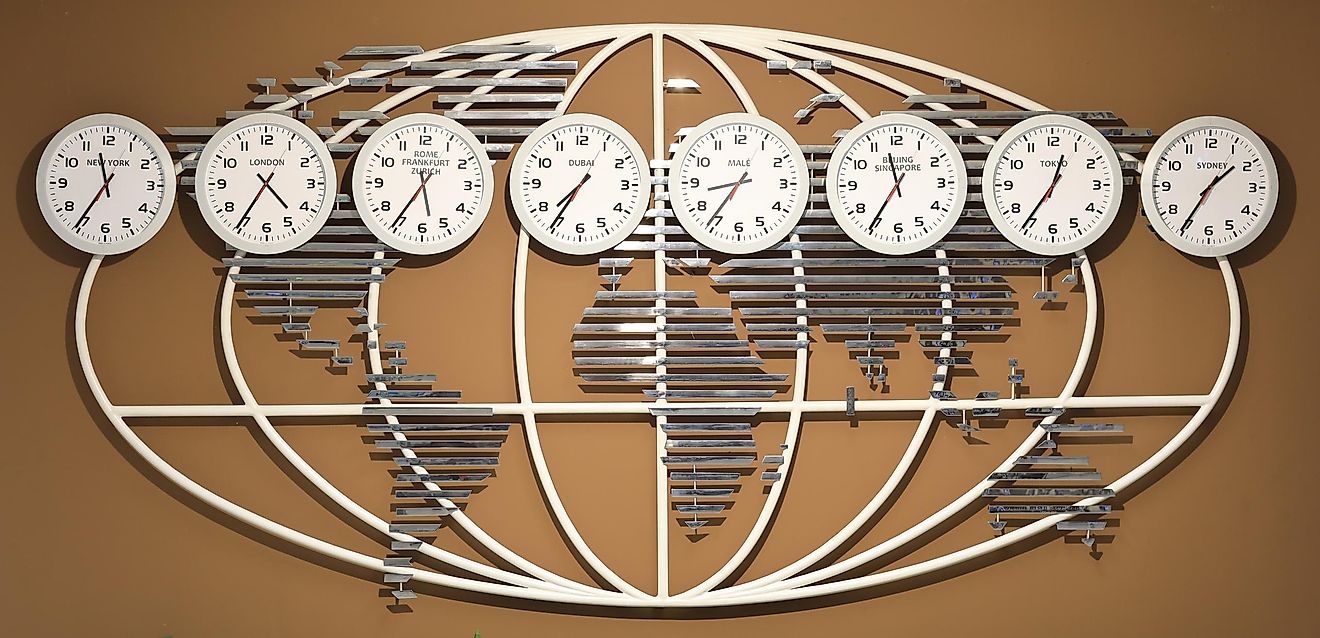
The world's clocks are coordinated against Coordinated Universal Time (UTC), the modern successor to Greenwich Mean Time (GMT). UTC was established in 1960 by the International Telecommunications Union and the International Astronomical Union; the abbreviation UTC was formally adopted in 1967. UTC does not adjust for daylight saving time, and the various time zones around the world are expressed as offsets from UTC (positive offsets for zones east of the prime meridian at Greenwich and negative offsets for zones west of it).
In principle, the maximum east-west span of standard time zones should be 24 hours, with one extreme at UTC+12 and the other at UTC-12. The International Date Line, which runs roughly along the 180th meridian in the Pacific Ocean, marks the calendar transition from one day to the next. In practice, several Pacific nations have moved their clocks east of UTC+12, creating zones at UTC+13 and UTC+14 to keep their working calendars aligned with major trading partners.
The 26-Hour Spread
The two specific places at the extremes are Howland Island and the Line Islands of Kiribati.
Howland Island is an unincorporated, uninhabited US territory in the central Pacific (best known for its associated airstrip, the planned destination of Amelia Earhart's 1937 round-the-world flight on which she disappeared). Howland uses UTC-12, along with neighboring Baker Island, making the two islands the latest places in the world to begin each calendar day.
The Line Islands, part of the Republic of Kiribati, sit at UTC+14, making them the earliest places to enter each calendar day. Kiribati moved its Line Islands to UTC+14 on January 1, 1995, by relocating the International Date Line eastward around its territory. The change unified all three of Kiribati's island groups into a single calendar date (previously the Gilbert Islands had been on one side of the date line and the Phoenix and Line Islands on the other) and let the entire country share a working week with its main Pacific neighbors.
The two extremes are only about 2,100 kilometers apart, but their clocks are 26 hours apart. A traveler going westbound between Howland and the Line Islands moves the calendar forward by 26 hours; the reverse trip moves it back by 26 hours.
Other Unusual Time Arrangements
The Howland-to-Line-Islands gap is the most dramatic case, but unusual time-zone arrangements appear all over the world.
Single Country, Many Zones
Russia spans 11 time zones, from Kaliningrad (UTC+2) in the west to Kamchatka and Chukotka (UTC+12) in the east, making it the country with the most time zones on a single contiguous territory.
France, when its overseas territories are included, spans 12 time zones (from French Polynesia in the eastern Pacific to Wallis and Futuna in the western Pacific), the most of any country in the world.
The United States spans 11 time zones counting all of its territories (mainland US, Alaska, Hawaii, American Samoa, Guam, the Northern Mariana Islands, Wake Island, Howland and Baker Islands, Puerto Rico, the US Virgin Islands).
Single Country, One Zone Despite Span
China uses a single time zone (UTC+8, Beijing time) across its entire 5,250-kilometer east-west extent, even though the country naturally spans about five geographic time zones. The result is that solar noon in the far western Xinjiang region falls around 3 PM by the official clock. Many Uyghurs in Xinjiang informally use an unofficial Xinjiang Time set at UTC+6.
India uses a single time zone (UTC+5:30, India Standard Time) across a roughly 2,900-kilometer east-west extent. Sunrise in the easternmost state of Arunachal Pradesh comes about 90 minutes earlier by the clock than in the western states.
Fractional Offsets
Most of the world uses whole-hour offsets from UTC, but a handful of countries and regions use half-hour or quarter-hour offsets. India and Sri Lanka are at UTC+5:30; Iran is at UTC+3:30; Afghanistan is at UTC+4:30; Myanmar is at UTC+6:30; the Northern Territory and South Australia in Australia are at UTC+9:30; Newfoundland in Canada is at UTC-3:30; the Marquesas Islands are at UTC-9:30; and Nepal is at UTC+5:45, one of the few places on Earth using a quarter-hour offset.
Iran's Daylight Saving Abolition
Iran observed daylight saving time annually from 2008 to 2022, then permanently abolished the practice in March 2022 and now stays on UTC+3:30 year-round. The change was implemented as a cost-saving and convenience measure after public surveys consistently showed support for ending the seasonal clock change.
Samoa's Date Line Move
One of the more striking recent time-zone changes was Samoa's decision to move from the eastern side of the International Date Line to the western side on December 30, 2011. The change relocated Samoa from UTC-11 to UTC+13, aligning its calendar with Australia and New Zealand (its primary trading partners) rather than the United States.
The mechanics of the change were that December 30, 2011 simply did not exist in Samoa: the calendar jumped from Thursday December 29 directly to Saturday December 31. American Samoa, a separate US territory just to the east, remained on UTC-11 (and skipped no day), so the two Samoas (separated by about 130 kilometers of ocean) now sit 24 hours apart on the calendar despite their physical proximity.
What All of This Means Practically
The 26-hour maximum spread is one of the more curious features of the modern timekeeping system, but it has practical consequences for international business, broadcast scheduling, and travel. Two people on the phone between the Line Islands and Howland are not just talking across what feels like a date change; they are talking across two date changes, with the conversation happening in calendar days that are more than a day apart even though their watches are showing local hours and minutes only a few hours different. The 26-hour spread also means that the world is never simultaneously on a single calendar date: at any given UTC moment, somewhere on Earth is in yesterday's date, somewhere is in today's, and somewhere is in tomorrow's. The transition window where three different calendar dates exist on Earth at the same time runs for about two hours every UTC midnight, primarily across the Pacific.