What Happens Inside A Neutron State
A single teaspoon of neutron star matter would weigh about one billion tons on Earth. That's approximately the combined weight of five million blue whales, the largest animals ever to live, or about 200 million adult African elephants! If you somehow reached a neutron star's surface, its immense gravity would crush you thinner than a sheet of paper almost instantly.
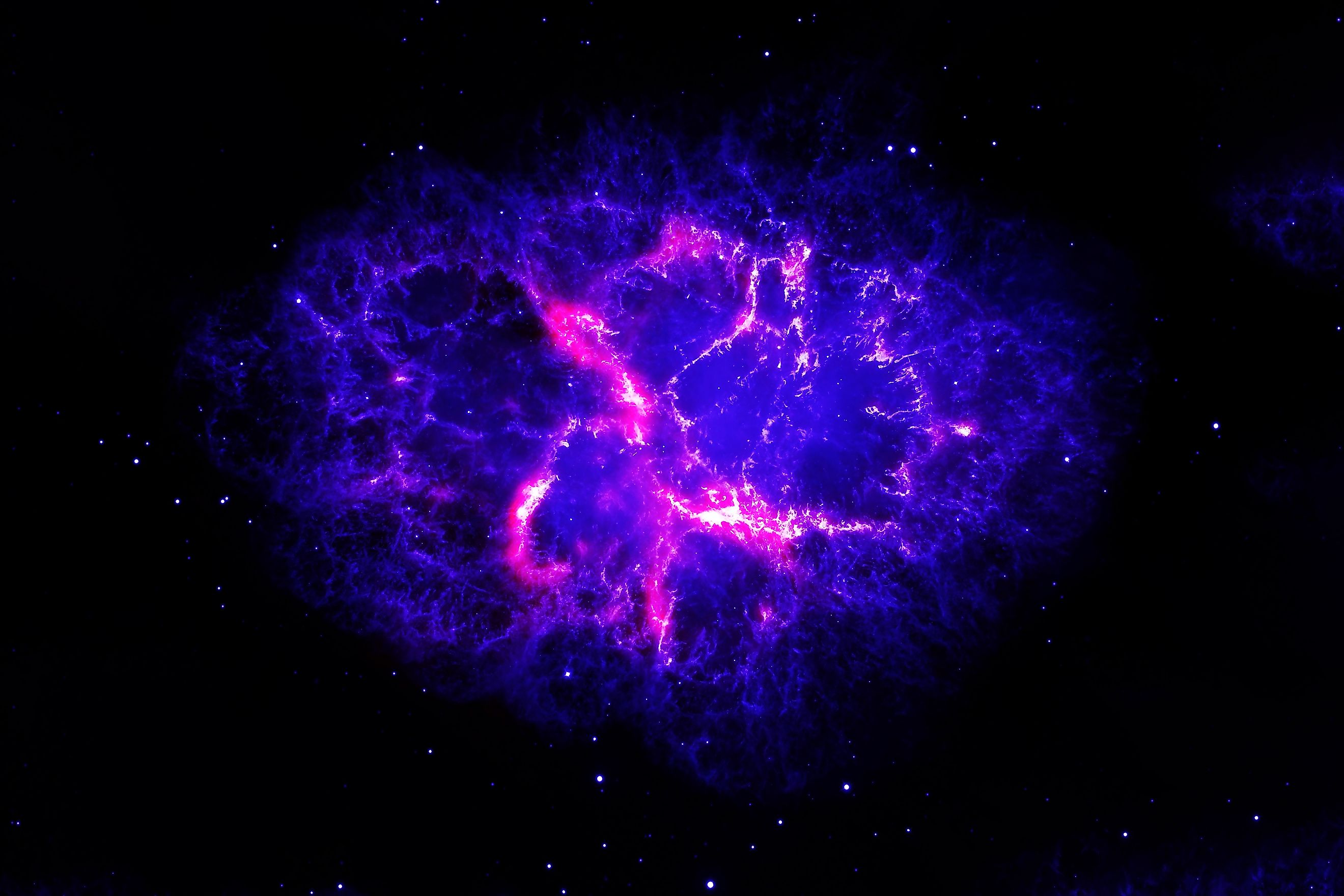
A neutron star is what's left behind after a massive star dies. It's not a planet or a star in the traditional sense, because it no longer produces energy through nuclear fusion. Astronomers classify it as a stellar remnant: the collapsed, superdense leftover core of a star many times heavier than Earth's Sun. Basically, it's a stellar corpse that's heavier than the Sun and barely wider than a city.
Beneath it's surface, pressure becomes so intense that ordinary atoms lose their familiar structure, leaving behind matter made almost entirely of neutrons. Scientists believe the deepest layers may contain even stranger forms of matter unlike anything ever observed on Earth, but exactly what lies at the center is one of astronomy's biggest unsolved mysteries.
The Violent Birth of a Neutron Star

Every neutron star begins as a massive star that has burned through its nuclear fuel. For millions of years, the star balances two powerful forces: gravity pulling inward and the energy from nuclear fusion pushing outward.
Think of it as a never-ending tug-of-war. As long as both sides are evenly matched, the star stays stable. But once the fuel runs out, the outward push disappears, and gravity wins almost instantly. In less than a second, the star's core collapses inward. The event is so violent that the star's outer layers explode outward in a supernova, briefly outshining an entire galaxy. At the center, only the crushed core survives: a neutron star.
Imagine squeezing about 1.4 times the Sun's mass into a ball just 12 to 14 miles across, small enough to fit inside Manhattan Island. Since the Sun itself already equals about 333,000 Earth masses, a neutron star at 1.4 solar masses ends up containing somewhere around 460,000 Earths' worth of mass, packed into a sphere the size of a city.
Despite its small size, a neutron star's gravity is almost impossible to imagine. Estimates from NASA's Chandra X-ray Observatory team and independent calculations by physicists at the University of Illinois put neutron star surface gravity at about 100 to 200 billion times stronger than Earth's. Using those figures, a 154-pound (0.077 ton) person would weigh somewhere between 7 and 15 billion tons standing on one! That said, no human, spacecraft, or material ever built could survive touching its surface, not even for a fraction of a second.
The collapsed core also has a solid outer crust. It isn't made of ordinary rock or metal. Instead, atomic nuclei are packed together so tightly that they form a crystal-like structure believed to be the strongest material in the known universe.
Beneath the Surface of a Neutron Star

On Earth, every atom has a tiny nucleus surrounded by electrons, with large amounts of empty space between them. When a star collapses, the crush of gravity triggers a reaction called beta decay, a phase where protons and electrons are forced to combine and transform into neutrons. When this happens, the familiar structure of atoms disappears, leaving behind matter packed more densely than anything scientists can reproduce in a laboratory.
Deeper inside, this neutron-rich matter may form an incredibly dense liquid called a superfluid that flows with almost no internal friction. On Earth, superfluids only form when certain substances are cooled close to absolute zero.
Physicists from the Massachusetts Institute of Technology (MIT) recreated superfluid-like behavior in the lab using clouds of ultra-cold atoms trapped by lasers, giving researchers a rare, small-scale stand-in for a process that would otherwise be impossible to test directly. Inside a real neutron star, neutrons are thought to become superfluid despite temperatures of millions of degrees, because the sheer pressure changes how the particles interact.
This nearly frictionless fluid doesn't rotate as one smooth mass. It forms countless tiny whirlpools called vortices, similar in principle to the vortex that forms when you drain a bathtub. Normally, these vortices stay anchored, or "pinned," to the solid crust above, forcing the superfluid to rotate at the same speed as the rest of the star. But as the crust gradually slows down over time, tension builds between the two layers.
When enough vortices suddenly break free and shift outward at once, they transfer their momentum to the crust all at once, causing the star's rotation to speed up abruptly, an event astronomers call a pulsar glitch. Scientists still don't fully understand exactly what triggers the vortices to unpin when they do.
Because no telescope can see inside a neutron star, these sudden speed-ups give scientists rare, indirect clues about what's happening beneath the surface. They're one of the only windows researchers have into a structure they can never observe directly.
The Mysterious Center of a Neutron Star

The center of a neutron star is one of astronomy's biggest mysteries, and part of the reason is simple: no telescope can see through hundreds of meters of crushed, opaque crust to observe it directly, and no laboratory on Earth can recreate the pressures involved. Scientists have to infer what's happening at the core from indirect evidence, like the star's mass, its size, how fast it cools, and how its rotation changes over time.
One leading idea, outlined by the U.S. Department of Energy's research into fundamental particles, is that under this extreme pressure, neutrons themselves may break down into their smallest known building blocks, called quarks. They're bound together by gluons, the particles that carry the strong nuclear force, making it somewhat impossible to pull a quark free under normal conditions. But at the pressures found in a neutron star's core, some physicists think quarks and gluons could break loose from one another, forming a dense, exotic state of matter called the quark-gluon plasma. It's unlike anything naturally found on Earth.
Each new observation, such as a a glitch, a merger, a precise measurement of a neutron star's size, narrows the range of possibilities, but none have solved the mystery.
Why Getting Close Is a Very Bad Idea

A spacecraft approaching a neutron star could encounter radiation intense enough to damage or destroy its electronics. As it moved closer, gravity would pull harder on the side facing the star than on the side farther away. These uneven forces, known as tidal forces, might stretch and tear the spacecraft apart before it even reached the surface. The mission would end long before the sightseeing began.
The same physics would apply to a human body, only faster and more violently, with nothing to shield it. The crushing gravity and tidal stretching would destroy a person almost instantly. Even electromagnetic radiation, the light and X-rays escaping the star, doesn't travel in a straight line here. The star's gravity bends it so strongly that astronomers may see parts of the far side that would normally be hidden from view.
Tiny Stars with Enormous Power

Despite being only about the size of a city, some neutron stars spin hundreds of times every second. The fastest known, PSR J1748−2446ad, was clocked by researchers at the National Radio Astronomy Observatory at about 716 full rotations per second, a record that has held since its discovery in 2004. By comparison, the blades of a powerful high-speed kitchen blender may rotate roughly 330 to 500 times per second. The difference is that a blender spins a small set of blades, but an entire neutron star, an object heavier than the Sun, spins hundreds of times every second.
Many neutron stars have powerful magnetic fields, but a rare subclass called magnetars are in a class of their own. A magnetar is a neutron star with an extraordinarily strong magnetic field, up to 1,000 times stronger than a typical neutron star's, and about 10 trillion times stronger than a refrigerator magnet. Their magnetic fields are so intense they can distort the structure of atoms and interfere with electronics from enormous distances.
Some neutron stars reveal themselves through narrow beams of radiation that sweep across space as the star rotates, much like the beam from a lighthouse. As the beam sweeps past Earth, it appears as a rapid, rhythmic flash hundreds of times a second for the fastest-spinning stars. It is spaced with such regularity that astronomers can use them to keep time like an atomic clock. These flashing neutron stars are known as pulsars, and their steady pulses have even been used to help detect gravitational waves rippling through the galaxy.
Predicted by Einstein over a century ago, gravitational waves are ripples in the fabric of space-time itself. They're created whenever massive objects accelerate violently, such as when two neutron stars spiral into each other and collide. As these waves pass through space, they slightly stretch and squeeze everything in their path, including the timing of a pulsar's steady beams. By watching for tiny disruptions in that otherwise perfectly regular pulse, astronomers can detect gravitational waves rippling through the galaxy.
Why Scientists Keep Studying Neutron Stars
Neutron stars let scientists study matter under conditions no laboratory on Earth could ever recreate. Every unusual pulse, sudden glitch, and detected merger gives scientists another clue about how matter behaves when pushed to its limits.
When two neutron stars collide, they send ripples through space-time called gravitational waves. These mergers also create heavy elements such as gold and platinum before scattering them across space. Some of the precious metals found on Earth may have originated in collisions like these billions of years ago.
A neutron star may be only 12 to 14 miles across, yet it can contain more mass than the Sun, cause atoms to lose their familiar structure, and bend light around itself. Deep inside, matter may take forms never observed anywhere else. Discovering what lies at the core would do more than solve one of astronomy's biggest mysteries. It could change the worlds understanding of what matter is capable of becoming under the most extreme conditions in the universe.