Which State Has More Venomous Snakes: Florida or Georgia?
Florida and Georgia are two of the most snake-rich states in the Southeast, and the comparison is closer than most people expect. Both states have 46 snake species, and they share the same six venomous ones: the eastern diamondback rattlesnake, timber rattlesnake, pygmy rattlesnake, cottonmouth, copperhead, and eastern coral snake. The real difference is not the species list, but how widely each snake is distributed across each state’s habitats.
Eastern Diamondback Rattlesnake (Crotalus adamanteus)

Eastern diamondback rattlesnakes are the largest and most renowned venomous snakes in the U.S. They feature a distinctive pattern of black diamonds with beige borders and brown centers along their backs. These heavy-bodied pit vipers have keeled scales with raised ridges and a prominent high rostral scale on their head. Adults measure between 33 and 72 inches. Known as North America's most dangerous venomous snake, they carry a nearly 30% mortality rate due to toxins that cause severe pain and hemolysis.
Timber Rattlesnake (Crotalus horridus)

Timber rattlesnakes are large and heavy-bodied, with a distinctive black tail earning them the nickname “Velvet Tail.” Their bodies are tan or pinkish-gray in color with black chevron-like cross bands. Their heads are noticeably wider than their necks, with a telltale pit on each side of the face between the eye and the nostril. These heat-sensitive pits help the rattlesnakes locate and accurately strike at warm-blooded prey. Timber rattlesnakes grow to between 26 and 60 inches long and are sometimes mistaken for eastern diamondback rattlesnakes.
Although timber rattlesnakes have a large population in the eastern U.S., they are limited to 12 counties in the extreme northeastern Florida Panhandle, where they live in river beds, hardwood hammocks, swamps, and fields. In northern Georgia, timber rattlesnakes can be found in various habitats, such as along ridges in the Appalachian Mountains. In southern Georgia, they live in creeks and river bottoms.
Pygmy Rattlesnake (Sistrurus miliarius)

Pygmy rattlesnakes are small pit vipers characterized by chunky heads and slender tails that end in a tiny, nearly invisible rattle. Many confuse their rattle with the buzzing of a small insect. Found in southeastern U.S. states such as Florida, Georgia, North Carolina, and South Carolina, they are also known as dusky pygmy rattlesnakes (Sistrurus miliarius barbouri). The dusky subspecies features an ash-gray color with dark blotches along the back and sides, giving it a dusty or dirty look. These snakes range from 12 to 24 inches in length, though they are only about 5 inches long when born. Their heads are topped with nine large scales.
The pygmy rattlesnake is the most abundant venomous snake in Florida. It is found throughout the state, except in the Florida Keys. The rattlers prefer low-lying areas, wetlands, pine flatwoods, cypress swamps, and sandhills. In the Peach State, they are found in the northeastern, northwestern, and central portions of Georgia and are common in the Coastal Plain. Bites by these snakes are rare due to their defensive behavior, and even when they bite, they do not produce enough venom to be fatal to humans.
Cottonmouth (Agkistrodon piscivorous)

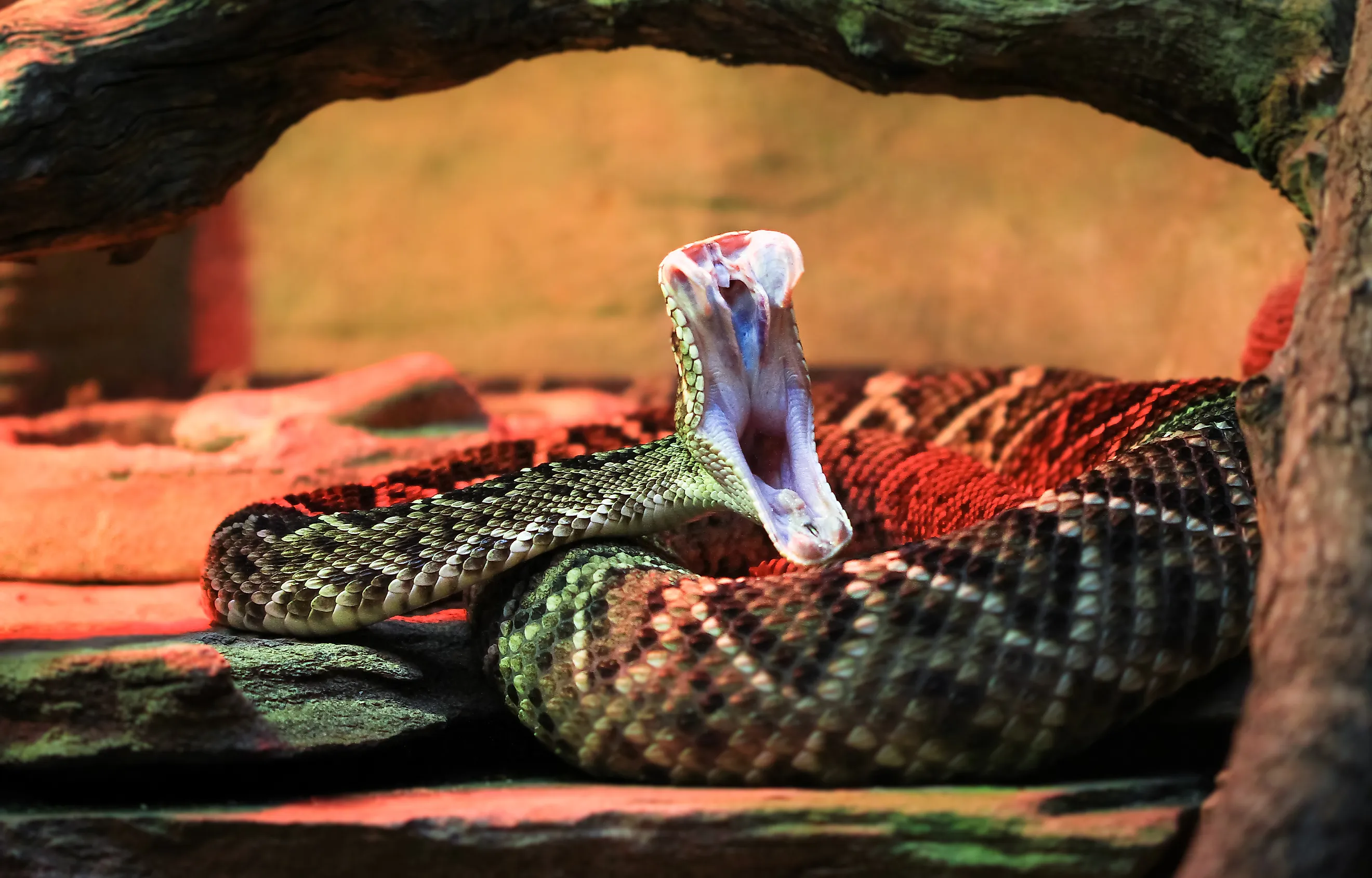
Cottonmouth snakes get their name from the white, cotton-like interior of their mouths, which they open as a warning when threatened. They are semi-aquatic snakes, comfortable in water and land, and strong swimmers. They are heavy-bodied, thick snakes with a pattern of light brown and dark brown crossbands. The pattern fades as the snake ages, so older cottonmouths tend to be all black with only a faint pattern visible. A bold facial stripe obscures the snake’s eye, and its head is covered by plate-like scales—adult cottonmouths average 30 to 48 inches in total length.
Florida cottonmouths are found throughout the state, mainly near rivers, springs, lakes, swamps, and roadside ditches. They also inhabit several islands that make up the Cedar Keys. In Georgia, they can be found almost anywhere there is water, including swamps, creeks, and lakes, but they have been spotted in the state capital of Atlanta.
Eastern Copperhead (Agkistrodon contortrix)

Copperheads are masters of camouflage, well-known for their ability to blend into their environment. They are thick-bodied tan or brown snakes overlaid with darker hourglass-type shapes. Their heads are distinct from their bodies, very angular and coppery colored. Like all members of the pit viper family, copperheads have a heat-sensing pit between their nostrils and eyes. Copperheads usually grow between 24 and 30 inches in length, but the largest on record is 53 inches.
Copperheads typically inhabit upland pine and mixed woodlands with abundant leaf and forest debris for cover, as well as low, wet areas near swamps, stream beds, river bottoms, and damp ravines. They are primarily located in Florida's Panhandle, especially in the western tip and along the Apalachicola River and its tributaries. In Georgia, copperheads are the most common venomous snake and are found throughout the southeastern region. Their venom is relatively weaker compared to other regional snakes, making bites rarely fatal.
Eastern Coral Snake (Micrurus fulvius)

Eastern coral snakes are long, slender-bodied, and highly distinctive-looking, making them fairly easy to identify. The snakes have a series of red, black, and yellow bands encircle their bodies. The red and black bands are generally the same width and are separated by narrower yellow bands, and inspired a children’s rhyme to help distinguish the venomous snake from other North American non-venomous snakes, “Red and yellow can kill a fellow; red and black, friend of Jack.” They range in length from 20 to 36 inches. These venomous snakes are not pit vipers but belong to the Elapidae family, which also includes cobras, mambas, and sea snakes.
Eastern coral snakes are found in every county in Florida and on Key Largo in the northern Florida Keys. They thrive in diverse habitats, ranging from dry, well-drained flatwoods and scrub areas to low, wet hammocks and the edges of swamps. Secretive by nature, they often hide beneath debris and loose soil, with woodpiles and rotting logs as preferred spots. They prefer well-drained sandy soil in Georgia and do not tolerate low-lying areas with wet soil.
Florida For the Win
Florida and Georgia each host an impressive diversity of venomous snakes, with 46 species in each state, including six common venomous varieties. Determining which state has the most venomous snakes is difficult due to factors like the snakes' elusive behavior, fear of humans, and camouflage skills. Environmental influences such as habitat destruction, climate change, and habitat diversity also affect snake populations, complicating comparisons. While Georgia has diverse habitats, Florida’s extensive wetlands, tropical, and subtropical regions provide an ideal environment for a broader distribution of these snakes. This larger range suggests that Florida might slightly lead Georgia as a venomous snake hotspot, though both are significant.