5 Strange Discoveries About the Ruins of Babylon
Historians believe that human civilization began approximately 6,000 years ago in Mesopotamia, known as "the land between the two rivers." Unsurprisingly, this fertile region subsequently gave birth to many of the world's first cities, including Nineveh and perhaps the most romanticised of all: Babylon, thought to be in present-day Iraq. Many of the other cities quickly disappeared from the scene and left nothing remarkable to posterity, but not Babylon, which has continued to resonate in Judeo-Christian culture for millennia.
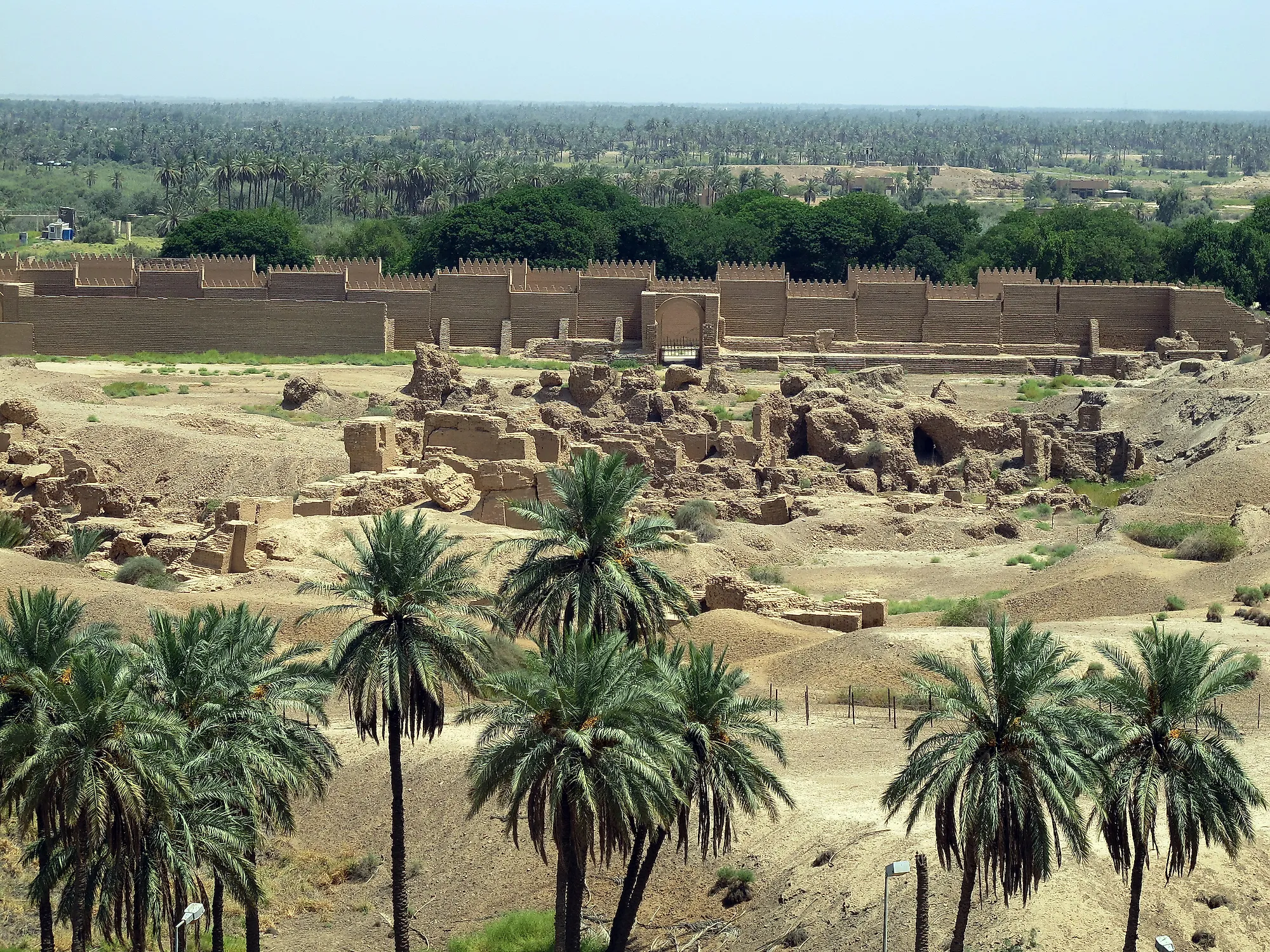
The story of Babylon dates back to the Middle Bronze Age. A series of strong kings, most notably Hammurabi, helped Babylon rise to dominance. Babylon later fell dramatically to the Medo-Persian ruler Cyrus, but not before dazzling the world with unmatched architectural and socio-cultural feats, including the supposedly spellbinding Hanging Gardens. Still, much remains shrouded in mystery. Enamoured historians and archaeologists have been studying Babylon through its ruins and other extant records, gradually unravelling some incredibly strange discoveries about Mesopotamia's hub of early urban civilization. The following are five of the strangest discoveries about the ruins of Babylon uncovered so far.
Two Ancient Houses Stuffed With Hundreds of Lost Treasures

In 2024, a team of archaeologists with the Iraqi State Board of Antiquities and Heritage (SBAH), led by Quhtan Abbas Hassan Aboud, made a remarkable discovery while excavating near the ancient city of Babylon in central Iraq. The excavation area is divided into two key sections: Point A and Point B, each with distinct features. Situated in the southern section and spanning about 1.5 acres, Point A contains two floor levels, the first of which has been eroded due to natural forces and previous disturbances. Fortunately, the second floor remains intact and dates back to ancient Babylon, providing a well-preserved snapshot of the city's historical architecture. Point B, slightly larger at about 2.2 acres, may be even more intriguing. It features two houses with rooms of various sizes. Archaeologists hypothesize that the variation in room size reflects different purposes, such as living rooms, storage areas, or workspaces.
The 2024 discovery yielded over 400 artefacts, including pottery vessels that are useful in understanding Babylonian domestic life. There were also several cylinder seals, which were used in ancient Mesopotamia for marking ownership and authorizing documents. Additionally, there are cuneiform inscriptions etched onto clay tablets, nails, and other surfaces, promising a treasure trove of historical information. Archaeologists believe these texts may reveal more about Babylon's political, economic, and religious systems once they are fully deciphered. Only time will reveal the full significance of these unusual yet relatively recent discoveries.
Climate Change is Destroying Babylonian Ruins

When people think of the devastating effects of climate change, they often consider food production, natural disasters, and dwindling resources. Rarely do they consider its impact on research, especially the preservation of knowledge. If urgent mitigation and restorative efforts are not implemented, the world will lose a vital link to one of civilization's most celebrated cities.
As recently as October 2025, Iraqi officials sounded the alarm that increased salinity in the soil, primarily due to dry weather, is damaging hundreds of monuments related to the ancient city of Babylon. At the same time, erosion from wind and sand dunes is causing the deterioration of the northern side of the majestic ziggurat. It's crucial to note that Iraq has been experiencing rising temperatures and heavy droughts, factors that have led to increased salinity levels in its south, where the mighty Tigris and Euphrates rivers converge as they flow toward the Gulf. This situation, therefore, underscores the urgent need for a swift and well-considered response.
Babylonians Were Using Applied Geometry More Than a Century Before Pythagoras

You probably know that the sum of the angles of a triangle is equal to two right angles, or that the square of the hypotenuse equals the sum of the squares of the other two sides in a right triangle. In high school, this was the Pythagorean theorem, named after the ancient Greek philosopher and mathematician, and an interesting early proponent of vegetarianism. Pythagoras is often credited as a foundational figure in Greek geometry. But is he? Markings on a clay tablet made in Babylon during the Old Babylonian period, centuries before Pythagoras or the Golden Age of Greece, are the oldest known evidence of humans using applied geometry.
For perspective, the Old Babylonian period spanned from approximately 1900 to 1600 B.C.E., and the tablet in question was part of the Babylonian ruins discovered in the late 19th century in what is now central Iraq. Pythagoras lived approximately from 570 to 495 B.C.E. The 2021 study is the work of a team of researchers led by Dr Daniel Mansfield from the University of New South Wales' School of Mathematics and Statistics. The tablet records how a Babylonian land surveyor settled a boundary issue using Pythagorean triples more than 1,000 years before Pythagoras.
Babylonian Ruins Reveal the Earliest Depiction of Ghosts

You are walking in the dark or down a hotel corridor, and you suddenly see wisps of light, a translucent figure, or hear footsteps on the stairs. Your hair stands on edge; you know what that means: a ghost. Scientists may dismiss paranormal experiences, but in a 2021 poll of 1,000 American adults, 41% reported believing in ghosts, and 20% claimed to have personally experienced them. Whatever your position, a tablet made in ancient Babylon around 1500 B.C.E. may be the earliest known depiction of a ghost in human history. The clay tablet is in the British Museum, which acquired it in the 19th century.
According to Dr Irving Finkel, a curator at the British Museum in charge of cuneiform inscriptions on clay tablets from ancient Mesopotamia, the image on the tablet is only visible when viewed from above under a light. The broken tablet reveals elaborate instructions for getting rid of ghosts. According to the writings, the exorcist should make figurines of a man and a woman, prepare two vessels of beer, and at sunrise speak ritual words directed to the venerated Mesopotamian god Shamash. The purpose was ostensibly to transfer the ghost into one of the figurines. For context, "Shamash" was the Babylonian god responsible for bringing ghosts to the underworld. The text's final line urges readers to "not look behind you!" Whatever that means.
The Discovery That Was Initially Thought Would Prove the Existence of the Hanging Gardens

One of the architectural feats most closely associated with Babylon and most well-known was the Hanging Gardens. The problem is that nothing in the Babylonian ruins has yielded firm evidence concerning their location or existence. During the first excavations of the ruins of Babylon at the beginning of the 20th century, work principally associated with the German archaeologist Robert Koldewey, a robust, arched structure was unearthed in the northeast corner of the Southern Palace. Koldewey and several others believed that this would turn out to be the very structure that had supported the famous gardens. It had thick walls, seemingly strong enough to support a suspended garden, and was made of carved stone, meaning it would be more resistant to moisture than standard bricks.

Unfortunately, that was not to be. Today, the consensus is that the building was likely a warehouse, as evidenced by the excavation of several storage jars from the site, as well as a cuneiform tablet detailing the distribution of sesame oil, grain, dates, and spices.
Is the story about the Hanging Gardens of Babylon true? Maybe. Probably not. The account did not come until much later, and Herodotus, in his Histories, written only a century after the time of Nebuchadrezzar, surprisingly makes no mention of the Hanging Gardens. Today, some scholars believe that the gardens were in Nineveh, not Babylon.
The Mysteries Hidden Behind The Ruins Of Babylon
As the world continues to marvel at the ancient city of Babylon, a UNESCO World Heritage Site since 2019, the ongoing excavation of its ruins will likely continue to pique our interest. Much has been written about Babylon, from the lofty legal codes of Hammurabi to the majestic ziggurat to the Hanging Gardens, supposedly a stunning feat of architecture and aesthetics. Everyone hopes that a more luminous light will emanate from the ruins, giving the world a clearer understanding of what has been billed as the City of Cities.