5 Most Beautiful Gothic Churches In Oregon
From Portland's streets to the state's valleys, Oregon's architecture offers a unique perspective on how Gothic architecture was adapted to the material and cultural conditions of the Pacific Northwest. The state is home to a remarkable collection of Gothic Revival and Carpenter Gothic churches that demonstrate inventiveness and aspiration, despite the absence of the massive stone cathedrals of Europe or the old eastern American cities.
These structures, often made of readily available local wood rather than stone, demonstrate how communities adapted the pointed arches, lofty vertical lines, and symbolic shapes of traditional Gothic architecture to create structures suitable for growing cities, frontier settlements, and congregations. From the First United Methodist Church in Salem to the Old Scotch Church near Hillsboro, discover the most beautiful Gothic churches in Oregon.
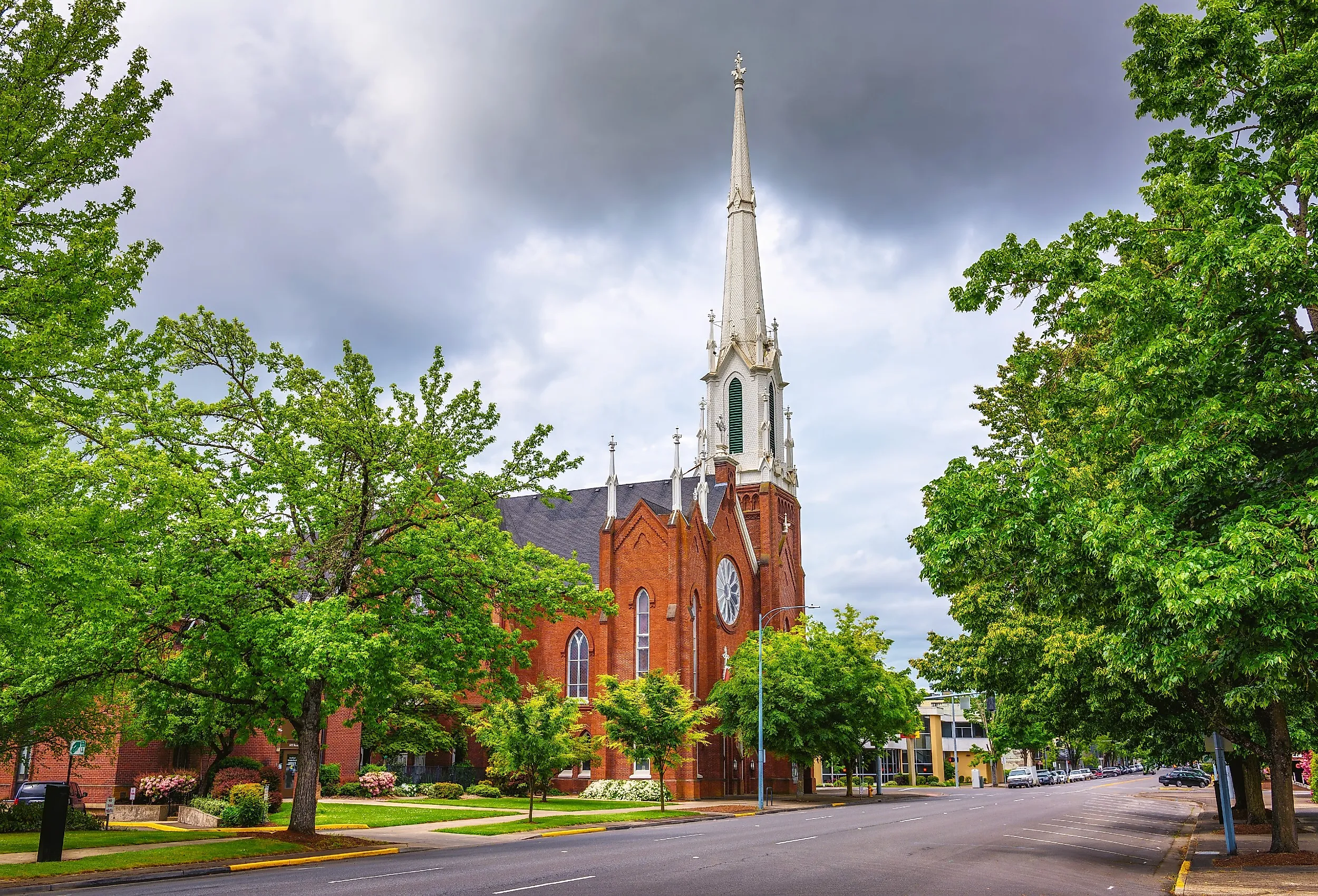
First United Methodist Church, Salem

Built around 1878 for one of the first Methodist congregations just west of the Rocky Mountains, the Salem First United Methodist Church is a brick Gothic Revival monument with roots in Oregon's early colonial past. It goes without saying that the intricate Gothic elements, such as the building's brick tower, pointed-arch windows, and brickwork, emphasize the verticality of the building design.

Although the original 185-foot wooden spire, which was previously a notable part of Salem's skyline, was replaced in 1984 for safety reasons, the church still showcases its iconic historic silhouette and architectural formation. Its listing on the National Register of Historic Places is unquestionable evidence of the persistence and growth of organized religion in late 19th-century Oregon.
Old Scotch Church, Hillsboro

Completed around 1878, Hillsboro's Old Scotch Church is a great example of a Carpenter Gothic architectural design. It transforms traditional European stone Gothic Revival traditions into a simple yet timber building that blends in well with a rural frontier setting. Its spire, side buttresses, lancet windows, and pitched roof display both the congregation's need for a church with a vertically oriented shape and the technical prowess of the locals.
The nearby cemetery, which is home to many early Scottish immigrants and followers of the founding community, shows locals and visitors the church's cultural significance in local history. Listed on the National Register of Historic Places since 1974, the church continues to serve an active congregation, standing as a well-preserved symbol of the simple beauty, craftsmanship, and enduring heritage of Oregon’s early Scottish community.
The Old Church, Portland

Constructed in 1882, Portland’s Old Church is a carefully preserved Carpenter Gothic/High Victorian Gothic landmark originally built for the Calvary Presbyterian congregation, reflecting both the ambitions of a growing city and the craftsmanship of late-19th-century builders. The Povey Brothers' stained-glass windows give the sanctuary color, brightness, and artistic individuality, while its wooden pointed arches, conspicuous steeple, and delicately ribbed internal woodwork evoke the structural complexity of stone Gothic vaulting.
Retaining its historic exterior and much of its original interior detailing, the building exemplifies the refinement attainable in wooden Gothic architecture. Ever since 1972, it has functioned as a concert hall and community gathering space, and its ongoing preservation underscores not only its architectural integrity but also its enduring role as a cultural and civic landmark in Portland.
Advent Christian Church, John Day

The Advent Christian Church in John Day is a Carpenter Gothic building constructed between 1898 and 1900 by local builders who interpreted and imitated European Gothic architectural elements in a frontier location, utilizing conventional woodworking skills. Its steep roof and pointed-arch windows emphasize verticality, while the decorative wooden belfry and carefully hand-planed moldings reveal the skill and attention to detail characteristic of rural artisan craftsmanship at the turn of the century.
It was also listed on the National Register of Historic Places in 1992. The church illustrates how Gothic architectural ideals spread to small, isolated Oregon communities, and even though it is no longer an active church, it stands as both an aesthetic landmark and a meaningful cultural touchstone for the region’s early religious and civic history.
First Presbyterian Church of Redmond

The First Presbyterian Church of Redmond, a modest Gothic Revival building with slight Queen Anne elements, concluding its construction in 1912, reflects the architectural preferences of small but growing Central Oregon cities in the early 20th century. The rectangular shape of the chapel and its simple decoration display its community-built character, accompanied by arch windows and a two-story bell tower.
It is easy to see how the building's proportions and details give it an obvious Gothic appearance. Standing as Redmond's oldest surviving church and a property on the National Register of Historic Places, it is a significant architectural and historical monument (although it no longer operates as a church, but rather as a private events venue) that exemplifies the timelessness of Gothic design traditions.
Oregon may not have the enormous stone cathedrals of the East Coast, but what it does offer is a diverse, regionally adapted Gothic heritage, spanning wood and brick, metropolitan cores and rural towns, continuing from the late 19th century into the early 20th.
Whether you admire the soaring steeple of Salem’s First United Methodist Church, the simple white charm of the Old Scotch Church, the Gothic‑linens and stained glass of Portland’s The Old Church, the pioneer‑built Advent Christian Church in John Day, or the small‑town steeple of historic Redmond’s First Presbyterian, these five churches show how the Gothic spirit found root in Oregon soil, in varied and enduring forms.





_-_230.jpg)
