5 Most Beautiful Gothic Churches In Delaware
Most Gothic Churches in Delaware tend to be smaller, constructed from wood, and intimate, especially compared to the grand stone cathedrals in Europe from which they drew inspiration. Many of the 19th-century churches in the First State are Carpenter Gothic, a style that favors simplicity over grandeur, making them feel less like imposing monuments and more like community gathering spots. There are a few outliers on the list as well. So put on your walking shoes, brush up on your medieval architectural vocabulary, and get your cameras and smartphones ready for a tour of five of Delaware's most beautiful Gothic churches.
St. Paul's Episcopal Church, Georgetown

St. Paul’s Episcopal Church in Georgetown was originally known as St. Paul’s Protestant Episcopal Church and traces its humble roots to a simple wooden-frame chapel built with funds raised through a public lottery around 1806, and to a plain brick structure in 1844. It wasn’t until the 1880s that the church underwent a Victorian Gothic Revival transformation under the direction of Reverend John Linn McKim, the uncle of the famous New York City architect Charles Follen McKim, who is often credited with the church’s design.
One of Georgetown’s standout landmarks, the church’s sky-high steeple dominates the landscape, but it is the church's interior that draws architecture and art enthusiasts from all over. The tongue-and-groove wooden ceiling in the nave (the central part of a church) is said to resemble the bottom of Noah’s Ark, while the walls of the nave feature 8 spectacular stained glass windows, including a replica of Raphael’s famous final painting, “The Transfiguration.” The original version of the masterpiece is on permanent display in the Pinacoteca Vaticana (Vatican Art Gallery) in Vatican City.
St. Stephen’s Protestant Episcopal Church, Harrington

St. Stephen’s Episcopal Church in Harrington is a small Carpenter Gothic single-story wood-frame church founded as a mission church in 1876 by Reverend J. Leighton McKim. Upon his death in 1918, he gave the church, which was his personal property, to the Episcopal Diocese of Delaware. Known as “The Little Red Church,” it was abandoned in the 1960s and sat vacant until it was purchased and donated to the Greater Harrington Historical Society.
After extensive renovations, the chapel was lovingly restored to its former glory by volunteers, who recreated its original stained-glass windows using old photos. Today, the historic building is one of three museums run by the Greater Harrington Historical Society. It includes items from the former Harrington High School, local churches, and a military showcase.
Star Hill African Methodist Episcopal Church, Star Hill

The Star Hill AME Church is an important historical landmark in Star Hill, an early free African American community in Kent County. Built around 1866 in a modest Gothic Revival style with a small bell tower atop a gabled roof, the church is next to a cemetery whose graves date back to the early 1890s. The church’s original name was “Star of the East,” which is associated with the idea of a guiding star for enslaved people seeking escape during the American Civil War. Members of the church were thought to have participated in the Underground Railroad. Today, the church houses a museum with exhibits on the history of the African American community, the legacy of slavery, and the network famously guided by Harriet Tubman.
Grace United Methodist Church, Wilmington

The Grace United Methodist Church in Wilmington is the best surviving example of High Victorian Gothic still standing in Delaware. Popular in the mid-to-late 1800s, the architectural style was inspired by storybook-like medieval European castles and cathedrals, featuring elements such as pointed arches and roofs, towers, and polychromy, which is the use of contrasting brick or stone colors. At Grace United Church, this polychromatic effect is visible on the church’s exterior, where green serpentine sandstone is set against brown stone.
Construction of the 600-seat chapel began in April 1865, and the first service was held there the following year. The main part of the church, with an additional 800 seats in the nave, opened in January 1868, and a plaque outside the church commemorated the 100th anniversary of Methodism the same year.
Today, some of the stained-glass windows in the church are the original windows, complete with tracery and brilliant colors like purple and red, and date back to the 1870s. 21 lancets were replaced in 1913-1914 with glass copies of famous paintings. “Come to Me” is a stunning stained-glass window in the apse (the front of the church), and one of the largest stained-glass windows in the U.S. Designed by an artist from New York’s Tiffany studio, the window is 30 feet tall, weighs over 2 tons, and contains 18,000 pieces of glass.
St. Hedwig Roman Catholic Church, Wilmington

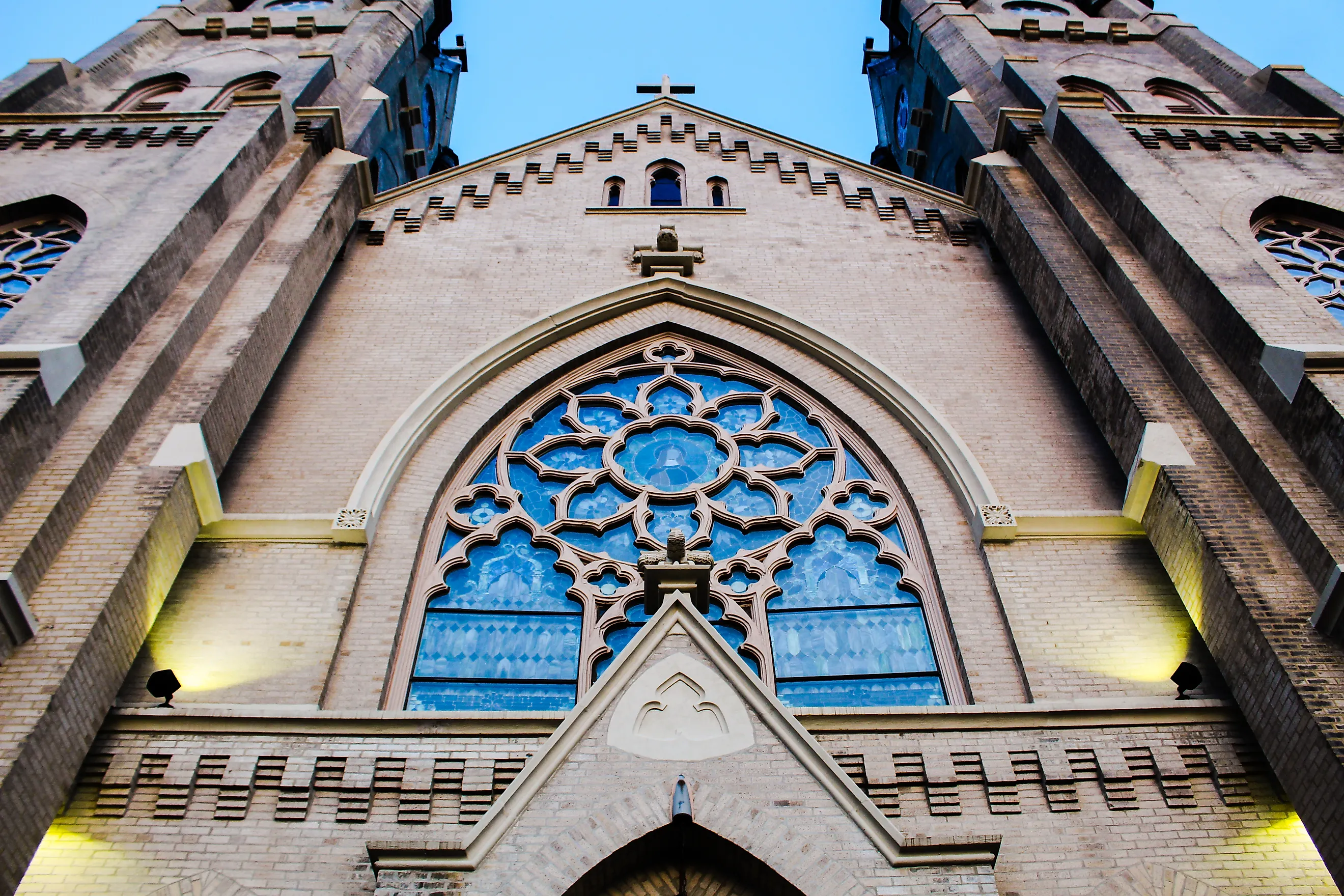
The historic St. Hedwig Roman Catholic Church in Wilmington was built in 1904 and serves as an important cultural center of Wilmington’s Polish community. The church is an example of late Gothic Revival architecture, cruciform in shape, meaning it looks like a crucifix when viewed from above, has three naves divided by ornate columns, and an arched ceiling. The church’s exterior facade features two 80-foot-tall towers with gilded crosses on top, making it the only church in Delaware with twin towers. St. Hedwig’s was added to the National Register of Historic Places on November 12, 1982.
Delaware’s Historic Gothic Gems
Gothic revival architecture became popular in the U.S. from the mid-19th century, drawing inspiration from European churches and castles. In Delaware, Gothic Revival churches run the gamut, ranging from modest Carpenter Gothic chapels to dramatic High Victorian landmarks. The style was particularly popular with Episcopal churches, especially in Delaware, at churches like St. Paul’s and St. Luke’s. Beyond the Gothic architecture, these Delaware churches reflect the state’s rich cultural roots, with St. Hedwig’s serving Wilmington’s Polish-American community and Star Hill AME preserving an important piece of African American history, the Underground Railroad. Part architectural marvel, part history lesson, a visit to the five most beautiful Gothic Churches in Delaware reveals soaring spires, intricate glasswork, and the vibrant communities behind them.