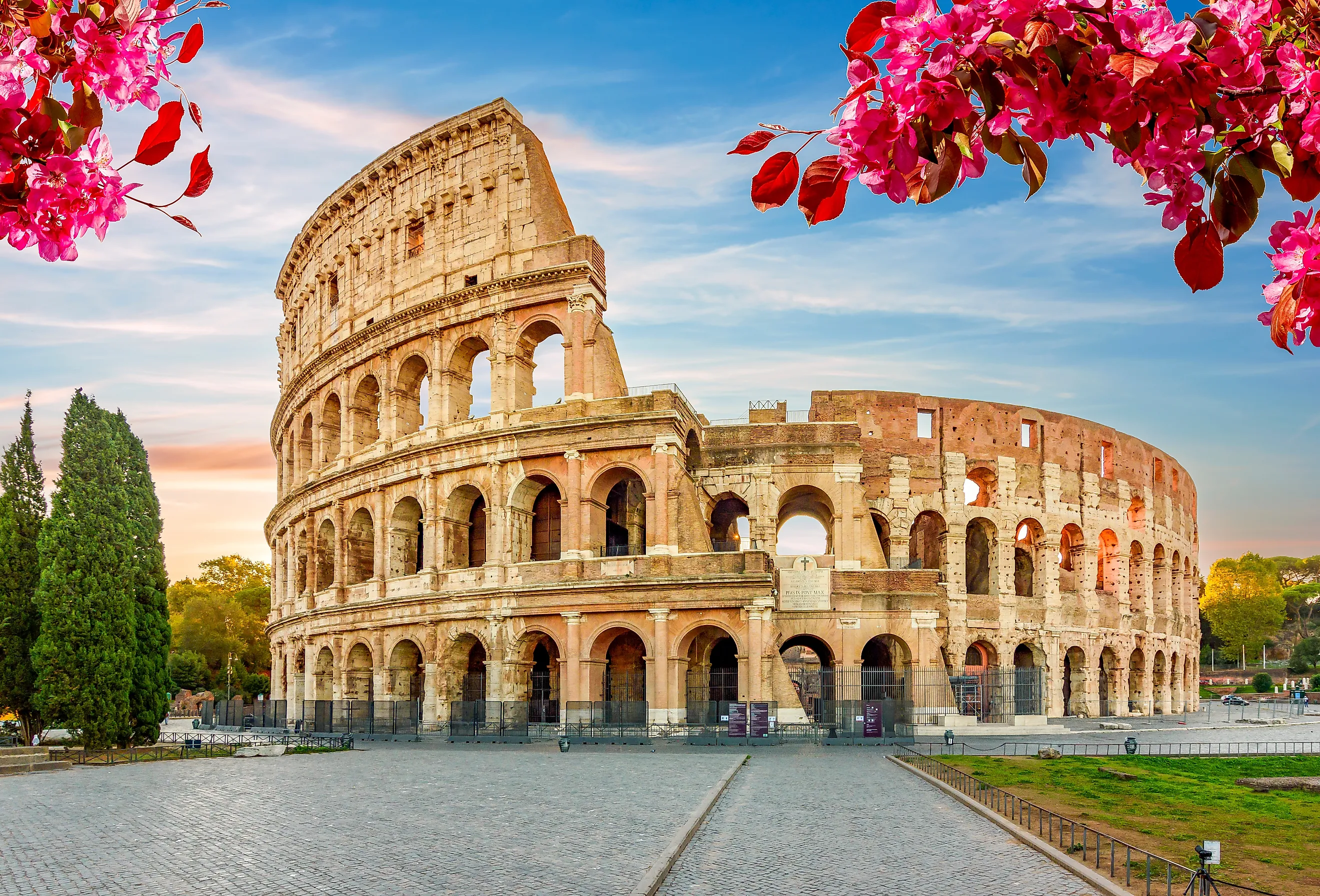
4 Bizarre Discoveries About the Colosseum in Rome
The Colosseum in Rome endures as the monarch of all European ruins. Its sheer scale and magnitude are an enduring ode to human ingenuity and imagination. The Roman Colosseum was built between AD 70 and 80, mainly by the resources supplied by the sack and plunder of Jerusalem during a cataclysmic operation led by Titus, a celebrated Roman general with excellent military skills. Measuring some 620 × 513 ft (~6 acres), the Colosseum was the largest amphitheater in the Roman world. It entertained the ancient world for almost half a millennium before being abandoned and gradually getting into a state of disrepair. Although several historians have written about the Colosseum, discoveries are constantly emerging, many of which tell the story of its grandeur and its shame.
A Secret VIP Tunnel Emperors Used to Sneak In and Out
In Ancient Rome, as in modern-day America, the ruling class often enjoyed interacting with the masses, although it was usually for show. Still, emperors valued private passageways for safety and convenience; after all, navigating the chaos of a packed crowd was hardly fitting for a ruler.
French excavators, under the direction of architect Carlo Lucangeli, discovered a hidden 180-foot corridor once used by Roman emperors to slip into the Colosseum unseen. The discovery was made between 1810 and 1814. It was known as the Passage of Commodus, and it was added in the late 1st or early 2nd century and later associated with Commodus because he used it. Commodus was a ruthless leader who frequently visited the Colosseum and fought in gladiatorial bouts, often dressed as Hercules. He once beheaded an ostrich before a cheering crowd. For the first time after the fall of the Roman Empire, the tunnel was restored and opened to the public in October 2025.
A Wild Elevator System That Made Lions Burst Out of the Arena Floor

Think of a huge wooden arena floor measuring 287 × 180 ft (~0.12 acre) and covered with sand to soak up the blood of the combatants. Below the arena, and unseen by the general public, is an incredibly complex and elaborate system of lifts, pulleys, and elevators. Thanks to this tangled system, which archeologists call the hypogeum, Latin for “underground,” animals often appeared suddenly from below, as if by magic, and would really scare surprised combatants. Sometimes, they were apparently launched high into the air, adding to the dramatic effect. To add to the suspense, a combatant in the arena wouldn’t know where the next lion would appear, or whether three lions might emerge at once.

Thanks to the work of Heinz-Jürgen Beste of the German Archaeological Institute in Rome, the leading authority on the hypogeum, the world is beginning to understand the full extent of the Colosseum's design and layout. He and his team started exploring the hypogeum in 1996. Further investigations have revealed that there were somewhere between 24 and 28 lifts, each designed to transport up to 600 pounds, the average weight of two lions. Think of up to 56 lions “flying” at you at once.
The Spectacle of the Velarium

Rome can be unbearably hot, especially during the summer, when temperatures typically climb to nearly 100 degrees Fahrenheit. Sometimes more. Now think of 50,000 people, packed elbow-to-elbow, in the sweltering heat of an unremitting summer sun. One thing is sure: The pleasure-addicted Romans, whether plebeians or patricians, would find it difficult to endure such a state of affairs. That's why they designed one of the most astounding awnings in the world's history: the Velarium. It allowed them to settle back and drink in a day of bloodsport in shady bliss. But make no mistake. Providing cover for the nearly 200 feet tall behemoth, the largest amphitheater in the ancient world, was not a walk in the park.

To pull it off, Romans used separate tapered pieces of fabric, more than 200 evenly spaced wooden masts, and several sockets for buttressing them. The Velerium sloped downwards towards the centre but did not completely cover the Colosseum's top, meaning the actual action was dramatically spot-lit by the sun. Sailors primarily operated this system, and, in a touch of the bizarre, a few of these sailors were slaves awaiting their turn in the fatal mock sea-battles, a feature of the Colosseum's earliest stagings.
Death Gate

Even the coldest of hearts would find it bizarre that people can intentionally design a structure where death is celebrated as a sport, and where every door and corridor is carefully designed to facilitate murder. It doesn't matter if the victim is a convicted criminal. Two of the Grand Archways of the Colosseum bear interesting names. One is called “Porta Triumphalis,” or Door of Victory, while the other is called “Porta Libitinaria,” Door of Death.

To a 21st-century audience, this means the death of animals and gladiators was almost a given. Expectedly, injured or dead gladiators were left through the Porta Libitinaria, which led to the hospital and morgue situated by the Ludus Magnus. For perspective, Libitina was the goddess of tombs. On the flip side, winning (or just lucky) gladiators left through the Porta Triumphalis. Needless to mention, those who fought in the Colosseum did not have the liberty to choose their preferred exit gate.
So, although we have marvelled and lamented at the Colosseum, an astounding edifice that stands as a volcanic crater with centuries of history in its grey walls, spade-carrying archeologists continue to dig into the ruins and uncover details that have hitherto never been known. Still, to stand in the immediate presence of the Colosseum is to feel the whole weight of Roman history in your chest.