America's 10 Most Beautiful Skylines
A skyline is the first thing a city shows you, whether you arrive by plane, by train, or across the water. Some cities make their case with sheer height, some with a single landmark you would know anywhere, and a couple with hardly any tall buildings at all. Nobody will ever agree on which ten are the most beautiful, so treat this as a friendly argument rather than a verdict. These are ten American skylines worth stopping to look at, in no particular order.
New York City, New York

Manhattan's skyline is the one the whole world pictures, and it has been collecting famous buildings for more than a century. Out in the harbor stands the Statue of Liberty, a gift from France dedicated in 1886, still greeting arrivals the way she always has; visitors who reserve far enough ahead can climb the spiral staircase all the way up into her crown. Behind her, the skyline stacks up in layers you can almost read like tree rings. The Chrysler Building's stainless-steel Art Deco crown held the title of world's tallest for about eleven months in 1930, before the Empire State Building took it in 1931, and the Gothic-revival Woolworth Building predates them both.
The newest anchor is One World Trade Center, better known as the Freedom Tower. It rises to exactly 1,776 feet, a nod to the year the Declaration of Independence was signed, which makes it the tallest building in the Western Hemisphere. Its observation deck sits higher than any other in the city, and the elevator ride up plays a time-lapse of New York growing from a handful of streets into the skyline you are about to see. The plaza below holds the 9/11 memorial pools, set where the Twin Towers stood.
Las Vegas, Nevada

Las Vegas builds a skyline the way a kid builds one out of every toy in the box. Along a few miles of the Strip you will find a half-scale Eiffel Tower, a black-glass pyramid with a light beam shooting out the top, a replica Statue of Liberty, and the dancing Fountains of Bellagio, all set against a backdrop of bare desert mountains. It should not work, and somehow it does. The newest headliner is the Sphere, which opened in 2023 for about 2.3 billion dollars; it is the largest spherical building on Earth, wrapped in the biggest LED screen anywhere, so its exterior can turn into a giant eyeball one night and a pumpkin the next.
The Strip keeps growing upward, too. Fontainebleau Las Vegas, a blue-glass tower of 67 floors and around 3,700 rooms, finally opened in 2023 after sitting half-finished for well over a decade. Nearby stand Resorts World, the Encore, the Palazzo, and the needle-topped STRAT. It is not subtle architecture, and it is not trying to be. The skyline is the whole point of the city, and the city knows it.
Los Angeles, California

Los Angeles spreads out rather than up, but its downtown cluster of towers makes a real skyline, especially with the San Gabriel Mountains rising behind it on a clear day. For decades the tallest was the US Bank Tower, 1,018 feet with a glass crown you can pick out from all over the basin. Then the Wilshire Grand Center opened in 2017 and edged past it to 1,100 feet on the strength of a slim spire. That spire only exists because of a rule change: for years, Los Angeles required flat roofs on its tall buildings so helicopters could land in an emergency, and when the city dropped that requirement in 2014, architects were finally free to add crowns and spires.
The best view is not from downtown at all. Head up to the Griffith Observatory on a smog-free evening and you can watch the whole grid light up below, with the Hollywood sign on the hillside nearby and the Pacific off in the distance. The Observatory's own domes, sitting alone on the slope of Mount Hollywood, are as recognizable as anything downtown.
Chicago, Illinois

Chicago basically invented the skyline. The first true skyscraper went up here in the 1880s, after the Great Fire of 1871 cleared the way for a rebuild, and the city has been a proving ground for tall-building design ever since. Today it is the third-largest city in the country and still the place architects go to try things out. The skyline reads best from out on Lake Michigan, where the buildings line up along the shore.
The building that anchors it is the Willis Tower, 108 stories of black glass and steel topped by two white antennas, still the third-tallest building in the Western Hemisphere and known to locals by its old name, the Sears Tower. Around it stand the wavy-sided St. Regis Chicago, the tallest building in the world designed by a woman, the architect Jeanne Gang; the sleek 875 North Michigan Avenue, which most people still call the Hancock; and NEMA Chicago, one of the tallest all-rental towers in the country. It is a working skyline rather than a decorative one, and that is a good part of its appeal.
Honolulu, Hawaii

Honolulu is the surprise on this list: an island city with a genuinely dense cluster of high-rises, most of them hotels and condos built for the visitors who fill Waikiki. On its own, the architecture is fairly plain, a wall of white towers. What makes the skyline is everything around it. The towers stand against the deep blue of the Pacific, with the golden curve of Waikiki Beach in front and green ridges behind, and the extinct Diamond Head crater closing off one end of the view.
It is the rare American skyline that reads as a tropical resort rather than a financial district, even though Honolulu is very much the business center of the islands. Look for the classic view from Waikiki Beach itself, from Magic Island, or from the Tantalus Lookout in the hills above town, where the city, the reef, and the ocean all line up at once.
Philadelphia, Pennsylvania

Philadelphia keeps its skyscrapers in conversation with its history, which is unusual for an American city. This is where the Declaration of Independence was signed, where the young country ran its government during part of the Revolution, and where the Marine Corps was founded in a tavern in 1775. For most of the twentieth century, an unwritten rule kept every building below the statue of William Penn on top of City Hall. That held until 1987, when One Liberty Place finally rose above his hat, and the modern skyline followed.
Today the tallest is the Comcast Technology Center, the tallest building in Pennsylvania, standing alongside its glass-and-steel neighbor the Comcast Center, the two Liberty Place towers, and the FMC Tower. Philadelphia is more than twice the size of Pittsburgh, the next-biggest city in the state, and its downtown carries itself accordingly. The best seats are the One Liberty Observation Deck downtown, or the steps of the Philadelphia Museum of Art, where the skyline lines up behind the fountains.
San Francisco, California

San Francisco's skyline may be the one that best stands in for the country as a whole, thanks mostly to the Golden Gate Bridge framing it from the west and the Bay Bridge from the east. The city sits right on the San Andreas Fault, so most of its downtown towers are recent and engineered to move in an earthquake, but two stand out. The Transamerica Pyramid has been the city's signature since 1972, when its pointed shape ranked it among the ten tallest buildings in the world, and it held the title of tallest in San Francisco for forty-five years.
Then, in 2018, the Salesforce Tower topped out at 1,070 feet and took the crown. Its rounded top has a public viewing floor, and on a clear evening the view runs out over the bay and the bridges; on a foggy one, the tower's crown glows above the mist while the streets below vanish. For the postcard angle, though, cross the water to Angel Island, once the immigration station known as the Ellis Island of the West, and look back at the whole city with Mount Tamalpais rising behind it.
Seattle, Washington

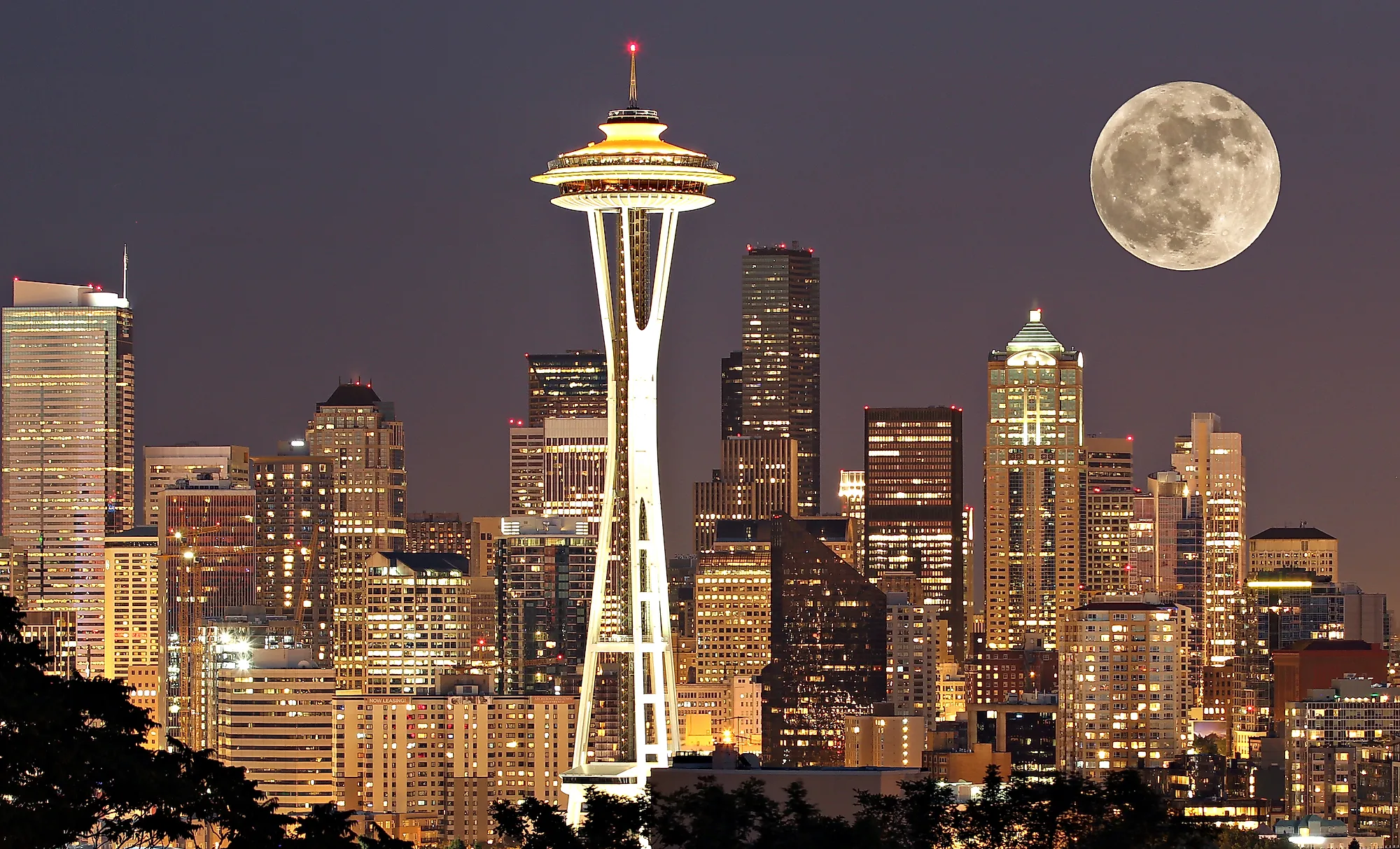
Seattle sits on a narrow strip of land between Puget Sound and Lake Washington, with Mount Rainier looming to the south on clear days, and that setting does a lot of the work. The skyline's landmark is the Space Needle, built for the 1962 World's Fair and standing 605 feet tall; when it went up, it finally overtook the Smith Tower, the pyramid-topped 1914 building that had been the city's tallest for nearly half a century. The two of them, old and new, still frame the view.
The rest of the skyline is younger than it looks. Downtown Seattle has added dozens of high-rises since the mid-2010s, many of them tied to Amazon's growing campus just north of the center. Because building heights downtown are regulated, the towers stay varied rather than crowding into one flat wall. For the framed-postcard version, head to Discovery Park, 534 acres on a former Army post called Fort Lawton, where the city, the Sound, and the mountains all line up.
St. Louis, Missouri

St. Louis has the simplest skyline on this list and maybe the most memorable, because one shape does almost all the work: the Gateway Arch. At 630 feet it is the tallest monument in the country, a clean stainless-steel curve on the bank of the Mississippi River, and it looks like a different object depending on the light, silver against a storm one minute and pink at sunset the next. It was built to stand for the country's westward expansion, the city's old role as the gateway to the West.
The French founded St. Louis in 1764, and the city has packed a lot of history into the years since; it hosted the 1904 World's Fair and the first Olympic Games ever held outside Europe. Just west of downtown is Forest Park, opened in 1876 and larger than New York's Central Park, home to the city's zoo, art museum, and history museum. For the best look at the Arch, cross the river to the Malcolm W. Martin Memorial Park on the Illinois side, where the curve frames the downtown towers behind it.
Washington, D.C.

Washington, D.C. proves you do not need skyscrapers to have a skyline. By law, buildings in the capital stay low, so nothing competes with the monuments. The Washington Monument rises above everything, a 555-foot marble obelisk capped with a small aluminum pyramid, with the domed United States Capitol at one end of the National Mall and the Lincoln Memorial at the other, lit up after dark. The White House and the Smithsonian buildings fill in the rest.
The best view in the city is from the top of the Washington Monument itself, which has an observation level near its peak looking out in every direction. In the evening, driving along the Potomac River with all of it lit up, it is easy to forget you are looking at a working government town rather than a memorial. That mix of grandeur and low-slung restraint is exactly what makes the skyline work.
Picking A Favorite
There is no single thing that makes a skyline beautiful. New York wins on sheer accumulation, Las Vegas on nerve, Honolulu on setting, and Washington on restraint. What they share is that people care about them, argue over them, and photograph them constantly. A skyline is really a city's self-portrait, and these ten are the ones worth framing.